Retro Television Review: For My Daughter’s Honor (dir by Alan Metzger)


Welcome to Retro Television Reviews, a feature where we review some of our favorite and least favorite shows of the past!  On Sundays, I will be reviewing the made-for-television movies that used to be a primetime mainstay.  Today’s film is 1996’s For My Daughter’s Honor (a.k.a. Indecent Seduction)!  It  can be viewed on YouTube, Tubi, and Prime.
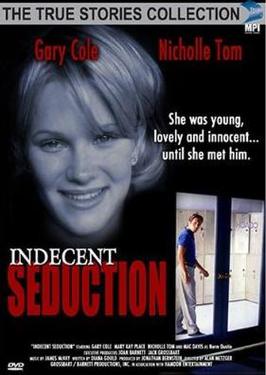
Welcome to Tate, Oklahoma.

It’s a nice little town in what is usually referred to as being the heartland of America.  It’s a place where the streets are clean, the people are friendly, and where everyone roots for the local high school football team.  That makes Coach Pete Nash (Gary Cole) a pretty important person in Tate.  At a start-of-the-year pep rally, the football team is introduced as “Oklahoma’s team” and that would make Pete Nash Oklahoma’s coach.  Make no mistake about it, they love football in Oklahoma.  They love it almost as much as we love it in Texas.

Coach Nash also teaches Biology and he’s known for being the cool teacher that all of the students like to hang out with.  Soon, Nash is hanging out with 14 year-old Amy Dustin (Nicholle Tom) and Amy’s friends, Kelly (Allyson Hanigan) and Kimberly (Sara Rue).  With Coach Nash, they all get to drink beer.  They get to break into the school library and have fun with the copy machine.  Coach Nash sends Amy flirty little notes and she writes back.  Nash even encourages his daughter to invite Amy over for a sleepover so that she can lose her virginity.  Yikes!

Amy’s mother (Mary Kay Place) and her father (Mac Davis) both have their concerns about the amount of time that Amy is spending with Coach Nash.  Amy’s father is especially upset when he hears that Coach Nash threw a fit after he saw Amy dancing with a boy her own age.  But everyone in town tells them that they’re being paranoid and that Coach Nash is a good guy who just happens to be very close to his students.  He’s a family man and he’s a good football coach and that’s all that matters.

Though the names and the central location have all been changed, For My Daughter’s Honor is based on a true story.  The actual events took place in Texas and, as happens in the movie, the parents of the victim ended up suing the school district for failing to do anything about the predatory teacher.  The film certainly does capture the feeling of living in a small community where everyone thinks that they know everyone else and where people often choose not to believe what is obviously happening right in front of them.  Coach Nash makes no effort to hide his activities but he gets away with it because no one wants to confront what’s going on.  It’s easier to just say that Coach Nash is a passionate teacher or that he’s someone who lets his emotions get the better of him.  For many in the town, it’s easier to blame Amy and her family than it is to hold Coach Nash responsible for his own actions.

Gary Cole gives a strong performance as Coach Nash and is equally believable whether being blandly affable or obsessively creepy.  One of the reasons why this film works is because everyone has had at least one Coach Nash in their lives, that person who seems friendly but just gives off a strange vibe.  In the end, this is a film that says that it’s okay to be concerned.
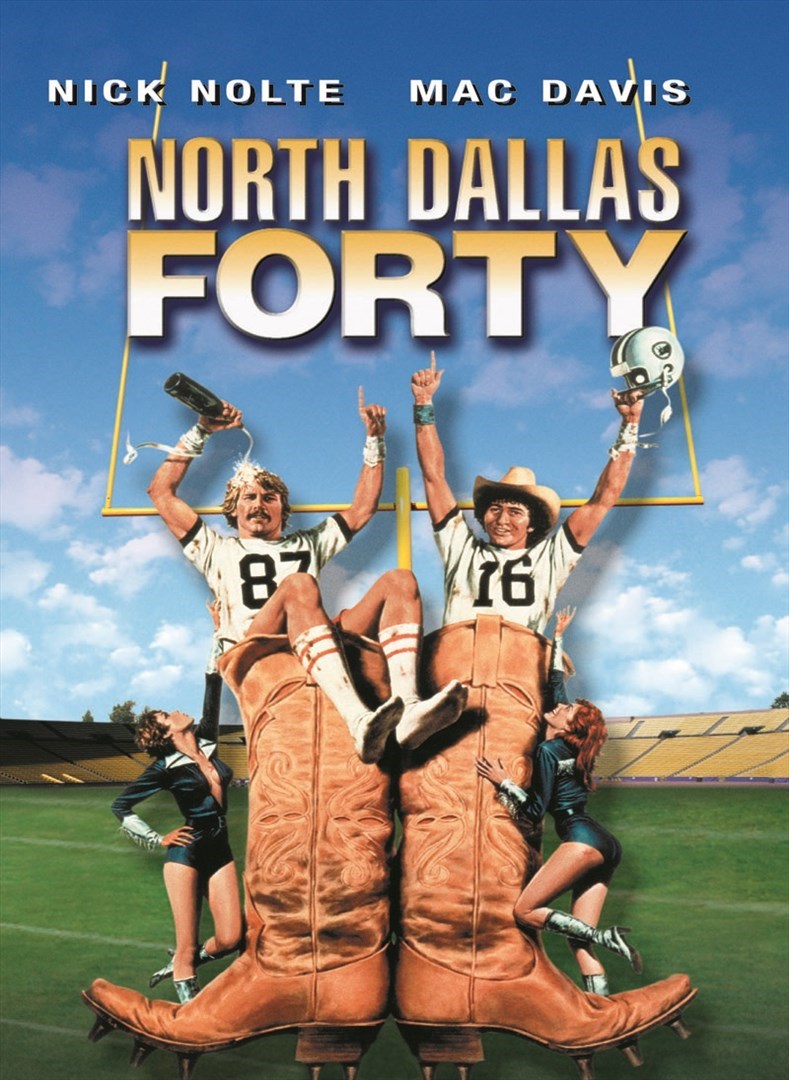
North Dallas Forty (1979, directed by Ted Kotcheff)


Pete Gent was a college basketball star at Michigan State University who, in 1964, received a tryout with the Dallas Cowboys.  Intrigued by the $500 that the team was offering to any player who attended training camp that summer, Gent accepted.  Despite the fact that Gent had never before played football, the Cowboys were impressed with his athleticism and they signed him to the team.

For five seasons, Gent played wide receiver.  During that time, he caught a lot of balls, became close friends (or so he claimed) with quarterback Don Meredith, and got under the skin of Coach Tom Landry with his nonconformist attitude.  After several injuries kept him off the field during the 1968 season, Gent was traded to the Giants who waived him before the next regular season began.

Out of work and with no other team wanting to sign him, Gent wrote a thinly veiled autobiographical novel about his time with the Cowboys.  North Dallas Forty was published in 1973 and it immediately shot up the best seller charts.  When the book was published, football players were still regularly portrayed as being wholesome, all-American athletes and the Dallas Cowboys were still known as America’s Team.  North Dallas Forty shocked readers with its details about groupies, drugs, racism, and gruesome injuries.  The NFL, of course, claimed that Gent was just a disgruntled former player who was looking to get back at the league.  When asked about the book (which portrayed him as being a marijuana-loving good old boy), Don Meredith was reported to have said, “If I’d known Gent was as good as he says he was, I would have thrown to him more.”

Meredith had a point, of course.  In the book, Pete Gent portrays himself as not only being the smartest man in football but also as having the best hands in the league.  Men want to be him.  Women want to be with him.  And the North Dallas Bulls (which is the book’s version of the Dallas Cowboys) don’t know what they’re losing when they release him for violating the league’s drug policy.  Today, when you read it and you’re no longer shocked by all of the drugs and the sex, North Dallas Forty comes across as mostly being a case of very sour grapes.

Luckily, the film version is better.

Nick Notle plays Phil Elliott, a broken-down receiver who wakes up most mornings with a bloody nose and who can barely walk without first popping a hundred pills.  Phil is a nonconformist and a rebel.  He loves to play the game but he hates how it’s become a business.  Mac Davis plays Seth Maxwell, the team’s quarterback and Phil’s best friend.  Seth is just as cynical as Phil but he’s better at playing politics.  G.D. Spradlin is B.A. Strother, the cold head coach who is a thinly disguised version of the legendary Tom Landry.  In the novel, B.A. Strother was portrayed as being a hypocritical dictator.  The film’s version is more sympathetic with Strother being portrayed as stern but not cruel.  Strother even tells Phil that he “can catch anything.”

Both the film and the book take place over the course of one week leading to a big game against Chicago.  In the book, Phil says that he and Seth don’t care about whether or not they win.  In the movie, they much do care but, at the same time, they know that they’re being held back by a system that cares more about whether or not they follow the rules than if they win the game.  While Phil’s teammates (including Bo Svenson as Joe Bob Priddy and John Mantuszak as O.W. Shaddock) behave like animals, Phil falls in love with Charlotte Caulder (Dayle Haddon), who doesn’t care about football.

Pete Gent was originally hired to write the film’s screenplay but left after several disagreements with producer Frank Yablans.  (The screenplay was completed by Yablans, directed Ted Kotcheff, and an uncredited Nancy Dowd.)  The movie loosely follows the novel while dropping some of its weaker plot points.  As a result, the film version has everything that made the novel memorable but without any of Gent’s lingering bitterness over how his career ended.  The novel used football as a metaphor for everything that was going wrong in America in the 60s and 70s but the movie is more of a dark comedy about one man rebelling against the system.

There’s only a few minutes of game footage but North Dallas Forty is still one of the best football movies ever made, mostly because Nick Nolte is absolutely believable as an aging wide receiver.  He’s convincing as someone who can still make all the plays even though he’s usually in so much pain that it’s a struggle for him to get out of bed every morning.  He’s also convincing as someone who loves the game but who won’t give up his freedom just to play it.  This is a definite improvement on the novel, in which Phil seemed to hate football so much that it was hard not to wonder why he was even wasting his time with it.  Country-and-western signer Mac Davis is also convincing as Seth Maxwell and fans of great character actors will be happy to see both Charles Durning and Dabney Coleman in small roles.

Whether you’re a football fan or not, North Dallas Forty is a great film.  Coming at the tail end of the 70s, it’s a character study as much as its a sports film.  It’s also one of the few cinematic adaptations to improve on its source material.  As a book, North Dallas Forty may no longer be shocking but the movie will be scoring touchdowns forever.