Love On The Shattered Lens: The Path of the Wind (dir by Doug Hufnagle)


The 2009 film, The Path of the Wind, begins with a man being released from prison and discovering that living in the real world can be just as confining.

Lee Ferguson (Joe Rowley) has spent the last few years locked up, convicted of killing a man.  It was a spontaneous fight and Lee didn’t intend for the man to die but that doesn’t change the fact that Lee is responsible for taking another man’s life.  He was a model prisoner and he intends to be a model citizen.  Fortunately, he’s inherited a nice house and a good deal of money from his father.  He’s also got a job waiting for him, as the well-meaning manager of the local grocery store has agreed to give Lee a chance.

From the minute he leaves the prison, Lee feels out-of-place in the world.  He’s still struggling to control his temper and, because of his past, he’s hesitant about letting anyone get too close to him.  He knows that if he tries to get close to anyone, he’ll eventually have to tell them why, despite his obvious intelligence and education, he’s currently working as a stocker in a grocery store.  And, after he tells them that he’s been in prison, he’ll then have to explain what he did to find himself in that situation.

Still, on his first night of working at the grocery store, he meets a young woman named Katie (Liz DuChez).  When he first sees her, Katie is being harassed by her violent ex-husband.  Lee chases the man off.  It turns out that Katie runs the local video store and she thanks Lee by offering him all of the free movies that he wants.  Eventually, Lee works up the courage to go to the video store and gets a bunch of western DVDs.  Later, he reveals that he not only doesn’t have a DVD player but he’s not totally sure what a DVD player is.  I guess Lee was in prison for a while.

It takes a while but Lee and Katie finally start to date.  Katie opens up about her past as a stripper and Lee finally tells her about the time that he spent in prison.  (It turns out that Katie already knew.)  They fall in love but there are still problems.  For one thing, Katie is rather religious whereas Lee is a committed agnostic.  Secondly, Katie refuses to have sex unless she’s married.  Lee, meanwhile, really, really wants to get laid….

Of course, that’s not all that’s going on in The Path of the Wind.  There’s about a different dozen storylines running through The Path of the Wind and the film doesn’t do a particularly good job of juggling all of them.  Along with having to deal with Katie’s psycho ex-husband, Lee also has to deal with not one but two evil coworkers and his bitter sister.  This is one of those films where a lot of plot points are raised but then mysterious abandoned.  There is one effective scene, in which Wilford Brimley shows up as the father of the man that Lee killed.  Brimley’s only in the film for a few minutes but he brings so much natural authority to his role that he basically takes over the entire movie for the limited amount of time that he’s on screen.

The film’s a bit of a mess but there’s a low-key sincerity to it that’s kind of likable.  According to the imdb, it was made for a budget of $100,000 and, with the exception of Wilford Brimley, the cast is largely made up of amateurs.  That said, both Joe Rowley and Liz DuChez have enough screen presence to be watchable and, even if the dialogue sometimes sounds a bit awkward, they have a likable chemistry and you can believe them as a couple.  Add to that, the film does attempt to deal with a very real issue, the difficulty that ex-cons face trying to rejoin a society that often values punishment and revenge over forgiveness and rehabilitation.  This is an amateur film but it may hold your interest.
Love on the Shattered Lens: Rapture (dir by John Guillermin)


The 1965 film, Rapture, is an odd one.

It takes place in France, largely at an isolated home sitting on a cliff above the Brittany coast.  Frederick Larbaud (Melvyn Douglas) is a former judge who has largely retreated from society.  He lives in his house with his teenager daughter, Agnes (Patricia Gozzi) and his promiscuous housekeeper, Karen (Gunnel Lindbloom).  He’s a stern man, one who is obviously struggling to overcome a vaguely defined personal tragedy.  He is very overprotective of his daughter, Agnes.

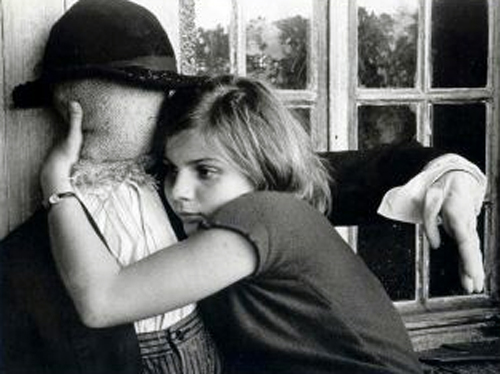
As for Agnes, she alternates between moments of childish immaturity and moments of surprising clarity.  She’s the type who still plays with dolls but who also casually tosses them over the cliff so that they can shatter on the rocks below.  She seems to be naive and innocent but, at the same time, she’s also capable of blackmailing Karen and threatening to tell her father that Karen’s boyfriend sneaks into the house at night.  When the sheltered Agnes gets her father’s permission to make a scarecrow for the garden, she throws herself into the work, even going so far as to flirt with the scarecrow after it’s been built.

Meanwhile, a sailor named Joseph (Dean Stockwell) has been arrested for getting into a fight during a drunken night on the town.  While he’s being transported to jail, the prison bus runs off the road.  Joseph escapes from the bus and runs up a hill, passing by Frederick, Agnes, and Karen.  Though the police manage to seriously wound Joseph, he still escapes.

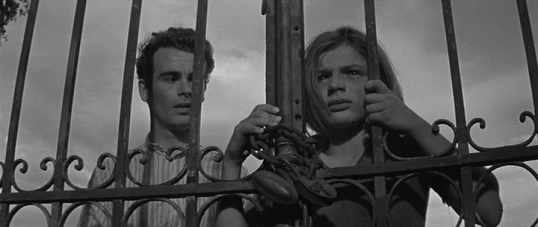
Later that night, during a violent storm, Agnes is shocked to see that her scarecrow has vanished.  While she’s out searching for it, she comes across a delirious Joseph.  Because Joseph has stolen the scarecrow’s clothes, Agnes decides that her scarecrow has come to life and, as a result, Joseph belongs to her.  Surprisingly, Frederick expresses no reservations about allowing Joseph to stay at the house while he recovers from his gunshot wound.

Once Joseph recovers, he explains to Frederick what happened and says that he should probably turn himself in and hope for the best.  Frederick, however, disagrees.  It turns out that Frederick has an agenda of his own and part of that agenda is revealing that brutality of the police.  He continues to allow Joseph to hide out at his house but little does Frederick know that Joseph is falling in love with Agnes (and, of course, Agnes still thinks that Joseph is her scarecrow come to life).

Rapture took me by surprise.  When the film started, I honestly thought it was going to be unbearably pretentious and I wasn’t exactly filled with confidence when I discovered that the film was directed by John Guillermin, a prolific British director whose career spanned from the 50s and the 80s but whose overall output is not particularly highly regarded among film historians.  With its obvious debt to Ingmar Bergman, Rapture did not seem like the type of movie that one would expect to be successfully directed by the 1960s equivalent of Taylor Hackford.  And, it should be said, that the first fourth of the film is rather pretentious and a bit silly.  The black-and-white cinematography is frequently gorgeous and atmospheric but Agnes’s eccentricity often feels overwritten and it seems to take forever for Joseph to actually show up at the house.

However, things get better.  The film, itself, doesn’t become any less pretentious but eventually Joseph starts to fall for Agnes and the chemistry between Dean Stockwell and Patricia Gozzi is strong enough that it carries the viewer over the film’s rough spots.  The film becomes less about how strange Agnes is and more about a sheltered girl falling in love for the first time and, freed from the inconsistency that marred her characterization during the first part of Rapture, Patricia Gozzi’s performance starts to click as Agnes becomes relatable and even sympathetic.

The film hits a high point when Joseph and Agnes try to start a life for themselves away from Agnes’s father and we watch a lengthy montage of their steadily deteriorating relationship.  In a manner of minutes, we witness how quickly the intrusion of the real world threatens to cause their too perfect romance to go awry.  Most of the montage is made up of overhead shots and it captures the feeling of two naive lovers being overwhelmed by the difficulties of living in the real world.  With each movement of the camera, we feel Agnes and Joseph’s world getting a little bit more claustrophobic and a little more threatening.

The film ends on a sad note, which shouldn’t come as a surprise to anyone watching.  From the minute that Agnes leads a wounded Joseph into the house, we know that their love is doomed.  That said, it’s still a rather odd ending and one that raises more questions than it answers.  It’s a strange ending for a strange film and it’s one that will stick with you long after you watch it.

Love On The Shattered Lens: Romeo and Juliet (dir by Franco Zeffirelli)


Happy Valentine’s Day!

Now that the Oscars and the Sundance Film Festival are over with, it’s time to start a new series of reviews here on the Shattered Lens.  For the rest of February, I will be looking at some films that deal with the universal topic of love.  Some of these films will be romantic.  Some of them will be sad.  Some of them might be happy.  Some of them might be scary.  Some of them might be good.  And some of them might be bad.  In fact, to be honest, I haven’t really sat down and made out a definite list of which films I’ll be reviewing for Love On The Shattered Lens.  Instead, I figure I’ll just pick whatever appeals to me at the moment and we’ll see what happens!

Let’s start things off with the 1968 film version of William Shakespeare’s Romeo and Juliet.

“Oh my God!  Romeo and Juliet are hippies!”

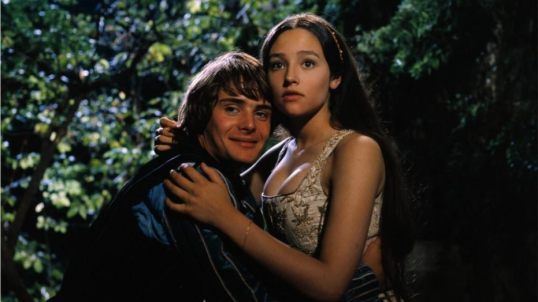
Well, that’s not quite true.  I mean, it is true that Romeo (played by Leonard Whitting) and Juliet (Olivia Hussey) are played by actual teenagers in this version of the classic play.  It’s also true that, even though the film is set in a painstakingly recreated version of 15th century Verona, almost all of the actors have what would have then been contemporary haircuts.  Romeo, Benvolio (Bruce Robinson), and Mercutio (John McEnery) all have longish hair, dress colorfully, and look like they could all be in the same band, covering the Beatles and writing songs about dodging the draft.  Even Tybalt (Michael York) seems a bit counter-cultural in this version.

As played by Olivia Hussey, Juliet comes across as being far more rebellious in this version of Romeo and Juliet than in some of the others.  It’s hard to imagine that Olivia Hussey’s Juliet would have much patience with Juliets played by Norma Shearer, Claire Danes, Hailee Steinfeld, or even the version of the character that Natalie Wood played in West Side Story.  Olivia Hussey’s Juliet is always one step away from running away from home and hitch-hiking to the free Rolling Stones concert at the Altamont Speedway.  Like the audience that the film was intended for, Romeo and Juliet both know that their parents are out-of-touch and that their friends are only temporary.  Embracing love and pursuing all that life has to offer is what matters.

Was this the first film version of Romeo and Juliet to make explicit that the two characters had consummated their marriage?  I imagine it was since it was apparently also the first version of Romeo and Juliet to feature on-screen nudity.  That’s quite a contrast to the largely chaste 1936 version, in which Norma Shearer and Leslie Howard both seemed determined to keep a respectable distance from each other.  Leonard Whiting and Olivia Hussey have an amazing chemistry together.  They’re the two prettiest people in Verona and they just look like they belong together.  From the minute they meet, you believe not only that they would be attracted to each other but that they’re also meant to be lovers.

Of course, we all know the story.  The Capulets and the Montagues are rival families.  Juliet is a Capulet.  Romeo is a Montague.  Juliet’s cousin, Tybalt, kills Romeo’s friend Mercutio.  Romeo kills Tybalt.  Juliet fakes her death.  Romeo commits suicide.  Juliet wakes up and does the same.  The Prince shows up and yells at everyone.  This film version moves around some of the events and it leaves out a few scenes but it actually improves on the play.  For instance, poor Paris (Roberto Bissaco) doesn’t die in this version.  Seriously, I always feel bad for Paris.

Throughout it all, director Franco Zeffirelli emphasizes the youth of the characters.  It’s not just Romeo and Juliet who are presented as young.  The entire Montague and Capulet feud is largely portrayed as being just a silly turf war between two competing high school cliques.  When Tybalt and Mercutio have their fateful duel, it starts out largely as a joke and, when Tybalt kills Mercutio, it comes across as if it was an accident on Tybalt’s part.  Tybalt appears to be just as shocked as anyone, like a scared kid holding a smoking gun and trying to explain that he didn’t know it was loaded when he pulled the trigger.  When Mercutio curses both the Capulets and the Montagues, it’s all the more powerful because Mercutio is undoubtedly wondering how the duel could have so quickly gone from playful taunting to a fatal stabbing.  The entire conflict between the Montague and the Capulets is a war that makes no sense, one in which the young are sacrificed while the old retreat to the safety of their homes.

Romeo and Juliet was a hit in 1968 and it’s still an achingly romantic film.  Whiting and Hussey generate more chemistry in just the balcony scene than Leonardo Di Caprio and Claire Danes did in the entirety of Baz Luhrmann’s version of the tragic tale.  Along with being a box office hit, it was also a critical hit.  The Academy nominated it for best picture, though it lost to Oliver!