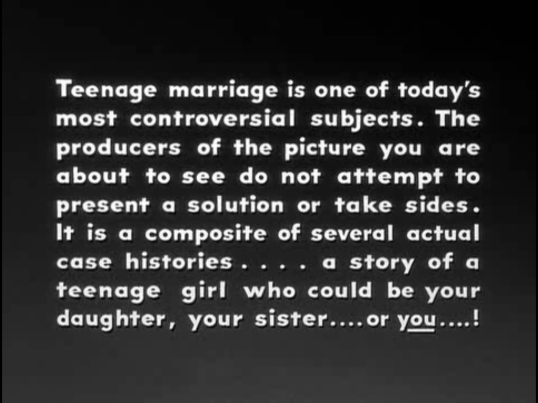
I always enjoy it when a film opens with a message statement that announces that it was made to shine the light on one of “today’s most controversial subjects.” Even better is when that message statement states that the film could be my story or that it could serve as a warning to people like me about what might happen.
Of course, it’s too late for me to be warned. I’m not in high school anymore. I’ve already made my decisions and had to deal with the consequences of my mistakes and all the other melodrama that makes life interesting. But I can watch a film like 1959’s The Diary Of A High School Bride and I can read the message statement at the beginning and I can think to myself, “If only I had seen this movie before I decided to sneak out that night and drink alcohol or smoke weed or let my boyfriend take pictures of me naked or have sex with a married man or rob a convenience store or read that forbidden book or become a bride of Cthulhu or agree to spy for the communists or whatever the Hell it was that I did that night!” If only…
Actually, it probably wouldn’t have made much of a difference. Life doesn’t come with a message statement and whenever I see one at the beginning of a film, it usually makes me less likely to take that film seriously. In fact, I tend to seek out films the open with message statements because they’re usually a lot of fun.
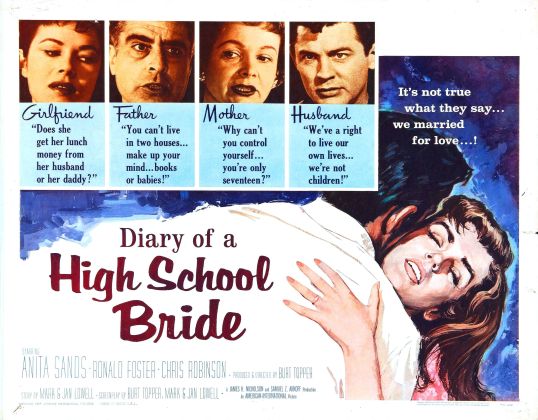
Take The Diary of a High School Bride, which is silly in a way that only an American International Pictures youth film could be. The film opens with 25 year-old law student Steve (Ron Foster) driving home from Las Vegas with his new wife, 17 year-old Judy (Anita Sands). When Steve gets pulled over by a police officer, Judy starts to tremble in terror. When the cops asks Judy how old she is, she lies that she’s 21 and then starts to cry. When the police officer asks if she’s really married to Steve, she wails, “Yes, and this record proves it!” At this point, she holds up a vinyl record.
However, a vinyl record is not the only thing that Judy has. She also has a teddy bear and oh my God, she literally carries that teddy bear with her everywhere! When she and Steve tell her parents, she has the teddy bear. When she wails at them, “AND NO — I’M NOT PREGNANT!,” she has the teddy bear. When she and Steve go out to a coffeehouse and listen to some pretty good flamenco music, Judy has that teddy bear. When they get back to Steve’s apartment and Judy finally see Steve with his shirt unbuttoned, Judy drops the teddy bear on the floor.
Why are Steve and Judy married? That’s never really made clear. They have absolutely nothing in common and Judy is so naive and so innocent that she spends most of the movie struggling to speak in coherent sentences. (And, of course, she also won’t let go of her teddy bear.) Steve, meanwhile — well, listen, when you’re 17, any man in his 20s is automatically attractive. But still, there’s something undeniably (and, judging from the film’s script, unintentionally) creepy about Steve’s marriage to Judy.
Anyway, when Judy goes back to school, she has to deal with people singing Here Comes The Bride at her. She also has to deal with her ex-boyfriend, Chuck (Chris Robinson). Chuck wants her back and soon, he’s harassing the newly married couple and making such a menace out of himself that the whole “She’s only 17!” thing gets forgotten about…
So, that’s Diary of a High School Bride. It’s a film that, if I had seen it when I was an out-of-control teenager, would have made absolutely no difference whatsoever. But, if you’re a fan of 1950s B-movies (and who isn’t!) and if you have a group of friends who like to be snarky while watching old movies (and who doesn’t!), you’ll probably enjoy The Diary of a High School Bride. At the very least, it features a fun little theme song from someone named Tony Casanova.
The Diary of a High School Bride was directed by Burt Topper and written by the poet Robert Lowell. (Okay, it was probably a different Robert Lowell…) It’s currently available on Netflix and it’s a lot of fun if you’re in the right snarky mood.
 Through the Shattered Lens