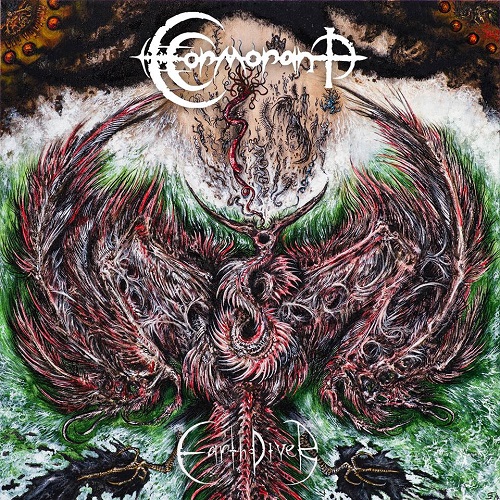
Cormorant are a 4-piece San Francisco Bay band formed in 2007. They released their third studio album, Earth Diver, back in April of this year. Lacking major ties to any other band I have heard of, it’s probably no surprise that they stayed off my radar until now, but this is a band that definitely deserves some attention. Their well-crafted mix of folk, progressive rock, post-rock, and black metal sets a high standard at the cutting edge of metal today. While Earth Diver may possess a fatal flaw, it offers a world of potential that few bands can hope to realize.
Cormorant – Daughter of Void, from Earth Diver
Earth Diver opens with “Eris”, a two and a half minute instrumental folk guitar track with a bit of a Spanish flare. As nice as the song sounds in and of itself, I am not convinced that it was the ideal choice for their opener. The second track, “Daughter of Void”, kicks off acoustic as well, and with the two tracks combined, the intro just seems a bit overdrawn. Don’t worry though; that’s the last time I’ll be complaining about the album’s structure. The acoustic portion of “Daughter of Void” sets the stage nicely and gets us straight to the point without much delay, kicking the metal side of the song off theatrically. We start with a nice metal groove lacking any of the repetitiveness you might expect from a band with the “black” tag, and at two minutes their prog tendencies start to show. Black metal vocals give way to something reminiscent of Opeth or Mastodon, and the song shifts through a variety of genre norms without really breaking from the overall feel. The song hits a peak at 4:05 with an Amorphis-esque vocal melody and a really catchy rhythmic hook. The bending tremolo behind the vocals starting at 5:35 is sick, and they build on it further at 6:25. The song is just packed with little standout moments that never last long enough to seem like overkill. (The youtube video ends early, but you’re only missing eight seconds.)
This is the sort of track you could easily remember from start to finish, if you could get in to it enough to care. If. The down side to “Daughter of Void” is a fairly mediocre production job that fails to really pull me in. I can hear everything clearly enough, but I can’t really feel it. They are going for classic low-key grit over big, booming sounds, and I get that, but it feels pretty washed out. The sort of sound Agalloch accomplished with Ronn Chick on Pale Folklore could have pushed this song from above average to outstanding.
Funny fact I didn’t realize until I wrote this: Cormorant actually do share some production history with Agalloch. They work with Justin Weis, who did a notoriously shitty job on Marrow of the Spirit. Go figure.
Cormorant – Sold as a Crow, from Earth Diver
“Sold as a Crow” has a very different feel about it. We kick off with some delicious post-black metal. A pretty tremolo melody warps into a desperate cry as the distortion and blast beats kick into gear. The snare does not always feel quite on point with the guitar, but Lev Weinstein might just have me spoiled in that department. This is the kind of black metal I live for. I love the single-beat stop at 1:46 and 2:00. I love the harmony at 1:50 and 2:05. I love the octave shift at 1:52. I love the three seconds of guitar flare at 1:55. This constant barrage of subtle nuances tends to distinguish post-black metal from its ancestor, and it’s the reason I can recall every note of a 15-minute Krallice composition while an Immortal track might fade into the back of my mind in seconds.
At 2:36 the main melody returns with a sort of flowing, jazzy feel, and then the majority of the song repeats. We get some new variation at 4:03 as build-up to a minute of soloing to close out the track. Maybe because the ending doesn’t appeal to me quite as readily, the production of the album starts to eat at me again. It still feels a bit of a wash, lacking depth or crispness without a good reason. I can appreciate “Sold as a Crow”. I can love listening attentively to every note from every instrument, especially in the first two and a half minutes. But I’m left without that desire to hear it again, right goddamn now. I can never listen to a whole Krallice album at once, because I always get stuck on a track and set it to repeat ad nauseam. “Sold as a Crow” could have been a song like that, but its beautiful structure is not matched by compelling tonal quality.
Cormorant – Broken Circle, from Earth Diver
What you’re not going to hear on Earth Diver is more of the same. This isn’t the sort of album where I can describe two or three tracks and feel like I’ve summed the collective up well. Every song is a masterfully complex beast unto its own. With Opeth always on the tip of my tongue, peppered by Amorphis, Agalloch, and Krallice, Cormorant manage to remind me of a lot of the most unique bands in metal without ever paralleling any of them for long or losing its own unique flavor. “Broken Circle” has jazzy acoustic guitar a la My Arms Your Hearse Opeth, straight-up in-your-face black metal, a break to a distinct Orchid-era Opeth sound at 3:29, brief allusions to math rock, and a world in between. When the singer isn’t barking in classic black metal fashion, he might be pulling off his best Pasi Koskinen or Mikael Åkerfeldt impression, letting out a bellowing roar, or even shouting at the top of his lungs (2:04). You can often catch the bass running wild, sounding especially like Johan De Farfalla during the Orchid moment (why oh why did Mikael fire that man?). But as many band references as I can throw out there, the majority of “Broken Circle” sounds like Cormorant’s own unique creation.
And yet. And yet I can’t pull this album in and hold it close for long. What struck me as mediocre production from the start begins to feel like a travesty in the face of such absolutely brilliant compositions. This album was robbed of its well-deserved glory by a quality of sound that totally ostracizes me. I keep cranking the volume up louder and louder, hoping that I am just not experiencing it immersively enough to feel the pull. But it’s never there. Oh, it doesn’t sound half as bad as the transcoded garbage you’re hearing in these youtube samples. It would be fine for an average, run-of-the-mill album. But Earth Diver is not that. It deserved above-average attentiveness–something carefully crafted to showcase their sound in all of its uniqueness. I can’t help but think that if Colin Marston had gotten his hands on this raw potential it would have been molded into the best album of 2014.
 Through the Shattered Lens