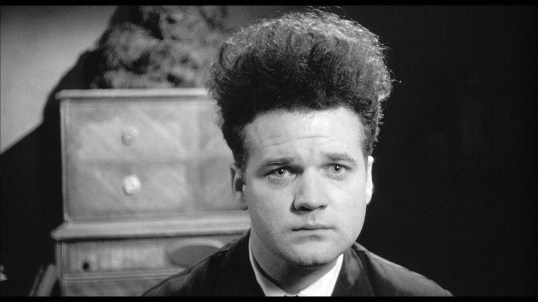
Jack Nance in David Lynch’s Eraserhead
I’ve been thinking about Eraserhead ever since I first heard the news about David Lynch’s passing.
Filmed in harsh but beautiful black-and-white and first released in 1977 (after a production period that lasted for seven years), Eraserhead tells the story of Henry Spencer (Jack Nance), an awkward young man who has the haircut that gives the film it’s name and who wanders through the film like an alienated character in a Kafka story. He lives in an industrial landscape and almost every scene seems to have the sound of machinery droning away in the background. He lives in an dark apartment and it appears that there’s a woman living in a radiator who sings that, “In heaven, everything is fine,” while stomping on sperm creatures. Occasionally, a mysterious woman in the hallway talks to him. Henry doesn’t seem to have a job or any sort of interests. He doesn’t really have much of a personality. Jack Nance, who would go on to become a member of David Lynch’s regular ensemble, has a permanently dazed expression on his face. It’s hard not to feel sorry for Henry, even if he isn’t quite sympathetic. In Heaven, everything is fine but in Henry’s world, it’s much different.
Henry has a girlfriend named Mary X (Charlotte Stewart). Mary lives with her parents in an apartment near the train tracks. When Henry goes over to her place for dinner, her father shows off how he can’t feel anything in his arm. Eating a piece of chicken becomes awkward when it appears to be alive and bleeding. Mary seems to have some sort of seizure. Mary’s mother informs Henry that Mary has had a mutant baby and Henry must take care of it. The baby (represented by a grotesque puppet) has no arms or legs or, it would appear, skin. It cries constantly, despite Henry’s attempts to care for it. The baby is the only truly sympathetic character in the film.
Eraserhead is often described as being a film that’s difficult to understand but, by Lynch standards, it’s not that hard to figure out. Lynch himself said that the film was fueled by his own anxiety over being a father and, throughout the film, Henry tries to take care of the baby but everything he does just makes things worse. As is often the case with Lynch’s film, many viewers get caught up in wondering why when they should just be paying attention to what happens. Why is the baby a mutant? Because it is. Why does Henry live in the middle of an industrial park? Because he does. Who is the scarred man who appears at the start of the film and who apparently pushes the levers that lead to Mary’s pregnancy? Again, it’s less important who he is and more important that he’s there and now, Henry is a father despite being woefully unprepared. Even if the viewer learned the scarred man’s identity (or if Henry even learned of his existence), it wouldn’t change Henry’s situation. (Technically, of course, the man is Sissy Spacek’s husband and frequent Lynch collaborator, Jack Fisk.) Eraserhead is a visually surreal film but it’s also an very emotionally honest one. Henry may be stuck in, as Lynch once put it, a “dream of dark and disturbing things,” but his fears and his anxiety are portrayed realistically That emotional honesty is something that would appear in all of Lynch’s work and it’s why he was one of our most important filmmakers.
Sadly, David Lynch is now gone. So is Jack Nance. But their work will live on forever.
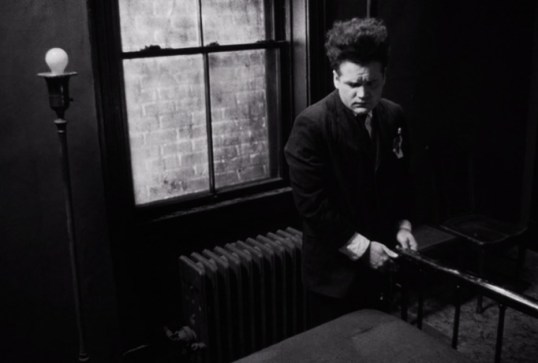
Eraserhead (1977, dir by David Lynch, DP: Frederick Elmes, Herbert Cardwell)
 Through the Shattered Lens