Hell-Fire Austin (1932, directed by Forrest Sheldon)


Having just gotten out of the army after serving in World War I, Bouncer (Nat Pendleton) and his friend, “Hell-Fire” Austin (Ken Maynard), head out to find their fortune in the west.  Austin claims that he’s an old west legend but, despite his claims, he still can’t get away with not paying his bill at a local café.  Austin and Bouncer are arrested and sentenced to work on a chain gang.

Times are tough but they start to look up when businessman Mark Edmonds (Alan Roscoe) arranges for them to be set free, on the condition that they train his horse and then ride it to victory in an upcoming race.  Edmonds wants the ranch that’s owned by Judy Brooks (Ivy Merton) and, in order to get it, he has to make sure that her horse, Tarzan, doesn’t win the race and the prize money that comes with it.  The only problem with the plan is that Austin likes Tarzan and he’s a little partial to Judy as well.

Hell-Fire Austin is an amusing film.  Like many of  the early western stars, Ken Maynard was a former rodeo star who turned to the movies and he looked authentic jumping on and riding a horse.  In Hell-Fire Austin, he and Nat Pendleton are a good comedy team, playing off of each other as only two friends who have been through both war and prison could.  The comedy comes less from what they say and more from their attitude towards each other.  They’re stuck with each other, no matter how much they might wish differently.  Hell-Fire Austin is an extremely simple movie but fans of the genre should enjoy it.  It’s post-World War I setting adds an extra element of meaning to the story, with Austin and Bouncer standing in for all the soldiers who, having seen terrible fighting in Europe, were now back in America and wondering what to do with their rest of their lives.  Austin and Bouncer had west, hoping to find a life like the one they’ve seen in the movies.  They find it but, of course, they have to go to prison first.

Ken Maynard was an actor who probably could have been nicknamed “Hell Fire” himself.  He was a big star in the early days of Hollywood but his reputation for drinking too much and being egotistical and temperamental sabotaged his career and he ended up back where he began, doing rodeo tricks for Ringling Bros.  He spent his last years living in a trailer, nearly forgotten and selling “memorabilia” that later turned out to be fake, a sad ending for an authentic cowboy.

Death Rides The Range (1939, directed by Sam Newfield)


In this “modern-day” western, Ken Maynard stars as Ken Baxter. While out camping in the wilderness with his trusty horse Tarzan and his two comic relief sidekicks, Pancho (Julian Rivero) and Panhandle (Ralph Peters), Ken comes across the gravely injured Professor Wahl (Michael Vallon). Wahl is an archeologist who has been left to die. Wahl is too weak to reveal who attacked him and, when Ken gets Wahl back to civilization, he discovers that Wahl’s colleagues, Dr. Flotow (William Castello) and Baron Starkoff (Sven Hugo Bard), aren’t willing to help Wahl unless he shares the location of a helium mine.

Flotow and the Baron are working for “a foreign power” and want to smuggle the helium back to Europe so that their country can use it to fuel their dirigibles. Ken and his sidekicks have to stop the bad guys from getting control of the ranch that sits near the mine. Going undercover, Ken allows himself to be hired by Joe Larkin (Charles King), who is trying to steal the property away from Letty Morgan (Fay McKenzie).  Romance and gunfight follows.  Ken’s horse, Tarzan, saves the day more than once.

The plot of Death Rides the Range is intriguing and, for a 55-minute programmer, complex. Unfortunately, the execution doesn’t allow the story to fulfill its potential. By the time Maynard starred in this film, the once-major cowboy star had alienated most of the major studios and he had a reputation being difficult. He was reduced to working for poverty row studios, like Colony Pictures. Maynard is a convincing hero and his horse, Tarzan, was one of the most talented of the animal actors working at that time but Death Rides The Range still feels rushed.

Death Rides The Range is mostly interesting as an example of the type of anti-German films that were being made before the U.S. officially entered World War II. The film keeps it ambiguous who Flotow and Starkoff are working for but any viewer who had been following the news out of Europe would automatically know they were working for the Germans. Even when he was making movies for Poverty Row, Ken Maynard was still fighting the good fight.

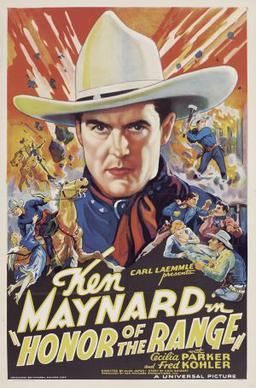
Honor of the Range (1934, directed by Alan James)


In an old west town, Sheriff Ken Bellamy (Ken Maynard) is an honest and upright lawman who thinks that he is trusted and respected by all.  His brother, Clem (also played by Ken Maynard), is a storeowner who is less respected and very jealous of his brother.  When Ken is asked to store some money in a safe, Clem decides to help the local outlaw, Rawhide (Fred Kohler), steal the money.  Clem gives Rawhide the combination but Rawhide then betrays Clem and takes him hostage.  Meanwhile, the townspeople think that Ken must has stolen the money so they toss him in jail and appoint a man named Boots (Frank Hageny) as the new sheriff.  Now, Ken has to not only figure out how to escape from jail and the townspeople but also how to defeat Rawhide’s gang.

Ken Maynard and his white horse Tarzan were two of the biggest western stars of the pre-code era.  Most of them were routine programmers but Honor of the Range stands out because it allows Maynard to step out of his usual heroic role by having him also play Clem.  Maynard could be a stiff actor when he was playing a traditional hero but here he seems to be enjoying playing the untrustworthy Clem.  Maynard actually produced Honor of the Range himself and it’s much more serious than the typical Ken Maynard western.  The town’s betrayal of the sheriff is played straight, as is Clem’s resentment of his brother.  With higher production values than usual and Maynard looking credible whenever he was holding a gun or riding his horse, Honor of the Range is one of the better westerns to be distributed by Universal during the pre-code era.