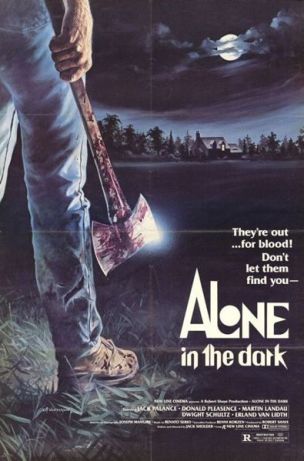
“There are no crazy people, doctor. We’re all just on vacation.”
— Frank Hawkes in Alone In The Dark (1982)
What is the difference between being crazy and being sane? Why are some forms of delusion considered to be socially acceptable while others are condemned? Who is the ultimate authority on what is normal and what is abnormal? These are just some of the issues that are raised by the gleefully subversive 1982 horror film, Alone In The Dark.
We know that there’s something off about Dr. Leo Bain (Donald Pleasence) from the minute we meet him. His smile is a little too nervous and his constant patter of positive words sound a little bit too rehearsed and convenient. When he greets another doctor, he insists on hugging him but it’s an awkward hug. Dr. Bain seems to be trying just a little bit too hard. (In many ways, Pleasence seems to be poking fun at his best-known role, Halloween‘s intense and dramatic Dr. Loomis.)
Dr. Bain is in charge of a psychiatric hospital. He doesn’t believe in conventional therapy. Instead, his hospital is perhaps the most oppressively positive place in the world, a place where every delusion is treated as being perfectly normal and where the patients are treated very leniently.
In fact, security is only present on the third floor of the hospital. That’s because the third floor is home to four inmates who are criminally insane. Frank Hawkes (Jack Palance) is a former POW who suffers from paranoia and gets mad whenever he hears anyone curse. Bryon “Preacher” Sutcliffe (Martin Landau) is a pyromaniac. Ronald Estler (Erland van Lidth) is a gigantic child molester. And finally, there’s The Bleeder, who always hides his face. The Bleeder is a serial killer who is called the Bleeder because, whenever he kills, his nose starts to bleed.
Dr. Bain scoffs at the idea that these four even need security but, as he explains it, the state requires it. However, one night, the power goes out and the four of them manage to escape. As they make their way into the nearby town, they rather easily blend into the mob of “normal” people who are using the blackout as an excuse to go looting.
However, these four patients are on a very specific mission. They had all grown to trust their psychiatrist, Dr. Merton. However, Dr. Merton was eventually hired away by another hospital. Frank is convinced — and has convinced the others — that Dr. Merton was murdered by their new psychiatrist, Dr. Dan Potter (Dwight Schultz). They’re goal now is to track down Dr. Potter and kill him and his family.
Meanwhile, Dr. Potter has issues of his own to deal with. He’s a nice guy but he’s also a bit too uptight and rational for his own good. (Early on in the film, he gets upset when his wife tries to get him to go see a band called the Sic Fucks.) His younger sister, Toni (Lee Taylor-Allan), is visiting while she recovers from a nervous breakdown of her own. She manages to get arrested while protesting a nuclear power plant and, when she gets out of jail, she insists on bringing another protester, Tom (Phillip Clark), home with her.
It all leads to one long night, during which the inmates lay siege to Dan’s house. And, all the while, Dr. Bain worries about whether or not they’re all mad at him…
Alone in the Dark may come disguised as a slasher movie but actually, it’s a pitch black comedy, with a lot of the humor coming from the contrast between Dan’s rationality, Bain’s nonstop optimism, and the fact that every one else in the film is literally batshit insane. The final siege is a masterpiece of suspense and Palance, van Lidth, and especially Martin Landau are memorably frightening in their menacing roles. The film’s final scene deserves to be iconic.
Alone in the Dark is one of those horror films that definitely deserves to be better known. Do NOT mistake it for the Uwe Boll film.
 Through the Shattered Lens