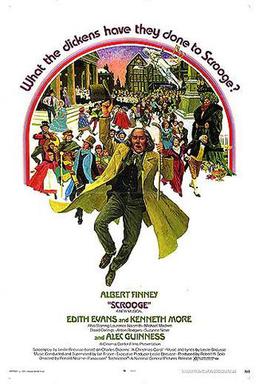
A Christmas Film Review: Scrooge (dir by Ronald Neame)


There have been many good film versions of the Charles Dickens novella, A Christmas Carol.  Several of them could even be called classics.  Everyone from Bill Murray to James Earl Jones to Tori Spelling to Fredric March has taken a turn at playing a version of the famous miser who, after being visited by three ghosts on Christmas Eve, changes his ways and becomes the most generous man in London.  This holiday season, I watched quite a few old TV shows and I was somewhat surprised to discover just how many sitcoms have featured an episode where one of the characters has A Christmas Carol-like experience.

Though actually, I shouldn’t have been surprised.  A Christmas Carol is a universal tale and it’s one that continues to be appealing 174 years after it was originally written.  You don’t have to be rich, British, greedy, or even a man to relate to what Ebenezer Scrooge goes through.  We’ve all be haunted by the past.  We’ve all wondered what we’re missing out on in the present.  And we all fear how we’ll be remembered in the future.  In fact, I would say that A Christmas Carol is probably as close to perfect you can get.  The only problem is that Bob Cratchit’s son is named Tiny Tim and any work of fiction that features a character named Tiny has to be docked a few points.

With all that said, my favorite film version of A Christmas Carol is the 1970 musical, Scrooge.

http://www.youtube.com/watch?v=g7xb1uSDxZ4

Scrooge sticks to the original details of the story.  Ebenezer Scrooge is played by Albert Finney.  (Finney was only 34 when he made Scrooge but was made up so that he looked closer to 120.)  The men, women, and spirits in Scrooge’s life are all played by a collection of distinguished British thespians.  Edith Evans is the stately Ghost of Christmas Past.  Kenneth More is the Ghost of Christmas Present, a decadent figure who drinks wine and travels around with two frightening-looking children.  Alec Guinness is a heavily chained Jacob Marley and he plays the role with just the right combination of sarcasm and concern.  (“No one else wanted to come,” Marley says when he greets Scrooge at the entrance of Hell.)  An actor named Paddy Stone is credited as playing the silent and shrouded Ghost of Christmas Future.  Let me just say that the Ghost of Christmas Future always scares me to death whenever I watch Scrooge.  I imagine little children in the 70s were traumatized by his skeletal visage.

What sets Scrooge apart is that it has singing and dancing!  That’s right, this is a musical version of A Christmas Carol, featuring songs composed by Leslie Bricusse.  Now, the overall quality of the songs is open to debate.  There’s 11 of them and really, only three of the songs are particularly memorable.  (Those songs are: I Like Life, I Hate People, and the Oscar-nominated Thank You Very Much.)  But, honestly, who cares?  The cast performs them with so much energy and enthusiasm that it’s impossible not to get swept up in it all.

(Admittedly, Albert Finney doesn’t really sing.  He just kinda growls the lyrics.  But that’s appropriate for the character of Scrooge.)

Scrooge is an outstanding production of a timeless tale.  It came on TV at least four different times this holiday season and I watched each time.  And I’ll do the same next year!

And as Tiny Tim, who did not die, said, “A Merry Christmas to all!  God Bless us, everyone!”

Horror Film Review: Taste the Blood of Dracula (dir by Peter Sasdy)


Taste_the_blood_of_dracula

Two years after being temporarily destroyed at the end of Dracula Has Risen From The Grave, Dracula returned in 1970’s Taste The Blood of Dracula!  Returning in the role and uttering only a handful of lines, Christopher Lee gave one of his most intimidating performances in the role of everyone’s favorite vampire.

Picking up where Dracula Has Risen From The Grave ended, Taste the Blood of Dracula opens with a sleazy merchant named Weller (Roy Kinnear) upsetting his fellow passengers during a carriage ride through Eastern Europe.  After they forcefully toss him out of the carriage, Weller comes across a crucifix-impaled Dracula.  Weller watches as Dracula dissolves into red dust.  Weller gathers up the dust and Dracula’s ring and brooch.

A few months later, the plot picks up with three wealthy men in England.  Hargood (Geoffrey Keen), Paxton (Peter Sallis), and Secker (John Carson) pretend to be charitable church goers but, in reality, they spend most of their spare time down at a wonderfully ornate brothel.  One night, at the brothel, they meet a disgraced nobleman named Courtley (Ralph Bates), who was disinherited for attempting to hold a black mass.  Intrigued by Courtley’s promise to give them an experience that they’ll never forget, the three men agree to purchase Dracula’s blood from Weller.

When they go to meet Courtley in a desecrated church, things suddenly go wrong.  Courtley attempts to force the three men to drink from a goblet containing a mix of his and Dracula’s blood.  After all three of the men refuse, Courtley himself drinks the blood.  The men respond by beating Courtley to death and then fleeing from the church.  After the men are gone, Courtley’s dead body transforms into a now living Dracula.  Dracula announces that those who have destroyed his servant will now be destroyed themselves.

And he proceeds to do just that, turning the men’s children into vampires and then commanding them to kill their parents.  Among those possessed are Alice (Linda Hayden), Hargood’s daughter for whom the film suggests Hargood may have incestuous feelings.  Alice is in love with Paul (Anthony Corlan), the son of Paxton.  When both Alice and his sister Lucy (Isla Blair) disappear, Paul sets out to find them and instead, comes across Dracula…

Taste the Blood of Dracula features Dracula at his cruelest (which, of course, makes it all the more ironic that his main motivation here is to avenge the death of his servant).  Whereas Dracula could probably very easily kill all three of the men himself, his decision to use their children to get his revenge adds a whole new level of horrific ickiness to the film.  Fortunately, none of the three men are particularly likable but still, it’s hard not to be disturbed when you’re confronted by the image of a vampirized daughter driving a stake into her own father’s heart.

But then again, that’s a part of the appeal of the old Hammer films, isn’t it?  Hammer films actually “go there” in a way that the period’s American horror films would probably never quite dare.

As for Taste the Blood of Dracula, there’s a lot to recommend it.  Director Peter Sadsy keeps the action moving, both the sets and the supporting cast are properly baroque, and how can you go wrong with Christopher Lee playing Dracula?  Christopher Lee is one of those actors who could do so much with just a glare and the fact that his Dracula says very little only serves to make him all the more intimidating and frightening.

Christopher Lee, of course, has never made a secret of the fact that he didn’t particularly care much for the Hammer Draculas, often complaining that the films failed to stay true to the spirit of Bram Stoker’s conception of the character.  Undoubtedly, Lee does have a point and the Hammer Draculas did decline in quality over the years.  (Just wait until we get to Dracula A.D. 1972.)  But Taste the Blood of Dracula is still a pretty effective vampire film.  Hammer’s Dracula may not have been Stoker’s Dracula but, as played by Lee, he still dominates our dreams and nightmares.