Lisa Marie Reviews An Oscar Nominee: Alice Adams (dir by George Stevens)


Katharine Hepburn was famous for both her relationship with Spencer Tracy and the films that she made with him.  They were such frequent co-stars and so associated with each other that “Hepburn-Tracy” became a film genre in and of itself, one that promised a bit of comedy, a bit of drama, and some sharp-witted romance.  That said, I have to admit that one of my favorite of Katharine Hepburn’s film is one that she made not with Spencer Tracy but instead with Fred MacMurray.  Alice Adams is a Tracy-Hepburn film without Tracy.

First released in 1935 and based on a novel by Booth Tarkington (who was quite a big deal back in the day even if, like Arrowsmith‘s Sinclair Lewis, he’s somewhat forgotten today), Alice Adams stars Hepburn as the title character.  Alice is the daughter of Virgil Adams (Fred Stone) and his wife, who is only referred to as being Mrs. Adams (Anne Shoemaker).  Virgil is a sickly man who has worked as a clerk at a glue factory for several years.  Despite living in a rather large house and having a maid named Malena (Hatti McDaniel), the Adams family is not wealthy.  However, Mrs. Adams desperately wants the family to be rich and Alice carries herself with the airs of a wealthy woman, despite the fact that everyone in town knows that she’s not.  Alice love her family and is loyal to them, even if her younger brother (Frank Albertson, who later played Sam “Hee Haw” Wainwright in It’s A Wonderful Life) appears to be addicted to gambling and her mother is constantly browbeating her father for not being more ambitious.  Her family may embarrass her but we know she wouldn’t trade them for all the money in the world.  That’s why we like Alice, even if she does sometimes act like a snob.

However, when Alice meets and falls for the wealthy Arthur Russell (Fred MacMurray), she lies about her social background and tries to present herself as being just as rich as him.  When she invites Arthur and his parents to her house for a dinner party, she frantically tries to keep up the charade of being wealthy.  Meanwhile, Virgil finds himself wrongly accused of stealing from his boss (Charley Grapewin) and, as a result, the family’s financial future is put in jeopardy.

Alice Adams is a mix of screwball comedy and social drama.  On the one hand, Alice’s desperate attempts to throw the perfect party are frequently very funny.  Katharine Hepburn was always at her best when she played a flighty character and the contrast between Alice’s sophisticated airs and Alice’s actual personality makes me laugh every time that I watch the film.  At the same time, there’s a definite undercurrent of melancholy to the film.  Alice and her mother are both so desperate to be rich that they’ve both been blinded to just how wonderful their lives really are.  Alice may like Arthur and Arthur definitely likes Alice but one never forgets that a part of Alice’s attraction to Arthur is that Arthur can give her the life to which she aspires.

Alice Adams features one of Hepburn’s best performances and it’s a rare Hepburn performance to which anyone watching should be able to relate.  At some point in our lives, we’ve all felt like Alice.  We’ve all been Alice, even if we don’t want to admit it.  Fred MacMurray’s natural likability serves him well as Arthur.  He comes across like a genuinely nice guy and we definitely want him and Alice to end up together.

Alice Adams was nominated for Best Picture but it lost to a much bigger production, Mutiny on the Bounty.  Bette Davis beat Katharine Hepburn for Best Actress.  Davis later said that she felt Hepburn should have won.
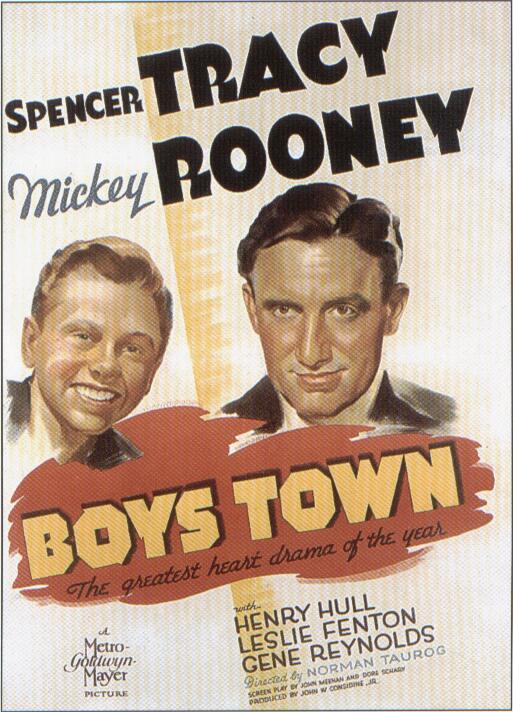
Lisa Reviews An Oscar Nominee: Boys Town (dir by Norman Taurog)


boys_town

Before writing about the 1938 film Boys Town, I want to share a story that might be false but it’s still a nice little story.  Call this an Oscar Urban Legend:

Boys Town is about a real-life community in Nebraska, a home for orphaned and homeless boys that was started by Father Edward Flanagan.  In the film, which was made while Father Flanagan was still very much alive, he was played by Spencer Tracy.  Boys Town was a huge box office success that led to the real Boys Town receiving a lot of favorable publicity.  When Tracy won his Oscar for Boys Town, his entire acceptance speech was devoted to Father Flanagan.

However, a problem arose when an overeager PR person at MGM announced that Spencer Tracy would be donating his Oscar to Boys Town.  Tracy didn’t want to give away his Oscar.  He felt that he had earned it through his acting and that he should be able to keep it.  Tracy, the legend continues, was eventually persuaded to donate his Oscar on the condition that he would get a replacement.

However, when the replacement arrived, the engraving on the award read, “Best Actor — Dick Tracy.”

That’s a fun little story, one that is at least partially true.  (Tracy’s Oscar — or at least one of them — does currently reside at the Boys Town national headquarters.)  It’s also a story that, in many ways, is more interesting than the film itself.

Don’t get me wrong.  Boys Town is not a bad movie.  For me, it was kind of nice to see a movie where a priest was portrayed positively as opposed to being accused of being a pederast.  In a way, Boys Town serves as a nice counterbalance to Spotlight.  But, with all that said, there’s not a surprising moment to be found in Boys Town.  It’s pretty much a standard 1930s juvenile delinquency melodrama.

The movie opens when Father Flanagan giving last rites to a man who is about to be executed.  (Boys Town takes a firm stand against the death penalty, which is one of the more consistent and laudable stands of the modern Church.)  The man says the he never had a chance.  From the time he was a young boy, he was thrown into the reform school system.  Instead of being reformed, he just learned how to be a better criminal.  Father Flanagan is so moved by the doomed man’s words that he starts Boys Town, under the assumption that “there’s no such thing as a bad boy.”

Father Flanagan’s techniques are put to the test when Whitey Marsh (Mickey Rooney ) arrives.  Whitey is angry.  He’s rebellious.  He tries to run away every chance that he gets and, during one such escape attempt, he even gets caught up in a bank robbery.  Can Father Flanagan reach Whitey and prove that there’s no such thing as a bad boy?

Well, you already know the answer to that.  As I said, there’s really nothing surprising to be found in the plot of Boys Town.  It’s just not a very interesting movie, though there is a great shot of a despondent Whitey walking past a several lines of former juvenile delinquents, all kneeling in prayer.  As Father Flanagan, Spencer Tracy is the ideal priest but his role is almost a supporting one.  Believe it or not, the film is dominated by Mickey Rooney, who gives a raw and edgy performance as the angry Whitey Marsh.

(That said, it’s hard to take Whitey seriously as a future gangster when he’s always wearing a bowtie.  Then again, that may have been the height of gangster style in 1938.)

Boys Town was nominated for best picture but lost to You Can’t Take It With You.

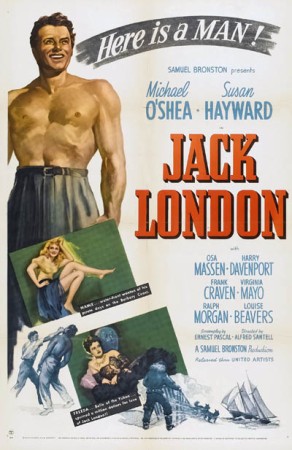
The Fabulous Forties #28: Jack London (dir by Alfred Santell)


Jack-London-1943

The 28th Film in Mill Creek’s Fabulous Forties box set was a 1943 biopic about the writer, Jack London.  Not surprisingly, the title of the film was Jack London.

Now, I should start this review off by mentioning that I know very little about Jack London.  I don’t think that I have ever read any of his short stories or his novels.  I know that he wrote a novel called White Fang but that’s largely because there’s been so many different film versions of the book.  (Long before directing Zombi 2, even Lucio Fulci made a version of White Fang.)  Here’s what I do know about Jack London:

  1. He was a prominent writer at the turn of the century.
  2. He was reportedly an alcoholic.
  3. He was a Socialist who even ran for mayor of Oakland, California on the party’s ticket.
  4. He was an atheist.
  5. In 1916, depending on the source, he either committed suicide, died of alcohol poisoning, or simply passed away as the result of 40 years of hard living.

Of those 5 facts, 4 are totally ignored in Jack London.  The film does acknowledge that Jack London eventually became a prominent writer, even going so far as to open with stock footage of a U.S. warship being named after him.

As for his alcoholism, we never see London drunk.  Indeed, the film’s version of Jack London is so earnest that it’s hard to believe he’s ever had a drink in his life.

As for his Socialism, we are shown that London grew up in a poor family.  When, after serving at sea, he takes a writing class, he argues with a professor over London’s desire to write about the poor.  However, we never hear London express any specific ideology.  We certainly don’t see him running for mayor of Oakland.

As for his atheism — yeah right.  This film was made in 1943!  There’s no way that Jack London was going to be portrayed as talking about why he didn’t believe in God.

As for his death — well, Jack London ends with the writer very much alive.  There’s not even a title card informing us that London eventually died.

Instead, Jack London is much more concerned with Jack (played by Michael O’Shea) dealing with the Japanese.  Oh sure, we get some scenes of Jack London watching a shootout and breaking up a bar fight in Alaska.  And Susan Hayward shows up as Jack London’s always supportive wife.  (For that matter, Louise Beavers also shows up as Jack London’s always supportive house keeper.)

But, in the end, the majority of the film features Jack London as a war correspondent covering the turn of the 20th century war between Russia and Japan.  When he’s captured by the Japanese, he observes the harsh way they treat prisoners and is shocked when he witnesses several prisoners being ruthlessly executed.  When he talks to a Japanese commandant, he’s outraged as the commandant explains how the Empire of Japan is planning to take over the world.  When Jack finally gets back to America, he’s less concerned with writing White Fang and more concerned with warning the American people to remain vigilant…

Jack London is basically wartime propaganda disguised as a biopic.  The entire point of the film seems to be that if Jack London was still alive, he would want the men in the audience to enlist and the women to buy war bonds.  None of it is subtle and, beyond its value as a time capsule of how Americans viewed the Japanese in 1943, none of it is particularly interesting as well.

In the end, Jack London plays out like one of those earnest but dull educational films that tend to show up on PBS when no one’s watching.

Cleaning Out The DVR #16: Johnny Belinda (dir by Jean Negulesco)


X-johnnybelindalenda48-jjp

Continuing my effort to watch 38 films in 10 days (and, as of today, I only have 6 days left!), I spent part of last night watching the 1948 film Johnny Belinda.

Johnny Belinda takes place in Canada, on Cape Breton Island.  The residents of the island are a hearty, no-nonsense group of people.  They work hard, they don’t play hard because they never play, they farm, and they don’t have much use for outsiders.  When a new doctor, Robert Richardson (Lew Ayres), arrives on the island, he has to work hard to earn their trust.

Dr. Richardson is fascinated by Belinda McDonald (Jane Wyman), a young woman who is deaf and mute.  Belinda lives on a farm with her father (Charles Bickford) and her aunt (Agnes Moorehead).  Everyone in the community assumes that Belinda is a simple-minded and, because her mother died giving birth to her, she is resented by her father.  Only Dr. Richardson believes that Belinda is in any way intelligent and, over her father’s objections, he teaches Belinda sign language.

Dr. Richardson’s secretary, Stella (Jan Sterling), falls in love with him and grows angry when it becomes apparent that he’s more interested in taking care of Belinda than pursuing an adulterous romance with Stella.  Meanwhile, Stella’s husband, a viscous alcoholic named Locky (Stephen McNally), gets drunk and rapes Belinda.  9 months later, when Belinda gives birth to a boy that she names Johnny, everyone assumes that Dr. Richardson is the father.  Soon, both Richardson and the McDonald family are being shunned by the judgmental community.

Locky, meanwhile, is determined to keep anyone from finding out about his crime, to the extent that he’s willing to commit murder.  Both Locky and Stella are determined to take Johnny away from Belinda and it all eventually leads to further tragedy and, somewhat inevitably, a dramatic murder trial.

Much like Random Harvest, Johnny Belinda is another film that I could imagine being remade for Lifetime.  It’s a well-made melodrama that appeals to all of the emotions and features a cast of talented actors doing good work playing characters that are probably just a bit too familiar.  In fact, there’s really not a single moment of Johnny Belinda that will take you by surprise but, despite that, the film still works.  Jane Wyman does such a good job playing the silent Belinda that it makes the entire movie worth watching.  (It’s interesting to contrast Wyman’s innocent, vulnerable, and sympathetic performance here with her far more severe work in The Yearling.)  Reportedly, Wyman devoted so much time and effort to her performance that it was cited as a reason for her divorce from future President Ronald Reagan.  For Johnny Belinda, Wyman lost the chance to be first lady but she did win an Oscar.

(And, for the record, Wyman voted for Reagan in 1980 and 1984, saying that it wasn’t often that you got to vote for your ex-husband.)

Johnny Belinda was nominated for best picture of the year and, with 10 nominations, it was the most nominated film of 1947.  Though it won an Osar for Wyman, it lost best picture to Laurence Olivier’s Hamlet.