
Dear Mr Vernon,
We accept the fact that we had to sacrifice a whole saturday in detention for whatever it was we did wrong. But we think you’re crazy to make us write an essay telling you who we think we are. You see us as you want to see us – in the simplest terms, in the most convenient definitions. But what we found out is that each one of us is a brain, and an athlete and a basket case, a princess and a criminal.
Does that answer your question?
Sincerely yours,
The Breakfast Club.
— Brian’s essay from The Breakfast Club (1985)
That’s one thing that has always bothered me about The Breakfast Club. The film, of course, is famous for being about five different high school students who are forced to spend a Saturday in detention with each other. Over the course of the day, they start off as antagonists, separated by their own preconceived notions of who they are. But, as the day progresses, they talk and they bond and they discover that they all have more in common than they might think. And, at the end of the film, “basket case” Allison (Ally Sheedy) pairs off with “athlete” Andy (Emilio Estevez) and “criminal” Bender (Judd Nelson) pairs off with “princess” Claire (Molly Ringwald). And while Claire is busy giving Allison a makeover and Bender is thinking about how iconic he’ll look when he raises his fist while leaving the school, “brain” Brian gets to write everyone’s essay.
Originally, all five of them were supposed to spend their time in detention writing individual essays about how they’re going to be better students and citizens. But, in the end, only one essay is turned in and Brian is the one who writes it. It’s always seemed a bit unfair to me that, while everyone else was getting to reveal a new side of his or herself, Brian was basically doing everyone’s schoolwork. I know it can be argued that this shows that the other students finally appreciate Brian’s intelligence but everyone already knew he was smart. In the end, Brian is the one who articulated what they all discovered during that Saturday detention but he also seems to be the one who gained the least from the experience.
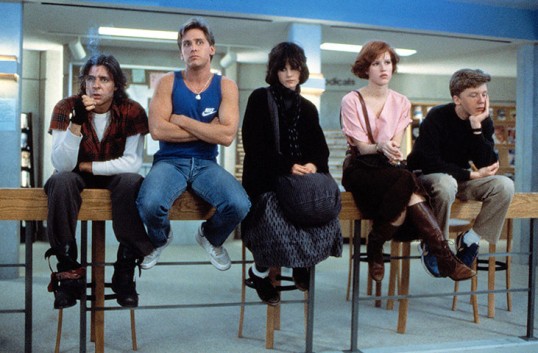
But, at heart, The Breakfast Club is a deeply ambiguous movie. That’s one reason why, despite the fact that it was initially released the same year that I was born, the film still feels relevant today and why it remains one of the most popular high school films ever made. Everyone can relate to at least one of the five students and I imagine that when most people watch it, they wonder how they would react to an aggressive character like John Bender or how they would handle the horrific story that Andy tells when asked what he did to get sentenced to detention. And, at the end of the film, everyone wonders if any of the new friendships and relationships would actually last longer than a weekend. When Bender asks Claire how she’s going to act if Brian approaches her on Monday, we all know what will probably actually happen if he does. At the end of the film, you’re happy that they got that Saturday together because you know that, once Monday comes, it’s going to be like it never happened.

I’ve watched The Breakfast Club a handful of times. Whether I relate the most to Claire or to Allison usually depends on my mood. I think that a lot of people want to relate to Allison because, for much of the movie, Claire is unapologetically selfish and spoiled. But, if we’re honest with ourselves, we have to admit that we’re all a lot more like Claire than any of us want to admit.
It’s also easy to relate to Allison because she’s not really a very well-drawn character. While the other characters all come from an easily identifiable group, Allison is just there. She’s a collection of strange quirks that don’t always have a clear motivation and, in the end, the only reason Allison works as a character is because Sheedy does such a good job playing her. At the end of the film, Claire gives Allison a makeover and I have to admit that it always kind of breaks my heart to see how Allison goes from being strange to being very conventional.

(In Susannah Gora’s excellent book You Couldn’t Ignore Me If You Tried, Sheedy is quoted as saying that she didn’t feel very happy about it either. According to her — and she’s correct — the only thing that really redeems this scene is the fact that Allison doesn’t quite pull off her new look. She’s still a little awkward and you realize that she may have just been humoring Claire.)
As for the males, Anthony Michael Hall gets a lot of the laughs and Judd Nelson gets the best lines but Emilio Estevez gives the best performance. We already know that Brian is insecure despite being intelligent and we expect that Bender is angry because he’s got an abusive father. But when Andy explains why he, an otherwise nice and likable guy, committed a horrific act of bullying, it’s an amazing scene and Estevez plays it perfectly.

In fact, both Estevez and Sheedy are so good that I’ve decided that Andy and Allison did stay together after detention. Eventually they got married and, right now, they’re living in a pretty house in the suburbs of Chicago. Bender and Claire, however — there’s no way that lasted!
But, regardless of what happened on Monday, there’s no way your heart can’t soar a little when Bender lifts that fist above his head.



 Through the Shattered Lens