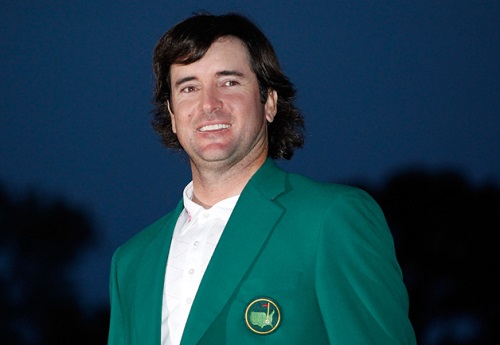
I have two major hobbies: music and sports. I only tend to write about the former because frankly, I have no idea what it’s like to be an athlete. Aside from some peewee baseball and my Army training, I can’t say I’ve ever physically exerted myself for reasons other than a paycheck. I love watching sports for the suspense and the statistics; I don’t pretend to know the game better than any of the players and coaches actually involved. It is with that in mind that I’d rather not pass judgement on Bubba Watson’s controversial comments to his caddie over the weekend. For those of you unfamiliar with the headlining golf gossip of the week, Watson headed to the 16th on Sunday with a two stroke lead and then managed to triple-bogey and blow the tournament. With all cameras pointed his direction, he appeared to criticize his caddie for one bad shot after another rather than accepting blame for his mistakes. Were his complaints legitimate? Probably not. He’d already played the par 3 16th three times that week, scoring two pars and a birdie. I would hope a professional at his level knew what to expect without relying on his assistant to make the calls for him. But I don’t play golf; I just watch it obsessively. Maybe his caddie really did cost him the tournament; or more realistically, maybe the media, riding off Sergio Garcia’s fried chicken comment, was desperate to create ratings-boosting controversies out of nothing. He is probably only guilty of forgetting that the cameras were rolling while venting his general frustration over a series of shots that cost him more than $800,000.
But let the pundits sling their mud, because I hate Bubba Watson’s guts. When he beat out Louis Oosthuizen at the 2012 Masters, I practically fell into a depression. There is always a bittersweet feeling when unrepentant athletes with substantial skeletons in their closets achieve the ultimate goal in sports, but at least no one thinks Kobe Bryant or Ray Lewis are good guys. Watson is different. Not only is he the biggest asshole in sports to have never killed somebody or beat his wife, but he has convinced a sizable fan base that he is the ideal Christian role model.
Bubba wants you to know that he “loves Jesus and loves sharing his faith”. It’s the very first line on his official website’s “Who is Bubba Watson” section. Moreover, “Bubba and his wife, Angie [sic] are committed Christians who share a passion for philanthropy and dedicate as much time as possible to giving back.” At every turn in Bubba’s career, he is careful to remind the media of his faith and philanthropy. He tells us through social media. He tells us in press conferences. He tells us in private interviews. Most athletes talk about “giving back” at some point; it’s PR 101. But Bubba wants you to know that he’s not just your average athlete philanthropist. No, his entire life is a service to Jesus Christ and his good word. Let us count the ways.
Bubba Watson adopted a child. He gave some poor Chinese girl about to be drowned in a river, or maybe some AIDs-ridden Nigerian teen, a shot at a good life, right? Oh, never mind. He adopted a one month old white male when his wife couldn’t get pregnant. You know, the sort of kid you have to go on a years-long waiting list to acquire, because every rich white asshole who can’t produce an heir wants one.
Bubba Watson places his family first, even at the expense of his tour schedule. That’s what he told us when he canceled his May tour dates, including the prestigious Players Championship, after winning the Masters last year. He wanted to be there for his little Caleb, and teach him how a responsible, caring a dad ought to act. He’s got his priorities straight, unlike those other pros. Now Caleb will have lots of great memories of his dad being there for him when he was… two or three months old? Yeah, it’s regarded as highly unprofessional in golf to take a month off just because you “feel like it”, but so what? Bubba had just banked $1,440,000 and accomplished the greatest goal in professional sports: he won a championship. Instead of just ignoring the petty media buzz over his vacation, he twisted it in his mouth and in his mind into some sort of charitable expression of Christian values. Give me a goddamn break. Phil Mickelson showed up to the U.S. Open jetlagged this year because he flew over night from his daughter’s graduation in San Diego, and the only reason the media made a big deal about it was because it’s Phil and he almost won anyway. He–like the majority of PGA tour members–knew how to responsibly balance his personal and professional priorities, and he never bragged about it. All Phil proved is that he’s a good father. He never suggested he was better than all the other good fathers out there. Bubba took a month off to party and celebrate his own accomplishments–that much is arguably tasteless but fine–and then he intentionally projected it as though this made him the PGA’s ultimate family man.
Bubba Watson raised over one million dollars for charity this year, through a combination of donations and his own earnings. Charitable giving ought to be expected, since, according to Bubba Watson, “Bubba’s character exemplifies the strength and humility it takes to succeed in life.” But what athlete doesn’t donate a little to charity? What has Bubba done towards this end that somehow gives him more bragging rights than the rest of them? Is it the fact that he does it with God on his side, whereas the others are just decent human beings? Bubba just loves to talk about what a humble guy he is–as long as the topic is distanced from his boasts about wearing a $500,000 watch (did I just say a $500,000 watch?…) and driving the original Dukes of Hazzard General Lee stunt car. Hey, I’d live large if I was a celebrity or sports star too, but I don’t think I’d brag about following the teachings of Jesus while doing so. I mean, I don’t read or believe in the Bible, but I’ve never seen anyone quote that passage where Jesus talks about the virtue of investing the vast majority of your earnings into frivolous social status symbols.
Bubba Watson donates for breast cancer research. That’s cool. He also donates to a military veterans service for wounded Green Berets. I’ve got no personal issue with that, though I think Jesus was a pacifist. But here’s what I really love: he donates to The City Church. I don’t know how familiar the average, non-psychopathic American is with non-denominational Christian mission organizations, but I grew up surrounded by them. They’re absolutely traumatizing brain-washing centers where you are taught at a young and volatile age that all of your friends and family will suffer terribly if you aren’t prepared to die as a martyr for their salvation. You learn all about how America ruthlessly persecutes Christians (i.e. non-denominational Christians, because anyone who acknowledges multiple interpretations of Christianity is clearly misguided and requires your guidance for salvation), how homosexuals, feminists, environmentalists, socialists, non-Christians, and really most Christians too–basically anyone who doesn’t watch Fox News–are corrupting God’s kingdom and distorting his values, and how only you have been entrusted by God with “the truth” and the power to fight back. Stellar fucking stuff; the real “Onward Christian Soldier” mentality. I have enough personal experience to recognize by browsing that website exactly what Bubba’s “charitable donations” are going towards. But it comes as no shock to me. It’s entirely in keeping with everything else the man does.
Bubba Watson is not afraid to speak out against corruption and evil when he sees it! Why, at the Alstom Open de France in 2011, when his classy 5-star hotel had the nerve to pollute his room with bottles of vintage wine, he dumped them out his window and let the world know about it. When the crowd heckled him the next day, he did not back down from righteousness! He bravely announced his total disgust with European culture and refused to return to any future European Tour event. (Except the Open Championship of course; he can make a lot of money there and maybe buy a second watch.)
Athletes and celebrities can do whatever they want with their earnings. While I think some of the charities he supports are better branded as dangerous hate groups, there is nothing fundamentally wrong with the majority of his actions. But Bubba adamantly insists–and adamantly believes–that he is the most humble and charitable man in golf. He’s the 21st century version of a white supremacist piece of shit, and quite possibly the most egotistical, self-righteous bigot on the PGA Tour. And did I mention he has openly criticized Tiger Woods for not setting a good example?

 Through the Shattered Lens