Trash Film Guru Vs. The Summer Blockbusters : “After Earth”


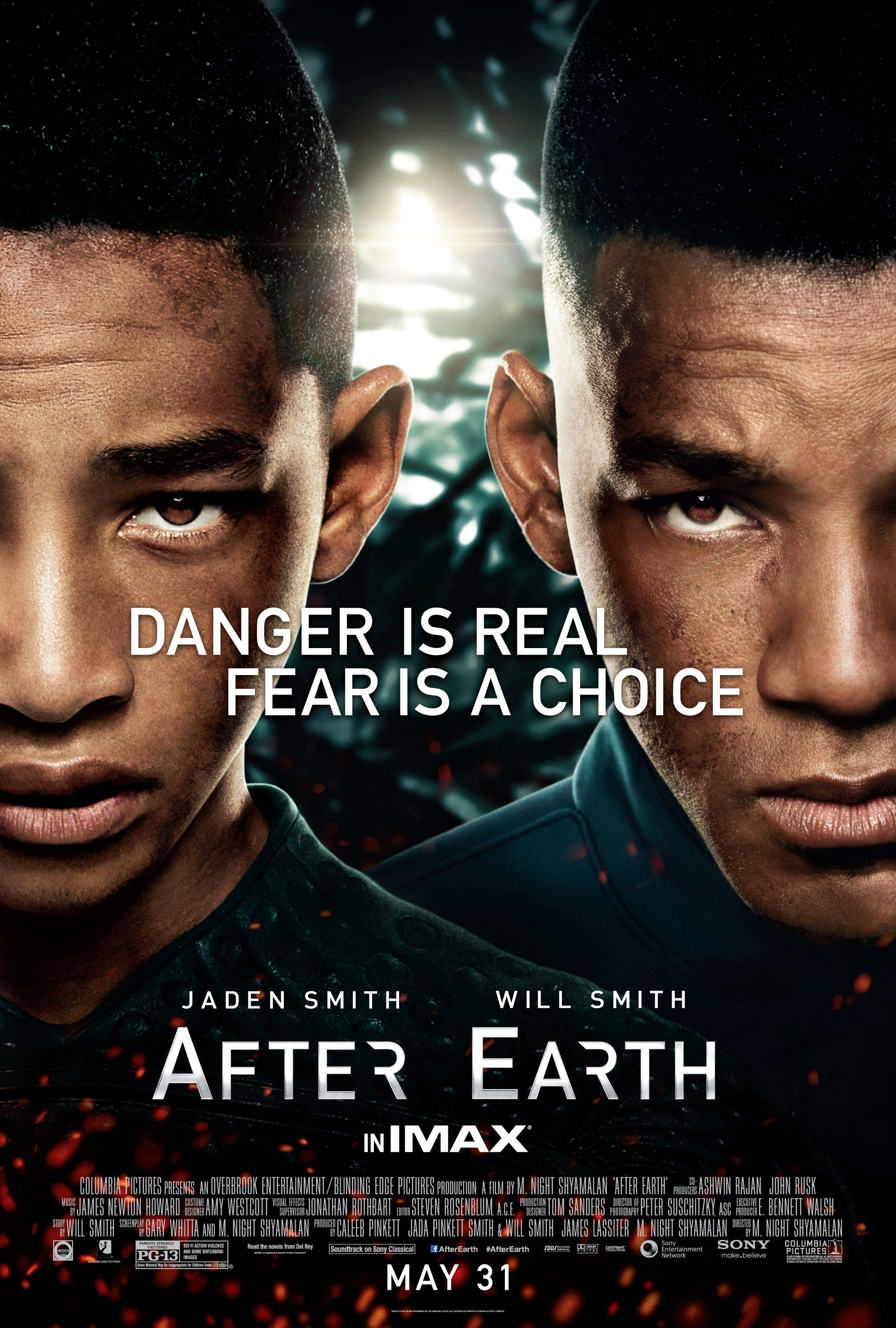
After-Earth-poster


Given that the always-on-the-ball Lisa Marie Bowman already beat me to the punch with this one on these virtual “pages,” I won’t waste too much of your time, dear reader, on my post-mortem analysis of the decidedly dull, wannabe-mystical-and-“empowering” mess that is Will Smith’s latest vanity project, After Earth, and instead merely remark upon some — -well, remarkable facts.

The first being that precisely two scribes here at TTSL actually saw this thing, and my best guess is that we both saw it in empty theaters because, according to box office receipts from the past weekend, nobody else went. So Sony/Columbia owes us a debt of thanks. And maybe some free passes to some future release of theirs.

Secondly, I’d like to state for the record that this film actually isn’t the abysmal and abject failure so many have quickly taken to labeling it as being so much as it’s just thoroughly predictable and almost relentlessly dull. 1,000 years after the evacuation of the planet due to largely unspecified but apparently quite serious environmental devastation,  emotionally distant military bad-ass-with-focus-group-tested -name Cypher Raige (Smith) and his son, Kitai (Smith’s kid Jaden) crash-land on the supposedly uninhabitable rock and must find a way to — yawn — survive while also learning to — yawn again — finally form the deep bonds of trust that all parents and their offspring are, y’know, supposed  to have.

There’s a bog-standard “warrior monk” mentality that runs through this picture that confuses stoicism for honor and nonchalance for dignity, and while Smith seems to be ill at ease with the material, he’s really got no one to blame but himself given that the film’s plot was apparently hatched in his own mind and the whole thing’s a family affair, with the former “Fresh Prince” not only starring in it, supposedly having a hand in scripting it, and casting his son to appear alongside him, but with his wife,  Jada Pinkett Smith, grabbing a producer’s credit, as well. And while it might be tempting to lay a pretty fair share of the blame for this overwrought snoozer on M. Night Shyamalan’s doorstep, as well — especially given his thoroughly uninspiring track record over the past decade or so —  the fact is that he’s pretty much acting as a director/co-writer-for-hire here, his fifteen minutes as Hollywood’s “next big thing” having apparently — finally! — run their course.

And weird as it sounds considering my disdain for pretty much anything he’s ever had his name attached to in the past, Shyamalan actually acquits himself reasonably well here. His direction doesn’t especially stand out in any respect, mind you, but you know what they say about how tough it is to make a silk purse from a sow’s ear. All in all, I got the distinct impression that he was at least trying to inject some life into some pretty goddamn listless proceedings.

His efforts certainly aren’t enough, though. LMB’s right that the film’s environmental message feels both heavy-handed and tacked on — shit, at least Birdemic was so hilariously inept at doing more or less the same thing that you couldn’t help but love it —but its New Agey emotional subtext is even more clumsy and ham-handed than its ecological one,  and to me that’s where the film’s most egregious sermonizing is to be found.

Parents should love their kids and be nice to them? Wow, ya don’t say.

Anyway, there’s probably not much point belaboring the obvious any further here — I’ve never been a big fan of piling on, and as I said, I don’t find  this flick so much actively bad as it is just dull, preachy, and without purpose apart from demonstrating to the world what an awesome, caring, understanding bunch the Smith/Pinkett clan is (after all, they’d never treat their kids like this in real life, right?). So there ya go —  and there it goes, since all indications are that After Earth will probably “enjoy” a well-deserved short-lived run on our nation’s movie screens before slowly dying on the home video and cable TV vine. Hang onto your cash and catch it on TNT or TBS some Saturday afternoon a year from now.
Film Review: After Earth (dir by M. Night Shyamalan)


After Earth is the latest of many forgettable films to have been released in 2013.

The film’s plot — which will be familiar to anyone who has seen Oblivion or any other science fiction film — deals with a father (Will Smith) and his son (Jaden Smith). The father is a great military leader but is emotionally distant.  (Will Smith, who is probably one of the most openly emotional actors working today, deals with being miscast by refusing to smile.)  The son is desperate to prove himself to his father.  When the two of them return to Earth (which was deserted a thousand years ago because of — you guessed it — pollution), their ship crashes.  The father is critically injured and, of course, the son has to save both of their lives, deal with his past guilt, and become a man.

Or something like that.

Did you know that M. Night Shyamalan directed After Earth?  If you didn’t, don’t feel bad.  In the advertising campaign leading up to this film’s release, Columbia Pictures has treated Shyamalan’s involvement like a dirty secret.  It’s understandable, really.  After all, Shyamalan’s last two films were The Happening and The Last Airbender and you can only refer to him as being “the director of The Sixth Sense” for so long.  That said, Shyamalan’s work here isn’t that bad.  It’s not that memorable either.  Instead, it’s the epitome of adequate and bland.  Some scenes (like the crash landing on Earth) actually come close to being exciting but there’s little sense of wonder or surprise to the film’s version of the future and, while the majority of the film is about Jaden Smith trying to survive and conquer the cruelty of nature, the environment of After Earth never truly feels alive.  Perhaps an Ang Lee or a Werner Herzog could have brought After Earth to life but all Shyamalan can do is keep the action plodding forward.

However, it’s unfair to put blame for After Earth on M. Night Shyamalan.  If anybody can truly be considered the auteur of After Earth, it is Will Smith.  Smith produced the film, came up with the film’s storyline, and gave the film’s lead role to his son.  Thematically, After Earth fits into Smith’s feel-good, good-for-you brand of cinema.  The problem, however, is that for an action film like this to work, you need a charismatic hero and, to judge from this film, Jaden Smith has inherited little of his father’s onscreen prowess.  Fairly or not, it’s impossible to watch Jaden in this film without being aware that he (as opposed to an actor who doesn’t have a famous father) got the role solely because he was the producer’s son.  As such, it’s far more difficult to forgive Jaden’s awkward screen presence than it might be otherwise.

After Earth is only 100 minutes long.  It’s considerably shorter than both Iron Man 3 and the latest Star Trek film.  However, when the film’s lack of surprise is combined with Jaden Smith’s bland lead performance, the end result is a film that feels a lot longer than it actually is.

When all I said and done, the only real question about After Earth is whether or not it’s worse than Oblivion.  It’s hard to say because After Earth and Oblivion are both oddly forgettable sci-fi films with similar premises.  In fact, while watching After Earth, I kept expecting Tom Cruise to pop up and say, “I thought I was the only man left on Earth!”

I guess the question really comes down to which film is more annoying and again, there are no easy answers.  Considering how bland both Oblivion and After Earth really are, it’s interesting that both of them manage to feature some overdone accent work.  It’s hard to know how to describe Will Smith’s vaguely Aruban (?) accent in After Earth but honestly, nothing could be more annoying than Melissa Leo’s butchering of the Southern accent in Oblivion.  So, as far as bad accents are concerned, Oblivion has to be considered the winner.

(Add to that, as weird as Smith’s accent was, it could at least be justified by the fact that After Earth was meant to be taking place in the far future.  There was absolutely no justifiable reason for Melissa Leo in Oblivion to sound like Cate Blanchett in Hanna.)

However, After Earth has a tacked-on environmental message, the type that makes Shyamalan’s The Happening seem subtle and intelligent by comparison. Don’t get me wrong.  I’m not objecting to After Earth (or any other film) having a subtext.  What I do object to is when a film uses an obvious and heavy-handed subtext to try to hide the fact that the movie itself isn’t that good.  In the case of After Earth, the environmental message feels lazy and predictable.  It almost feels as if, by paying lip service to a noble cause, Shyamalan is attempting to blackmail us into liking this film.

So, what’s worse?  A bad accent or an insincere message?

Ultimately, that’s a decision that everyone must make on their own.

Or you could just ignore both After Earth and Oblivion altogether and instead make the effort to see and support truly unique films like Upstream Color.

The choice is yours.