
THE CALL OF THE WILD (1997) is based on Jack London’s classic story about Buck, a domesticated dog who lived the first four years of his life on the regal estate of Judge Miller. In 1897, he’s kidnapped and shipped up north to the frozen arctic regions where powerful dogs are in high demand. And Buck, a St. Bernard-Scotch Collie mix, is as powerful as it gets.
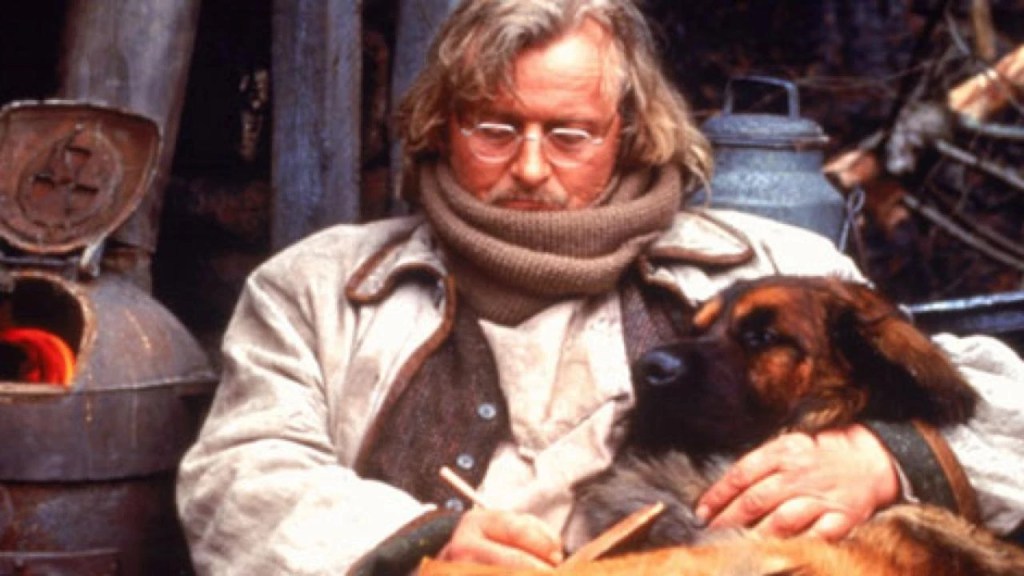
On his journey, we see Buck fall into the hands of three different masters. First, he’s purchased by a dispatch courier for the Canadian government named Perrault (Luc Morissette) whose sled driver is Francois (Robert Pierre Cote). Perrault and Francois are kind to the dogs, but life is still harsh as they carry their dispatches across the snowy, frozen north. Buck sees a dog killed by other dogs for the first time. This is where he first learns that only the strong survive, and he soon has to prove it when he’s forced to fight and kill Spitz, the lead dog of the team. Unfortunately, circumstances require Perrault to sell Buck and his sled team to a group of greenhorns led by Hal (Charles Edwin Powell), his sister Mercedes (Bronwen Booth) and her husband Charles (Burke Lawrence). These morons have no business looking for gold in the Yukon. They have no clue as to what they’re doing and seem to be leading the group to certain death. Starving, tired, and sensing disaster, Buck is lucky that the group arrives at the camp of John Thornton (Rutger Hauer) just in the nick of time. Collapsing at the doorstep of Thornton’s tent, Buck refuses to get up and go any further. As Hal begins to beat Buck with a stick, even going so far as pulling his gun to shoot him, Thornton forcibly takes Buck from the morons. With Thornton, Buck has finally found his “human.” John Thornton nurses Buck back to health and the two become inseparable. Buck has found love for the first time with Thornton and will not let him out of his sight for fear he might lose him. Then something strange happens, he starts feeling a call from the forest, and the promise of a freedom he’s never known before. His love for Thornton is strong, but is it as strong as the call of the wild?
Even though this 1997 version of THE CALL OF THE WILD is narrated by Richard Dreyfuss and includes the great actor Rutger Hauer in its cast, the true star of this film is Buck the dog. We really pull for Buck as we see him adapt to his new way of life after he’s stolen from his comfortable southern home. As hard as it is to see the animals kill the weakest among them, these are important lessons for Buck. His new world is no place for the weak, and he decides that he will never be weak again. Even though Buck has gotten tough, it’s still a relief when he ends up with John Thornton, the Hauer character. My favorite part of the film is when the two take off together in search of gold. Hauer is only in the film for about thirty minutes, but the relationship he shares with Buck is the highlight of the film as far as I’m concerned.
The last thing I want to mention about the film is that it’s directed by Peter Svatek. Svatek’s next film, BLEEDERS (aka HEMOGLOBIN) would also star Rutger Hauer, and he would follow that up with SILVER WOLF, starring Roy Scheider. For what it’s worth, the man definitely had something going for him since he was able to work with talents like Hauer and Scheider!
I’ve never read Jack London’s novel, but I have read that this version of THE CALL OF THE WILD may be the most faithful adaptation of the book out there. If that’s truly the case or not, I still really enjoyed this adaptation, and it’s an easy recommendation from me.

 Through the Shattered Lens