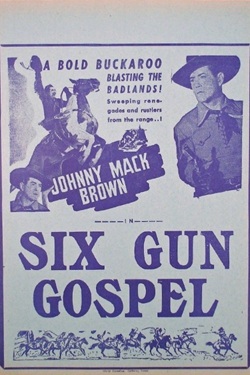
Six Gun Gospel (1943, directed by Lambert Hillyer)


Marshals Nevada Jack McKenzie (Johnny Mack Brown) and Sandy Hopkins (Raymond Hatton) are sent to the frontier mining community of Goldville to determine who is responsible for hijacking all of the gold that should be coming out of the town.  Not surprisingly, it’s all the work of another dastardly saloon owner (Kenneth MacDonald) who is planning on stealing all the gold, chasing off all the settlers, and then selling their land to the railroad company.  While Sandy goes undercover as the town’s new preacher, Jack agrees to ride shotgun on a gold shipment, along with with Dan Baxter (Eddie Drew).  Dan is in love with Jane Simms (Inna Gest), the daughter of honest miner Bill Simms (Kernan Cripps).

Johnny Mack Brown made a countless number of westerns for several different production companies but it seems like they always featured a crooked saloon owner and a plan to sell the land to a railroad company.  Luckily, nobody watches these movies for the plots and that was probably true even when they were first released.  People watch these movies for the nostalgia value of watching a movie where it’s good vs evil and good always triumphs without leaving any sort of lingering doubt about whether or not the heroes did the right thing.  Johnny Mack Brown is as authentic on a horse and carrying a gun as he ever was and there’s a scene where he manages to get a gun despite being tied up that’s pretty cool.  The appeal of Johnny Mack Brown was that he always seemed like he could do the things that he did in the movies in real life as well.  Raymond Hatton provides comic relief, pretending to know the hymns being sung by his congregation and providing some songs of his own.  There’s enough gun fights and horse chases to provide nostalgic happiness for fans of the genre and that’s the important thing.

The Fabulous Forties #33: Boys of the City (dir by Joseph H. Lewis)


Boysofthecity

The 33rd film in Mill Creek’s Fabulous Forties box set was 1940’s Boys of the City.

As a classic film lover, I have to admit that I groaned a bit when the opening credits announced that Boys of the City starred “East Side Kids.”  The East Side Kids were a group of actors who appeared in a number of B-movies from the 1930s through the 50s.  Many of the actors started out as members of the Dead End Kids and a few more were members of a group known as The Little Tough Guys.  In the 40s, they merged to become the East Side Kids and then eventually, once the East Side Kids started to hit their 30s, they became known as the Bowery Boys.  Their movies started out as tough and gritty melodramas but, by the time they were known as the Bowery Boys, they were making cartoonish comedies.  Occasionally, one of their films will show up on TCM.  Their early serious films (Dead End, Angels With Dirty Faces) remain watchable but, from what little I’ve seen of them, their later comedies appear to be damn near unbearable.

Boys of the City finds the East Side Kids in transition.  The kids still have an edge to them.  They are definitely portrayed as being juvenile delinquents who are walking a thin line between either a short life of crime or a long life of poverty.  But them film itself, while it may not be as cartoonish as the films that were to come in the future, is definitely a comedy.

Basically, the East Side Kids (Bobby Jordan, Leo Gorcey, Hal E. Chester, Frankie Burke, Sunshine Sammy, Donald Haines, David Gorcey, and Algy Williams) have been arrested for vandalism and are given a choice.  They can either go to juvenile hall or they can spend the summer at a camp in upstate New York.  Somewhat reluctantly (and hopefully remembering the unlucky fates of Humphrey Bogart in Dead End and James Cagney in Angels With Dirty Faces), the kids agree to go to the camp.

However, on the way to the camp, their car breaks down and they are forced to stay at the nearby home of a crooked judge (Forrest Taylor) until they can get the car repaired.  The judge, however, is killed and it’s up to the East Side Kids to solve the murder!  Was the judge killed by the gangsters that he was set to testify against?  Was he killed by his niece (Inna Gest)?  Or maybe it was his housekeeper, Agnes (Minerva Urecal, who appears to be parodying Judith Anderson’s performance in Rebecca)?  Or was he murdered by Knuckles (Dave O’Brien), who the judge wrongly sentenced to die and who, following his vindication and release from prison, has become a guardian to the East Side Kids?

Who knows?  Who cares?  I certainly didn’t.

Clocking in at 68 minutes, Boys of the City is a typical 1940s second feature.  Designed to keep audiences entertained without requiring them to think, Boys of the City moves quickly and adds up to nothing.  I know that there are some classic film lovers who can tell the difference between the various East Side Kids (or Dead End Kids or Bowery Boys or whatever you want to call them) but they all pretty much blended together for me.

Not surprisingly for a film made in 1940, Boys of the City is full of casual racism.  Sunshine Sammy plays an East Side Kid named Scruno.  As soon as Scruno sees the cemetery next to the house, his eyes go wide and he says, “G-g-g-ghosts!”  Apparently, that was very popular in the 40s but today, it’s impossible to watch without cringing.

Boys of the City has some interest as a time capsule but otherwise, it’s a film that is easily and happily forgotten about.