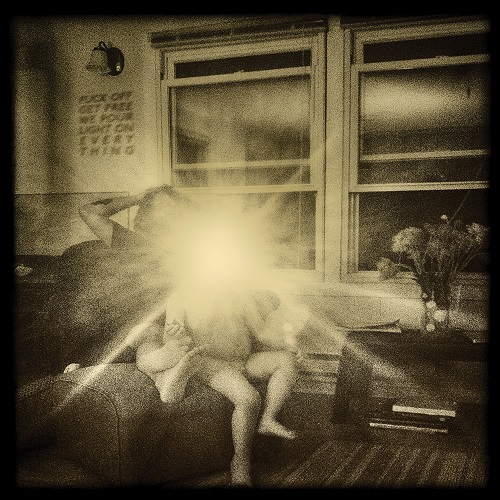
Review: Thee Silver Mt. Zion Memorial Orchestra – Fuck Off Get Free We Pour Light on Everything


I don’t normally step beyond the threshold of metal these days, but I was no stranger to post-rock in the late 90s and 2000s. It and indie were the defining musical genres of the last decade, and I gobbled them up for a time. I lost touch with ex-Godspeed You! Black Emperor legends A Silver Mt. Zion shortly after Horses in the Sky (2005), though “God Bless Our Dead Marines” was my favorite song by them until now.

I guess that wasn’t a very subtle hint of what’s to come. I picked up Efrim Menuck and company’s newest album because of its name. (Not the band name, presently on its fifth incarnation as “Thee Silver Mt. Zion Memorial Orchestra”.) Their seventh LP, released this January, is titled Fuck Off Get Free We Pour Light on Everything. That was just too delicious to pass up.

http://www.youtube.com/watch?v=WfPXY6mtq4U

Thee Silver Mt. Zion Memorial Orchestra – Fuck Off Get Free, from Fuck Off Get Free We Pour Light on Everything

I stumbled into one of the most novel and delightful sounds I had heard since, well, the days of post-rock and indie. It is in effect a merger of the two, utilizing classic GY!BE post-rock instrumentation and techniques in songs with distinctly indie structures and vibes. The opening title track sold me instantly with its warbling, almost unidentifiable instrumentation fused to a rock beat. These are sounds you would expect in some 20-minute build-up from silence, and they sound totally unique in their new environment. I suppose A Silver Mt. Zion had been heading this way for a while, but this is the first time I’ve listened to them that they’ve fully embraced the merger.

It’s not just the sounds themselves that make this song so convincing. The lyrics are paramount, infusing a crafty title with a great deal of depth and rendering the sounds relevant to the message. It shouts a pseudo-cryptic political/social statement with a keen eye we haven’t seen since the 60s and a punk rebel’s spirit, rocked back at the haters with a power to counter Ted Nugent’s whole discography. It begs the establishment and their drones to hate it. Need some harsh, gravely vocals to waggle your cock to? Sorry, voices don’t get more sissy than Efrim’s. They slam “wide white men” where a country star cries “freedom”, and the rejection of coherent grammar and sentence structure from a group totally fluent in English is an affront to the many that view their proper American English with some odd sense of pride. And it has a cuss word in the title! *gasp*

It’s a totally harmless song with a positive message, but I know a lot of people who would feel really insulted by it, and you probably know some too. I could easily see my mother showcasing this song in one of her Sunday School lessons about the corruption of youth, totally oblivious to the fact that it’s pushing her buttons on purpose. It’s what this song is all about: not letting the outdated, self-serving values of the ruling class tone down a message of peace and equality. Fuck off. Get free. We pour light on everything we see.

And how about that drop down into a stoner metal chug at 6:40? Last thing I saw coming, and I love it.

Thee Silver Mt. Zion Memorial Orchestra – What We Loved Was Not Enough, from Fuck Off Get Free We Pour Light on Everything

The album never really drops the slack the whole way through. It’s edgy, it’s angry, it’s indie in spirit, it’s eclectic as hell, and the message is great. There is really no down time at all–not something you might expect from the descendents of post-rock’s favorite son. “Take Away These Early Grave Blues” is especially intense and makes compelling use of a melody that I have to think came from some old country western film. I’m not going to go into detail on any of it; it’s hard to even begin to describe what’s going on with their odd choices of instrumentation. Suffice to say the first 34 minutes of the album pass very quickly, holding my attention all the while. It all leads to a grand finale with “What We Loved Was Not Enough”. This song is mind-blowing. With the sort of lengthy, escalating waltz common to many indie album closing tracks, the build-up is glorious and the lyrics cut deep.

This song uses a lot of excessively dramatic, over-the-top lines that remind me of The Decemberists, only A Silver Mt. Zion’s purpose is not all tongue-in-cheek fun and games. It has an apocalyptic flare, positioning the band at some breaking point where modern society crumbles in self-destruction: We can try to teach people to be open and understanding–to abandon their bigotry and love one another–but this vision will never come to pass. “What we loved was not enough. The day has come when we no longer feel. All our cities gonna burn. All our bridges gonna snap. All our pennies gonna rot. Lightning roll across our tracks. All our children gonna die. And the west will rise again.”

The band has tried their best. They pour light on everything they see. But in the end, it is up to the masses to let go of their pride and embrace a future of peace and love. Efrim knows they won’t, and he calls upon them mockingly: “So goodnight vain children. Tonight is yours. The lights are yours, if you’d just ask for more than poverty and war.”

This is an album for those of us who want to make a difference but know we can’t do shit to dent a machine that has mastered every art of cultivating people’s fears and hatreds. It’s an album to make you feel good about yourself, and to let you know you aren’t alone. I like that. “Kiss it quick and rise again.”

Fuck Off Get Free‘s only shortcoming is that they plugged a seemingly pointless four minute post-finale track after “What We Loved Was Not Enough”. I can easily forgive that.

Ten Years #19: The Shins


Decade of last.fm scrobbling countdown:
19. The Shins (1,344 plays)
Top track (75 plays): Pink Bullets, from Chutes Too Narrow (2003)
Featured track: Gone For Good, from Chutes Too Narrow

When I leave my heavy metal tunnel vision behind and consider what properly ought to be regarded as the most significant musical movement of the first decade of this century, the answer ultimately resolves to indie rock. What that means is, of course, no clear-cut, formulaic sound, any more than grunge or classic rock constitute a style. Indie rock was a particular attitude towards music–a love affair between earth and sky that saw bands fundamentally rooted to rationality float among the clouds. It is unfortunate that my last.fm charts for that era could not make room for the likes of Built to Spill, Ted Leo & the Pharmacists, and The Fiery Furnaces, but those bands that did grind their way into my top 50 represent, I think, one of the finest eras music has to offer. I wouldn’t call The Shins my favorite indie rock band–I’ll reserve that title for an entry a little nearer the top–but I do think they orbit closer the core of what indie rock stood for than any band before or since them.

James Mercer’s genius rests foremost in his lyrics. From the opening lines of Oh, Inverted World on, his ability to paint the simple, mundane concerns of life in lush metaphor–“I think I’ll go home and mull this over, before I cram it down my throat. At long last it’s crashed; its colossal mass has broken up into bits in my moat.”–has defined the indie attitude. It’s permeated with a smug wit, perpetually aware of the trite contrivances of standardized rock that it revels in. Mercer knows his lyrics are extravagant, overreaching their subject matter, and the sort of tongue-in-cheek arrogance of it all is what makes the music so delightful. You can fall in love with it and laugh at the same time.

I chose “Gone For Good” to represent The Shins in this post even though it’s stylistically a bit out of character, because I think it perfectly captures what I love about this band. The lyrics are deliciously pretentious, paired with a comically simple tune that nevertheless successfully pleads for the same pretty appeal as Mercer’s more creative melodies. And now, in an era permeated with the same lack of awareness that tortured the 1980s, it’s a relieving reminder that every dark cloud over the landscape of creative expression is followed by a bit of wit and sunlight.

Untie me, I’ve said no vows.
The train is getting way too loud.
I’ve got to leave here my girl, and get on with my lonely life.
Just leave the ring on the rail for the wheels to nullify.

Until this turn in my head,
I let you stay, and you paid no rent.
I spent twelve long months on the lam.
That’s enough sitting on the fence for the fear of breaking dams.

It took me all of a year,
to put the poison pill to your ear.
But now I stand on honest ground, on honest ground.
You want to fight for this love, but honey you cannot wrestle a dove.
Baby it’s clear.

You want to jump and dance,
But you sat on your hands and lost your only chance.
Go back to your home town, get your feet on the ground, and stop floating around.
I found a fatal flaw in the logic of love and went out of my head.
You love a sinking stone that will never elope,
So get used to the lonesome, girl you must atone some.
Don’t leave me no phone number there.

Ten Years #43: Neutral Milk Hotel


http://www.youtube.com/watch?v=h2NJ-alquqM

Decade of last.fm scrobbling countdown:
43. Neutral Milk Hotel (727 plays)
Top track (81 plays): Holland, 1945, from In the Aeroplane Over the Sea (1998)
Featured track: In the Aeroplane Over the Sea (full album)

When you listen to a really diverse and enormous catalog of music, terms like “favorite” can seem more cheap than they really are. We are bombarded, after all, with trite Rolling Stones style top 100 whatever lists for which half the entries are predetermined without any serious consideration whatsoever and the remainder are entirely arbitrary. I like to think that this Top 50 series contains sufficient factual restraints to avoid these shortcomings–that the inclusions are genuine in a manner that avoids momentary whims and degeneration to name recognition. (You won’t find any Led Zeppelin, Beatles, or Pink Floyd in this house.) But I also like to think that that the dozens–maybe hundreds–of musical entities I have described as a “favorite” here on Shattered Lens have been sufficiently qualified to bear weight. I don’t typically speak of unequivocal favorites. I point out what I like best under a well-defined set of conditions.

So read this as it stands: In the Aeroplane Over the Sea is my favorite album. At some point in the late 1990s, Jeff Mangum became possessed by some superhuman muse long enough to compose 40 minutes of poetic euphoria.

I don’t know that any prose description could fully capture the depth of this album. It is a mesh of beautiful poetic metaphors that only slowly begin to reveal themselves over dozens of listens. It does follow a loose chronology that is sufficiently cryptic to allow for multiple but similar interpretations. The album begins with a reflection on an innocent childhood and the narrator’s first sexual experience (presumably with her–or possibly his–step-brother, the “King of Carrot Flowers”) in an environment of domestic tension that they were at the time oblivious to. The scene then fades into the past like a movie, the The King Of Carrot Flowers Pts. Two And Three presenting a bizarre first-hand account of the experience of being born–some sacred moment followed by an explosion of chaos as the narrator first boldly proclaims her existence in total disregard to the good and bad around it. (Garbage bins? Dead dogs?) The title track which follows seems to hark back to the scene of the opening song from the perspective of the innocent in awe of the mysteries of life, embracing her young lover and dreamily “laughing out loud” at “how strange it is to be anything at all.” Two-Headed Boy is the first track in which the lovers start to grow up. The childish “King of Carrot Flowers” has become a metaphorical misfit, one head clinging to youth and the other being forced into the hardships of adulthood. Their physical love is expressed in passionate desperation, aware that their innocence is fleeting: “In the dark we will take off our clothes, and they’ll be placing fingers through the notches in your spine and when all is breaking everything that you can keep inside.” The narrator ultimately assures him that their innocence is eternal, lying in wait for the moment that he can overcome his recognition of the hardships of life, and then she gets up and leaves: “Two-Headed Boy, there’s no reason to grieve. The world that you need is wrapped in gold silver sleeves left beneath Christmas trees in the snow. I will take you and leave you alone, watching spirals of white softly flow over your eyelids, and all you did will wait until the point when you let go.”

At this point, an instrumental interlude marks the passage of time into the middle third of the album. A blundering plod titled The Fool, it seems to capture the cast’s development into typical adults, overcome by petty concerns and squabbles. This new stage is not immediately spelled out, however. Instead, Mangum introduces the elusive ‘voices in his head’ characters in the plot, beginning with Anne Frank and her friend or lover. Holland, 1945 rocks out in a peculiarly up-beat fashion. It seems to be narrated by a holocaust survivor reflecting on the loss of Anne. Unlike the Two-Headed Boy, the narrator here is peculiarly optimistic and remains positive even while presenting such cutting lines as “it’s so sad to see the world agree that they’d rather see their faces filled with flies, all when I wanted to keep white roses in their eyes.” Prevented by tragedy from ever experiencing a traditional passage into mundane adulthood, the narrator remains at once innocent and fully aware of one of the 20th century’s greatest atrocities. The next track is beautiful but hard to place in context. We meet the “Communist Daughter”, a woman placed in another 20th century nightmare, and the imagery is completely inverted. The ocean is filled with seaweed and the white mountain peaks are not blanketed in snow but stained with semen, while the industrial wasteland around her is beautiful–the “cars careen from the clouds”, and “the bridges burst and twist about”. Oh Comely presumably returns to the original cast, and it hits rock bottom. Narrated, I think, by the adult successor of the Two-Headed Boy, it captures an intense bitterness towards some former lover–probably not the step-sister–and towards life in general. The narrator describes Comely as having been raised by a broken family in a trailer park and blundering into one bad relationship after another in search of elusive happiness, sleeping with men who make shallow promises in order to take advantage of her: “Oh Comely, all of your friends are now letting you blow, bristling and ugly, bursting with fruits falling out from the holes of some bratty bright and bubbly friend you could need to say comforting things in your ear. But oh Comely, there isn’t such one friend that you could find here standing next to me; he’s only my enemy. I’ll crush him with everything I own. Say what you want to say and hang for your hollow ways.” The narrator goes on to reflect on his own relationship with Comely and those moments when their love felt sincere, and then the song gives way from bitterness to lament. Voices of the past speak out in the narrator’s head: Anne’s lover describes her miserable death and regrets being unable to save her, while another voice calls to his dear Goldaline, claiming to be trapped “inside some stranger’s stomach” and promising to return her to a place where “there is sun and spring and green forever”.

The album then moves on to what I would consider its third and final movement–three tracks of inspiring beauty that describe the narrator–possibly the adult King of Carrot Flowers/Two-Headed Boy–reaching that “point where you let go” described in Two-Headed Boy and abandoning his bitterness to embrace life again. Ghost is something of an awakening. The narrator realizes that the ghost of Anne lives within him with her youthful spirit intact, and with it a sort of universal, eternal innocence shared among all of us though often forgotten with age. Suddenly the optimism of Holland, 1945 makes sense. “One day a New York city baby, a girl, fell from the sky from the top of a burning apartment building fourteen stories high. When her spirit left her body, how it split the sun. I know that she will live forever. All goes on and on and on. She goes, and now she knows she’ll never be afraid to watch the morning paper blow into a hole where no one can escape.” Her spirit will never fall into that hole of adult drudgery–and the narrator can at last climb back out of it. The next track is an instrumental celebration of this. The closing track, Two-Headed Boy Pt. 2, is by far my favorite on the album. The narrator finally grasps what is important in life. He makes amends with the people who were once close to him–his misguided father, a wayward brother, perhaps a former sister-in-law–acknowledges the breaking point where the innocence of their relationships was lost, and encourages the Two-Headed Boy to appreciate the simple things in life while they last and not be bitter at their parting:

Daddy please hear this song that I sing. In your heart there’s a spark that just screams for a lover to bring a child to your chest that could lay as you sleep and love all you have left, like your boy used to be, long ago, wrapped in sheets warm and wet.

Blister please, with those wings in your spine, love to be with a brother of mine. How he’d love to find your tongue in his teeth, in a struggle to find secret songs that you keep wrapped in boxes so tight, sounding only at night as you sleep.

In my dreams you’re alive and you’re crying, as your mouth moves in mine, soft and sweet. Rings of flowers ’round your eyes, and I’ll love you for the rest of your life.

Brother see, we are one in the same. And you left with your head filled with flames, and you watched as your brains fell out through you teeth. Push the pieces in place. Make your smile sweet to see. Don’t you take this away. I’m still wanting my face on your cheek.

And when we break we’ll wait for our miracle.
God is a place where some holy spectacle lies.
When we break, we’ll wait for our miracle.
God is a place you will wait for the rest of your life.

Two-Headed Boy, she is all you could need. She will feed you tomatoes and radio wires, and retire to sheets safe and clean. But don’t hate her when she gets up to leave.

Song of the Day: Seven Devils (by Florence + The Machine)


April 1st is just right around the corner and that means the return of 2010’s breakout cable hit, Game of Thrones with a new season. The last couple weeks have seen numerous marketing and ad trailers hyping up this upcoming new season. Their latest trailer used a song that was quite memorable for how it sounded and how it fit in well with the mythology built during the first season.

The latest “Song of the Day” comes courtesy of the band Florence + The Machine and the song picked was from their latest album and is called “Seven Devils.”

I consider this song quite appropriate when it came to Game of Thrones since the song’s title takes a look at the opposite side of the show’s religion called The Seven. The song’s titles doesn’t just intimate that The Seven the people of Westeros worshipped may not be gods after all, but devils who have tempted many who pay lipservice to the faith and instead fall to temptation.

I wasn’t a major fan of Florence + The Machine when I was first introduced to them a couple years ago but time has since shown me the error of my ways.

Seven Devils

Holy water cannot help me
A thousand armies couldn’t keep me out
I don’t want your money, I don’t want your crown
See I have come to burn your kingdom down

Holy water cannot help you now
See I’ve got to burn your kingdom down
And no rivers and no lakes can put the fire out
I’m gonna raise the stakes, I’m gonna smoke you out

Seven devils all around me
Seven devils in my house
See they were there when I woke up this morning
I’ll be dead before the day is done

Seven devils all around you
Seven devils in your house
See I was dead when I woke up this morning
And I’ll be dead before the day is done
Before the day is done

And now all your love will be exorcised
And we will find you saints to be canonised
And it’s an evensong
It’s a melody
It’s a final cry
It’s a symphony

Seven devils all around me
Seven devils in my house
See they were there when I woke up this morning
And I’ll be dead before the day is done

Seven devils all around you
Seven devils in your house
See I was dead when I woke up this morning
And I’ll be dead before the day is done
Before the day is done

You can keep me alive
Till I tear the walls
Till I save your heart
And to take your soul
What have we done?
Can I be undone?
In the evil’s heart
In the evil’s soul

Seven devils all around you
Seven devils in your house
See I was dead when I woke up this morning
And I’ll be dead before the day is done
For the day is done