Lisa Reviews An Oscar Nominee: Three Coins In The Fountain (dir by Jean Negulesco)


The 1954 Best Picture nominee, Three Coins In The Fountain, tells the story of three American women living in Rome. They’re all employed by the same secretarial agency. Maria Williams (Maggie McNamara) is young and hoping that she’ll stay in Rome for at least a year and that she’ll meet her future husband. Anita Hutchins (Jean Peters) is not-so-young and is planning on returning to America so that she can meet her own future husband. Miss Frances (Dorothy McGuire) is middle-aged and has spent the last 15 years working for the man that she wishes could be her future husband.

If you’re getting the feeling that there’s not much to our leads beyond a desire to get married, you’re not wrong. However, Anita swears that it’s impossible to find a husband in Rome because the only Italians who are interested in “secretaries” are too poor to be good husbands which …. well, like I mentioned before, this film is from 1954. Just the fact that the film featured three single women living together in a foreign country was probably considered to be daring back in 1954.

The three women eventually end up at the Trevi Fountain, where Maria and Frances throw in their coins and make their wishes. Anita, however, does not toss in a coin because apparently, she’s not scared of offending God. No sooner have the three women visited the fountain than things begin to happen. Soon, all three of them are in love but each has to deal with a compliction.

Miss Frances may have finally convinced her employer, writer John Frederick Shadwell (Clifton Webb), to marry her but when he discovers that he’s terminally ill, he tries to call off the engagment.

Maria meets Prince Dino di Cessi (Louis Jourdan) but will the Prince still want to be with her after he discovers that she’s been lying about being interested in the same things that he’s interested in?

Anita falls for Giorgio (Rossano Brazzi) but he’s poor! Plus, he also works for the agency and apparently, there’s some sort of weird 1954 rule that forbids the American employees from fraternizing with the Italian employees. Is Anita willing to lose her job just so she can marry someone who doesn’t have any money?

That’s pretty much it. Other than John Shadwell wrestling with his own mortality, there’s really not a whole lot of drama to be found in Three Coins In The Fountain. This is a film about pleasant people doing pleasant things and having pleasant conversations. It’s a rather chaste romance, one of those films where you have no doubt that everyone involved will wait until marriage and that all of the women will quit their jobs and settle down as soon as the right ring gets put on their finger. In other words, this is very much a film of its time and watching it today can be bit of an odd experience. This is ultimately the type of film that works best as a travelogue. Rome looks beautiful. There’s a striking shot of the sunset reflected in the canals of Venice. The Trevi Fountain truly does look like it can grant wishes. (It’s amusing to compare the reverence that the American-made Three Coins In The Fountain shows towards The Trevi Fountain to the way that Rome-native Federico Fellini used the fountain in La Dolce Vita.) One gets the feeling that, even in 1954, people flocked to this film more to see Rome than to really worry about whether or not the Prince would eventually propose.

In fact, one of the main reasons why I watched this film tonight is because I spent one of the greatest summers of my life in Italy. I’ve been to Rome. I’ve thrown coins into the Trevi Fountain and I’ve made wishes. I loved Rome. I loved the people. I loved the culture. I loved the buildings. I loved the feeling of walking through history. I loved looking out at the horizon and feeling as if I was somehow in a living painting. (I actually went into a bit of daze when I was in Florence. Stendhal Syndrome is for real.) If you can’t find romance in Rome then you’re obviously not looking. For me, the main appeal of Three Coins In The Fountain was being able to watch it and say, “I’ve been there!” I imagine for audiences in 1954, the appeal was probably to be able to watch it and say, “I’m going to go there!”

How did this perfectly pleasant but otherwise unmemorable film end up as a best picture nominee? I imagine a lot of it had to do with the fact that the film was a box office success. It’s certainly not because it was a better film than either Rear Window or Sabrina, both of which were not nominated for Best Picture despite being nominated for Best Director. In the end, the 1954 Best Picture Oscar was won by On The Waterfront, a film that appears to be taking place in an entirely different universe than Three Coins In A Fountain.

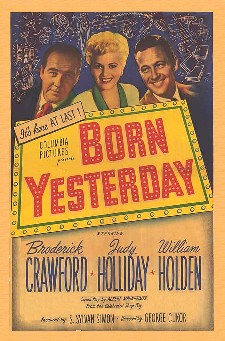
Cleaning Out The DVR: Born Yesterday (dir by George Cukor)


Born_yesterday

After I watched Goodbye, Mr. Chips, I decided to watch one more film that I had recorded off of TCM.  The movie I chose was Born Yesterday.

This 1950 film was directed by George Cukor and stars three Academy Award winners.  The lead actor was William Holden, who would win best actor three years after the release of Born Yesterday.  The villain was played Broderick Crawford, just a year after playing his Oscar-winning role in All The King’s Men.  Finally, the true star of the film was Judy Holliday, recreating her Broadway role of “dumb intelligent blonde” Billie Dawn.  For playing Billie, Holliday would win the award for best actress of the year.

In Born Yesterday, Billie is the girlfriend of Harry Brock (Broderick Crawford).  The crude and not particularly intelligent Harry has made a fortune as a “junkman” and, though the film never comes out and explicitly says so, it is suggested that Harry may have ties to the Mafia.  Harry has come to Washington, convinced that he can buy his way into political power.  Harry’s lawyer (Howard St. John) suggests that Harry should marry Billie, specifically because a wife cannot be compelled to testify against her husband.

However, there’s a problem.  Billie is uneducated and lacks formal manners.  Of course, Harry is even worse but then again, Harry is a rich white guy and, therefore, he doesn’t have to be polite or know what he’s talking about  After Billie embarrasses him during a meeting with a congressman, Harry hires journalist Paul Verrall (William Holden) to teach Billie how to fit in with Washington society.  At first, Paul refuses but, ultimately, he takes the job because he needs the money.

As Paul teaches Billie, it quickly becomes apparent that Billie is not as dumb as everyone assumes.  In fact, she has an insatiable desire to learn.  When Paul takes her on a tour of Washington, Billie is excited to learn the story behind every monument and to take a look at every historical artifact.  (When Paul shows her the bill of rights, Billie immediately reads the 2nd Amendment and gets Paul to explain it to her.  As Paul explained that it meant that citizens had the right to bear arms, my sister walked through the room and said, “You got that right.”)  Judy Holliday perfectly captures Billie’s excitement as, for the first time in her life, she’s actually treated like someone with a brain.

Billie also starts to fall in love with Paul.  After reading one of Paul’s articles, an obviously impressed Billie tells him, “I think it’s the best thing I ever read.  I didn’t understand a word.”  At the same time, Paul starts to fall for Billie.

Meanwhile, Harry is not falling for anyone but himself.  He continues to bribe congressmen but now, Billie not only realizes what Harry is doing but also understands that it’s illegal and goes against everything that the authors of the Constitution envisioned.  After a rather nasty scene in which she is repeatedly slapped by Harry, Billie goes down to the Lincoln Memorial, hears the voice of old Abe himself, and is finally ready to stand up for herself, for Paul, and for the American way of life.

(“When you steal from the government, you steal from yourself, you dumb ox!” she yells at Harry.)

Born Yesterday was based on a stage play and, with the exception of the scenes where Paul and Billie explore D.C., the entire film takes place in Harry’s hotel suite.  The film never quite escapes its theatrical origins.  Broderick Crawford bellows his lines out to the last row and William Holden feels miscast.  (That same year, he gave a far more interesting performance in Sunset Boulevard.)

But ultimately, Born Yesterday is mostly designed to showcase Judy Holliday as Billie Dawn.  When the film first started, I have to admit that I had my doubts about Holliday’s performance.  Her character was so stereotypically ditzy and spoke in such a nasal whine of a voice that I found myself wishing that the film had been made with either Marilyn Monroe or even Jayne Mansfield in the Billie Dawn role.  But, as the film progresses, I started to better appreciate Holliday’s performance.  I started to notice the sadness and the insecurity lurking underneath the surface.  I discovered that there was unexpected nuance to both the character and the performance.  By the time she was running through the National Archives and asking Paul questions about George Washington, she had totally won me over.

Still, Holliday’s victory for best actress does seem a little strange.  After all, to win the Oscar, Holliday defeated All About Eve‘s Bette Davis and Anne Baxter and Sunset Boulevard‘s Gloria Swanson.  Holliday’s performance definitely deserved a nomination but it’s a bit more difficult to argue that it deserved the Oscar.  Of course, Davis and Baxter played two tough and sarcastic divas, neither one of whom depended on a man for their success.  Swanson, meanwhile, played an older woman who ends up murdering her much younger lover.  Billie, meanwhile, is never without a girlfriend and doesn’t murder anyone.  Perhaps it’s understandable that certain Academy voters would be more comfortable with Billie Dawn than they would with Norma Desmond or Margo Channing.

Born Yesterday was also nominated for best picture but it lost to All About Eve.