April True Crime: Our Guys by Bernard Lefkowitz and Our Guys (dir by Guy Ferland)


If there’s any true crime book that I recommend without hesitation, it’s Our Guys by Bernard Lefkowitz.

First published in 1997, Our Guys deals with a terrible crime that occurred in the leafy suburban community of Glen Ridge, New Jersey.  In 1989, it was an affluent community that loved its high school football team and where conformity and financial success were the most valued qualities the someone could have.  On March 1st, a 17 year-old girl was invited to a house party where, after she was convinced to head down to the basement, she was raped with a broomstick and a baseball bat by several members of the football team.  The girl was intellectually disabled and was later determined to have an IQ of 64.  Her name has never been revealed to the public.  In his book, Lefkowitz assigned her the pseudonym of Leslie Faber.

The crime was terrible.  So was the aftermath.  When one of the witnesses went to a teacher with what he saw happen in the basement, the town responded by rallying around the accused.  Initially, Leslie was accused of lying.  Then, as it became clear that something actually had happened in that basement, Leslie was accused of bringing it on herself.  Leslie, who was desperate to have friends and who was later determined to be psychologically incapable of saying “no” or even understanding what consent meant, was cast as a wanton seductress who led the members of the football team astray.  A girl who went to school with Leslie even tape recorded a conversation with Leslie in which Leslie was manipulated into saying that she had made the entire thing up.  It also undoubtedly didn’t help that some of the accused boys had fathers who were on Glen Ridge’s police force.

It’s a book that will leave you outraged.  Lefkowitz not only examined the crime itself but also the culture of the town and its general attitude that “boys will be boys.”  Despite the fact that they had a losing record and the fact that one of them was infamous for exposing himself every chance that he got, the football team was viewed as being made up as winners.  They were allowed to party every weekend with their parties becoming so legendary that they bragged about them in their yearbook quotes.  With a group of supportive girlfriends doing their homework for them, the football team was free to do whatever they wanted and, by the time they were seniors, they were infamous for being voyeurs.  While one football player would have sex, all the others would hide in a closet and watch.  When one of the football players stole $600 from one of his classmates, his father paid back the money and no one was ever punished.  In a town that valued material success above all else and viewed being different as a sign of weakness, Leslie and her family were treated as being outcasts.  In the end, three of the football players were sentenced to prison.  One was sentenced to probation.  A few others accepted plea deals and had their arrests expunged from the record.  Years later, one of the guys who was in the basement but not charged would murder his wife while home on leave from the military.
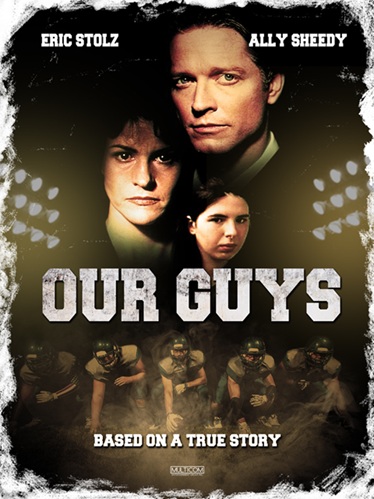
In 1999, Our Guys was adapted into a made-for-television movie.  Featuring Heather Matarazzo as Leslie, Ally Sheedy as the detective who investigated her rape, Eric Stoltz as the lawyer who prosecuted the case, and Lochlyn Munro as a cop who starts out on the side of the football team before realizing the truth, Our Guys simplifies the story a bit.  While the book focused on Glen Ridge and the culture of celebrating winners no matter what, the film focuses on Sheedy as the detective and her disgust with the suburbs in general.  Unfortunately, by not focusing on the culture of the town, the film presents the rape as being the bad actions of a group of dumb jocks as opposed to an expression of Glen Ridge’s contempt for anyone who was viewed as being on the outside.  What Lefkowitz showed through a precise examination of the town and its citizens, the film quickly dispenses by having Stoltz and Sheedy make a few pithy comments about how much the town loves it football team.  The story will still leave you outraged and Heather Matarazzo gives a heart-breaking performance as Leslie.  But, for those wanting the full story of  not only what happened in Glen Ridge but also how it happened, the book is the place to find it.
Back to School Part II #30: Welcome to the Dollhouse (dir by Todd Solondz)


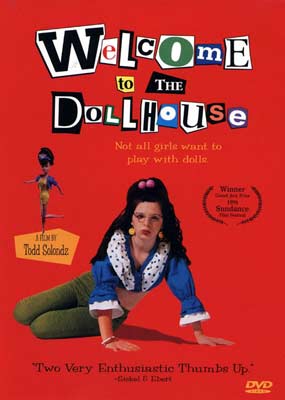
wdollhousemovieposter

1995’s Welcome to The Dollhouse is a seriously dark movie.

That really shouldn’t be too surprising.  The film was written and directed by Todd Solondz, a filmmaker who goes out of his way to showcase the darkest corners of human existence.  For that matter, the film stars Heather Matarazzo.  Matarazzo won an Independent Spirit Award for playing Dawn Wiener, a 12 year-old outcast who is nicknamed “Wiener Dog” and essentially spends Welcome to the Dollhouse being tormented by almost everyone in her life.  According to Wikipedia, upon winning the award, Matarzzo announced that she hoped to spend her career playing characters “whom are ostracized for some reason.”

And, if nothing else, Dawn is certainly ostracized.

There’s been a lot of movies that have claimed to be about teen outcasts.  Whenever you watch those films, one thing you immediately notice is that the “outcasts” rarely seem to truly be outcasts.  Instead, they’re often portrayed as artistic types who just need to take off their glasses, let down their hair, and go on a shopping spree.  For instance, Rachael Leigh Cook was an outcast in She’s All That but it turned out that all she needed to do was go out on a date with Freddie Prinze, Jr.  Sissy Spacek, Chloe Grace Moretz, and Emily Bergl all played outcasts in different versions of Carrie but, fortunately, they could always use their psychic powers to kill all the bullies at their school.  Unfortunately, Dawn doesn’t have psychic powers and it’s doubtful that even dating Freddie Prinze, Jr. would help her out.

There’s a scene in Welcome to The Dollhouse in which Dawn witnesses a group of bullies shoving another outcast into a locker.  When Dawn steps forward to ask him if he’s okay, her fellow outcast snaps, “Leave me alone, Weiner Dog!” and then runs off.  Dawn is the outcast that even the other outcasts make fun of.

The entire film is pretty much told from her point of view.  It’s a true journey into the life of an outcast and a chance to see what life looks like when you’re on the outside looking in.  We watch as her family ignores her and instead lavishes their attention on her bratty younger sister, Missy (Daria Kalinina).  When Missy is briefly kidnapped (largely because Dawn neglected to let Missy know that their mother wouldn’t be able to pick her up after ballet class), Dawn even goes, by herself, to New York City and searches for her.  Dawn wants to be the hero of this story but not only does she not find her sister but, when Dawn returns, she discovers that no one even noticed that she was gone.

Dawn does have two friends.  One is a fifth grader whose friendship she quickly loses.  The other is Brandon (Brendon Sexton III), an angry delinquent who, before becoming her friend, tries to rape her.  Brandon, who has a horrific and abusive home life, lights a joint at one point.  Dawn tells him that she doesn’t smoke but then earnestly adds that she does think marijuana should be legal.

Dawn does have an older brother named Mark (Matthew Faber).  Mark is as nerdy as his sister but he appears to have made peace with it.  (Either that or he’s so used to being on the outside that he doesn’t even notice anymore.)  Mark assures Dawn that things will get better but it’ll be a few years.  He also starts a band, which leads to Dawn getting a huge crush on the lead singer, Steve (Eric Mabius).  In fact, Steve is so handsome and charismatic (in a teenage rock star wannabe sort of way) that Dawn doesn’t even realize that, during the rare times that he does talk to her, he’s actually talking down to her…

Welcome to the Dollhouse is one of those films that you watch and you keep waiting for that one moment that Dawn is going to be allowed some sort of victory.  You wait for her to get a compliment.  You wait for her to make a new friend.  You wait for her to smile after coming to some sort of sudden realization.  And it never happens.  If anything, Dawn is more miserable at the end of the movie than she was at the beginning.

In the end, you realize that her only triumph comes from the fact that she’s managed to survive and she now has a better understanding of just how much life is going to suck.  It’s not exactly a happy movie.  It gets even worse if you know that Solondz’s 2004 film, Palindromes, opens with Dawn’s funeral.  (Dawn, we learn, committed suicide after getting pregnant in college.)

And yet, Welcome to the Dollhouse remains compulsively watchable.  Heather Matarazzo does such a good job as Dawn that you find yourself rewatching and hoping things turn out differently.  Whenever I watch Welcome to the Dollhouse, I always think to myself that I would have been nice to Dawn if I had known her.  Of course, that’s probably not true.  No one was nice to Dawn in the movie and no one would probably be nice to her in real life.  At the best, if I had gone to school with Dawn Weiner, I probably would have just patted myself on the back for not being mean to her face.

What sets Welcome to the Dollhouse apart from other teen films is that Todd Solondz is willing to admit this.

http://www.youtube.com/watch?v=JhXGDDN4PMI


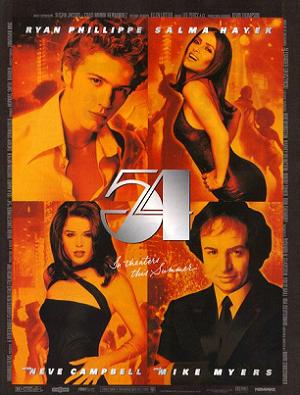
Embracing the Melodrama Part II #95: 54 (dir by Mark Christopher)


54_poster

“A guy named Steve Rubell had a dream: To throw the best damned party the world had ever seen and to make it last forever. He built a world where fantasy was put up as reality and where an 80-year-old disco queen could dance till dawn. Where models mingled with mechanics, plumbers danced with princes. It was a place where all labels were left behind. A place where there were no rules.”

— Shane O’Shea (Ryan Phillippe) in 54 (1998)

So, did you actually read that quote at the beginning of the review?  I don’t blame if you didn’t because not only is it ludicrous overwritten but it just goes on and on.  It’s one of those quotes that you read in a script and you think to yourself, “They better get absolutely the best actor in the world to deliver these lines,” and then you realize Ryan Phillippe has been cast in the role.

Except, of course, I doubt that any of those lines were found in the original script for 54.  54 is one of those films where, as you watch it, you can literally imagine the chaos that must have been going on during the editing process.  Subplots are raised and then dropped and the mysteriously pop up again.  Characters change both their personalities and their motives in between scenes.  Huge dramatic moment happen almost at random but don’t seem to actually have anything to do with anything else happening in the film.

In short, 54 is a mess but it’s a mess that’s held together by incredibly clunky narration.  Shane O’Shea, who spent the waning days of the 1970s working at Studio 54, narrates the film.  And, despite the fact that Shane is presented as being kinda dumb (think of Saturday Night Fever‘s Tony Manero, without the sexy dance moves), his narration is extremely verbose and reflective. It’s almost as if the narration was written at the last-minute by someone desperately trying to save a collapsing film.

I watched 54 on cable because I saw that it was about the 70s and I figured it would feature a lot of outrageous costumes, danceable music, and cocaine-fueled melodrama.  And it turns out that I was right about the cocaine-fueled melodrama but still, 54 is no Boogie Nights.  It’s not even Bright Lights, Big City.

54 does have an interesting cast, which makes it all the more unfortunate that nobody really gets to do anything interesting.  Poor Ryan Phillippe looks totally lost and, in the film’s worst scene, he actually has to stand in the middle of a dance floor and, after the death of elderly Disco Dottie (that’s the character’s name!), yell at all the decadent club goers.  Breckin Meyer is cute as Phillippe’s co-worker and Salma Hayek gets to sing.  Neve Campbell plays a soap opera actress who Phillippe has a crush on and…oh, who cares?  Seriously, writing about this film is almost as annoying as watching it.

Mike Myers — yes, that Mike Myers — plays the owner of the club, Steve Rubell.  The role means that Myers gets to snort cocaine, hit on Breckin Meyer, and vomit on the silk sheets of his bed.  I think that Myers gives a good performance but I’m not really sure.  It could have just been the shock of seeing Mike Myers snorting cocaine, hitting on Breckin Meyer, and vomiting on the silk sheets of his bed.

If you want to enjoy some 70s decadence, avoid 54 and rewatch either Boogie Nights or American Hustle.