Thousand Years of Dreams Day 23: The Ranking of Lives


Time to begin the third and final leg of this 33-day marathon and to usher this in will be the dream-memory simply titled, “The Ranking of Lives”.

It’s actually quite a coincidence that a dream-memory about a particularly virulent plague Kaim lived through in the past will come up the night before the release of the Steven Soderbergh film about a similar topic in his latest film, Contagion. The title of the memory Kaim remembers is also quite timely in that it brings to the mind my own country’s struggle on the idea of affordable health care for everyone. It’s a topic that has split the country between those who thinks this should be a necessity for everyone and those who think the government shouldn’t get involved in forcing such a plan to everyone whether they want it or not.

I try to remain silent about this topic when it comes up and will continue to do so here. I will say that the idea of ranking people’s lives in importance to the group, nation or state is an idea whose logic I do understand, but also one that is difficult for me to accept as a human being. It brings to mind the nature of the battlefield triage. In time of battle many soldiers and civilians will be wounded. It’s the level of their woulds which determines whether they get immediate treatment or pushed back to allow someone who needs the help more. Battlefield triage is a concept I do think takes the “ranking of lives” in a more humane fashion. Doctors and medics only look at the extent and level of the injuries. The patient’s standing in society both in the military and as a civilian don’t matter as much as whether the patient’s injuries need immediate attention. If their injuries are life-threatening, but can be mended then they go ahead of the line. If their injuries is not life-threatening then they wait.

Now, some will ask about those who are dying and whether they also get immediate help. It’s here that physicians must always make the toughest decisions. Do they take precious time and resources to try and save someone who is beyond saving or do they just help ease the pain and allow them to move on in relative peace? It’s a decision that not anyone can make and, for most of us, it’s something we’re glad we never have to make.

This type of “ranking lives” I can understand and accept, but it is still something that shouldn’t be easy to deal with.

The Ranking of Lives

A terrible epidemic is ravaging the kingdom.

The onset of the disease is sudden. Due to genetic or perhaps hormonal factors. It strikes only males. The victim experiences a high fever, a violent headache, and often a swift death.

The disease does have two hopeful aspects.

First of all, if an individual survives it, he need not fear catching it again: from then on he has immunity.

Secondly, an extremely effective medicine exists. If used preventatively or in the initial stages of the disease, the drug, a tablet made primarily from a plant that grows in the mountains, almost always results in a cure.

Does this mean people can relax, and that there is no need to worry?

Unfortunately not, for an ironic twist of fate is something that life tends to thrust upon people all too often.

The high-altitude plant used to make the medicine that is so effective in prevention and early cure is extremely rare, verging on extinction.

In other words, there is not enough medicine for all the kingdom’s subjects, only for certain people.

“Do you see what I mean?” asks Dok, a quiet man on patrol in the capital’s marketplace with his fellow military policeman, Kaim.

Sending his sharp gaze down one alley after another, Kaim responds “You’re saying they rank people to decide who gets the medicine?”

“Exactly,” says Dok.

“In deciding the rank order, they brand us as either ‘Subjects Indispensable to the Nation’ or ‘Other Subjects’.”

Capital military policemen will receive their medicine relatively early, which demonstrates their ranking as “Subjects Indispensable to the Nation.”

“I guess it makes sense,” Dok goes on, “If all of us were to keel over, order in capital would break down like nothing. We always have to be the picture of health as we patrol the city, right Kaim? ‘For the sake of the homeland,’ as they say.”

“I suppose so . . .”

“First the royal family gets the medicine. Then the royal guards. Third comes politicians, and then the financiers who run the country’s economy, the police and fireman, doctors, and finally us-the capital military police. There’s not enough to give it to just anybody.”

Dok all but spat out those final words, and asks, “What do you think, Kaim? Ordinary subjects are people, too. Is it okay to ‘rank’ them like that?”

In theory, Kaim should be able to reply without hesitation that of course it is not okay.

But, realistically speaking, he says, “There’s no way around it.” He averts his gaze from Dok’s as he hear himself saying these words.

“No way around it huh?” he mutters with obvious distaste.

“Maybe you’re right. Maybe there is no way around it.”

He sounds as if he is trying to convince himself, in fact it does seem to be the only means open to them.

“The folks here in the marketplace know about the disease, obviously.”

“Obviously.” answers Dok.

“If their fears get the better of them, they could riot at any time.”

“Absolutely.”

“We can just manage to keep the peace by patrolling the streets like this.”

“I know what you mean.”

“If we were to succumb to the disease, their lives would put them more at risk. If we can’t dose every subject in the kingdom, all we can do is think about how best to keep the harm or the impact of the disease to an absolute minimum.”

“I couldn’t have said it better myself Kaim. You get a perfect score. Good job!”

His words of praise carry obvious barbs.

Sensing their presence, Kaim falls silent. Underlying Dok’s sharp comments is not only the pain of biting saracasm but the sorrow of helplessness.

Two children, a boy and a younger girl, run past the men, laughing. Dressed in rags, they have probably come from the slum behind the market to gather scraps of vegetables little better than garbage.

Dok points to their receding forms and says,

“I’d like to ask you a question, Kaim.”

“All right . . .”

“Are those kids ‘Subjects Indispensable to the Nation?”

Kaim has no answer for him. Because he knows the right answer all too well, he can only lapse into silence.

Responding to Kaim’s silence with a bitter smile, Dok goes on,

“According to your logic, Kaim, if those kids fall sick and die. “There’s no way around it.’ Or at least capital police like us have a greater right to the medicine than those kids do. Am I right, Kaim? Isn’t that what you’re saying?”

Kaim could hardly declare that he was wrong.

Responding again to Kaim’s silence, Dok asks,

“Now don’t misunderstand me. I’m not attacking you. It’s just that everybody is indispensable to somebody. Even those kids. They may be just a nuisance to the state-poor beggars, but to their parents they are indispensable lives that must be protected at all cost. Am I wrong?”

What a kindhearted fellow, Kaim thinks, maybe too kind – to a degree that could prove fatal for a soldier.

From the direction of the castle comes the sound of the great bell – an emergency assembly signal to the soldiers patrolling the streets.

The medicine seems to have arrived for them.

“Let’s head back,” Dok pipes up, apparently emerging from his gloom,

“Let’s be good boys and take the miraculous medicine that’s going to save our lives and protect the kingdom.”

The sorrow-filled thorns sprouting form his words pierce Kaim through the heart.

It is the following day when Dok tells Kaim of his plan to desert.

“I’m only telling this to you Kaim,” he says when they are patrolling the marketplace again.

“I know the punishment for desertion is harsh. I’m not sure I can make it all the way, and if I’m caught, I know I’ll be court-martialed and executed.”

He has resigned himself to that possibility, he says, which is why he wants to make sure that Kaim knows the purpose of his desertion.

“I’m not betraying the country or the army. I just have to deliver . . . this.”

In his open palm lies the tablet that he was issued the day before.

“You didn’t take it?” Kaim asks, shocked.

“No, I fooled them,” he chuckles, immediately turning serious again and closing his open hand.

“You’re going to deliver this tablet?”

“Uh-huh.”

Dok holds out his hand now, pointing toward the mountains south of the capital.

“At the foot of those mountains is the village where I was born. My wife and son are there. He’s just five years old and he’s been sickly since the day he was born. If he gets the disease. It’s all over for him.”

“So you’re going to give him the medicine?”

“Do you think it’s wrong of me to do that?”

Transfixed by Dok’s stare, Kaim is at a loss for words.

Suddenly the gentle Dok’s eyes betray a murderous gleam.

“I may be a soldier dedicated to protecting the nation, but before that I am the father of a son, and before that I am a human being.

I don’t give a damn about the kingdom’s ranking of lives according to whether or not they are ‘indispensable.’

I want to save the life of one human being who is indispensable to me.”

Dok’s eyes take on added strength. They are bloodshot now, dear proof of his resolve.

“If I leave now, I can be back in the barracks by roll call tomorrow morning. I’ll come home as soon as I give him the medicine, so I’m asking you to do me this one favor: don’t cause any commotion until then.”

“No, of course not, but . . .”

“I’m not sure I can make it, but I am sure my boy will die if I just stay here. He’ll pull through if he has the medicine. If there’s even the slightest possibility of that. I have no choice: I have to take a chance.”

“They’ll kill you if they catch you.”

“I don’t care. I can die with pride, knowing I did it to save the life of the one person most important to me.”

“What if you get sick?”

“All I can do is leave it up to fate.”

Dok smiles.

Human beings can’t do anything about fate, but I want to do everything I can as a human being.”

This is why Dok has revealed his plans to Kaim.

“One more thing, Kaim. If they kill me or if I get sick and die. I hope I can depend on you to visit my village sometime and tell my wife and son what happened.

Make sure they know that I didn’t desert because I got fed up with the army. I did it to save my son’s life, which is something that is more more important to me than army rules and even more important than my own life.”

He will be satisfied as long as that message gets through, he says with a smile. Kaim has no way to reply to this.

Not that Kaim fully accepts everything Dok has said to him. He is convinced not so much by the man’s reasoning as he is overwhelmed by something that transcends reasoning: by the power of life, by the strength and depth of Dok’s desire to save a life precisely because it is something that will eventually be cut off by death.

“I’m going to make a run for it for it while we’re patrolling the marketplace. I’m asking you to look the other way. Tell them I dissappeared when you took your eyes off me for a split second.”

Kaim can do nothing but accept Dok’s plea in silence.

He sees that deep in the hearts of those who love, finite life is a place that cannot be entered by those who have been burdened irrevocably with life everlasting.

The two men reach the far end of the marketplace.

“All right then, sorry to put you through this . . .” Dok says.

He turns toward the exit and is about to plunge into the crowd when it happens.

A child comes bounding out the alleyway.

It is the same shabbily dressed girl from the slums who ran past the men yesterday, laughing. Today she is alone and crying her head off.

She looks around with wild eyes, and when she spots Kiam and Dok in uniform, she comes running to them, shouting. “Help! Help!”

“What’s the matter?” Doks asks.

She takes his hand and leads him into the alleyway as if to prevent the surronding people from hearing what she is about to tell him.

“It’s my brother!” she blurts out. “He’s sick ! He’s got a high fever and he’s shaking all over! We’ve got to do something or he’s going to die!”

Kaim and Dok look at each other.

“How about your parents? Don’t you have a father or mother to take care of him?” Kaim asks.

“What parents?” the girl retorts tearfully.

“They both died a long time ago. There’s just me and my big brother. Oh please help him, please!”

“But I was just . . .” Dok mutters, fidgeting, ready to run. He looks at Kaim with pleading eyes.

Kaim kneels and down and looks the girl straight in the eye. “When did his fever start?” he asks.

“Just a few minutes ago,” she says.

“We were leaving to pick up vegetable scraps, and he fell down . . .”

Only a little time has passed since the disease struck. He could be saved by the medicine.

But of course there is no medicine for slum children.

Judging from the girl’s wasted frame, her brother must also be eating poorly. The disease will almost surely ravage his malnourished body and snatch his life in a matter of hours.

The girl will not come down with the disease of course, but even if it cannot attack her directly, once she has lost the only other member of her family and has no one to take care of her, the tiny thing is bound to trace the same fatal path as her parents and brother sooner or later.

“Please help my brother . . . please!”

She clings to Kiam and Dok, huge tears streaming down her cheeks.

Kaim gives her a slight, silent nod. He rises slowly and reaches for a small leather pouch dangling from his sword hilt.

Before he can lay hold of it, he hears saying to the little girl.

“Don’t worry.”

Dok is holding out his hand to her, smiling gently.

In the palm of his hand is a tablet.

“Give this to your brother.” Dok says. “There’s still time to save to save him.”

The girl gives him a puzzled look and hesitates until he urges her.

“Hurry. Do it now!’

She reaches for it uncertainly and takes it in hand with great care.

“Hurry home, now!”

Dok says witha smile for her. the girl dashes off.

“Thank you! Thank you! Thank you!”

Her shrill, tearful voice rings out as she dissappears into the alleyway.

“I’m glad it worked out like this, Kaim.”

Dok says with a shrug and a pained smile. “So now I won’t be branded a deserter, and I won’t have to give you anything to worry about. No, this is a good thing.”

He sounds as if he is trying to convince himself. He even nods deeply in agreement.

Surely he cannot have done this without regrets, especially if his son at home should take sick and die.

His voice is calm, however, as he says. “I couldn’t help it. When I saw that little girl crying like that . . . I know my son would understand.” He gives himself another deep nod.

“Still, Dok . . .”

“Never mind. Don’t say a thing.” Dok cuts him off and squints towards the alleyway the girl ran down.

“There’s absolutely no rank order to lives. The only thing that matters is to save a life you see with your own two eyes.”

“I know what you mean.” says Kiam

“Just because I saved one slum kid’s life, there’s no guarantee he’ll grow up to be a credit to the nation.

Maybe all I succeeded in doing was prolonging the life of yet another drag on the state. Maybe after I get back to the barracks. I’ll start thinking of other people I should have save instead of him.”

“On the other hand, Kaim.” he says, interrupting himself and turning to look at Kaim as he considers yet another posssibility:

“On the other hand, I look at it this way, too. Maybe it is just a matter of innate human instinct to want to save the life before your eyes.

Maybe we learn those other kinds of ranking later: ‘for the nation,’ or ‘for the people, ‘ or even ‘for my son.’

I may have failed as a soldier or as a father. but I think I did the right thing as a human being.”

Dok stops himself there and starts walking without waiting for Kaim to reply. He might be trying to hide his embarrassment at his own tortured reasoning.

Seeing this, Kiam produces a laugh and calls out to to Dok as casually as if he were suggesting they go to the tavern for drinks.

“Hey Dok!”

“Uh-huh?”

“You forgot this!”

Now Kaim finishes what he interrupted before, reaching for the leather pouch tied to his sword hilt.

From it he takes a small pill.

“What? You mean . . .?”

“I didn’t take it either.”

Incapable of losing his life to a disease. Kaim has no use for the medicine to begin with.

Of course he has no intention of telling Dok about that. Even if he were to try telling him he had lived a thousand years, it is not likely that Dok would take him seriously.

“You have a family, Dok. Lives you’d give anything to protect.

That is a great thing.”

Now Kaim holds out a hand with a tablet in it the way Dok did earlier to the girl.

“I envy you,” he says with a smile.

“Wait, Kaim, wait . . . Hey, I mean you . . .”

“I don’t have a family,” he says, increasing the depth of his smile.

Responding to Kaim’s smile, with it’s mixture of sympathy and warmth. Dok silently accepts the tablet.

“Well now, would you look at that beautiful blue sky!” says Kaim.

“I think I’ll just stand here a while, looking up at it, not thinking about anything at all. This might be a good time for you to run home to your son.”

Kaim does as he says, looking up at the sky.

Before long, he hears the sound of footsteps running across stone pavement.

“Make sure you come back alive Dok,” Kiam mutters.

Kaim strolls along, looking up at the blue sky, until he dissappears into the marketplace crowd.

End
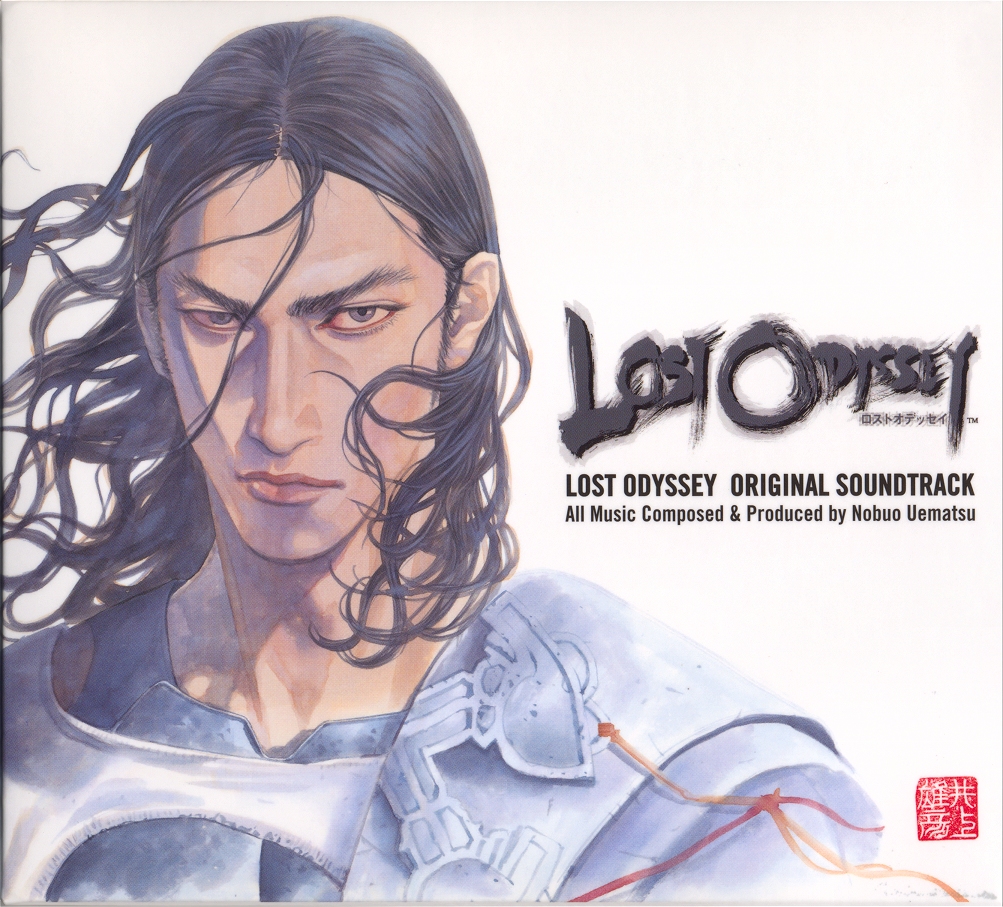
Song of the Day: Small Recollections (by Uematsu Nobuo from Lost Odyssey)


We’re now two-thirds into the 33-day Shigematsu Kiyoshi short story marathon and for the last third I decided to kick it off with my third favorite track from the Lost Odyssey soundtrack. The latest “Song of the Day” is the simple and playful tune “Small Recollections”.

This track gets used a lot in the game’s collected dream-memories. It’s usually used in concert with other music when the dream involves children Kaim has met through his 1000-year and more journey as the eternal warrior. I like this song for it’s simplicity. It’s a solo piece done on a calliope and made to sound like it’s coming from a child’s music box. It’s really quite a great use of this instrument and one I’ve rarely heard used in a soundtrack for a film or game.

It’s hard not to listen to this song and not think of the simpler times when one was a kid and the biggest worry in our mind’s was whether we’d get to eat ice cream, cake or both at a birthday party. “Small Recollections” is definitely something one can hear at a fair or a carnival and always something that would make one smile like a kid again.

Thousand Years of Dreams Day 21: Seth’s Dream Part 2


Day 21 brings us the second part of “Seth’s Dream” and while this particular dream-memory has more to do with unlocking part of the mystery that is the immortal fate of Seth and Kaim it still continues the theme and subject of prisons of solitudes we make for ourselves began with Part 1.

This remembered dream by Seth works best when paired with playing the game. Of all the 33 dreams created for Lost Odyssey these two remain the weakest in terms of emotional impact just for the fact that they’re more game plot related than stand-alones.

Seth’s Dream Part 2

I know you probably hate me now Aneira.

Or perhaps, as the descendant of the noble white-winged clan, you harbour no such vulgar emotion as hatred.

Kind and gentle as you are, perhaps you have forgiven me. Perhaps you have accepted what I did, and now you pity me for being trapped in the prison of solitude again.

But still, good, kind Aneira, I insist on making one last, selfish request:

Please hate me.

Please hate me for eternity.

If I know that you hate me, I can remain connected to you.

If I know that you have not forgiven me, the pain of that will enable me to feel you close to me.

Are you laughing at my convoluted reasoning?

Then let me say it more simply.

I am lonely.

I fear eternal solitude.

That fear has been with me ever since I killed you with my own two hands…

Nine hundred years have passed since we first met.

In the conventional way, I took a husband. Even more conventionally, I gave birth to a son.

Soon after naming the baby “Sed”, my husband died in an epidemic. At his bedside, of course, I cursed the fate that would not let me die.

Had you not been with me, Aneira, I would never have been able to find the strength to raise Sed by myself.

You said to me, “There is no greater joy than for a child to be born and to grow up healthy.”

Fitting words from you, sole survivor of the winged clan!

You also said to me, “You will be all right, Seth. You are no longer alone. Now you have Sed. You will never be alone as long as he is with you.”

I nodded to you in tearful recognition of the truth of your words, and you went on with some embarrassment:

“Leave Sed to me, I will train him to be a full-fledged man of the sea. If anyone should dare to threaten him, I will protect him with my life.”

How kind you were, Aneira!

How truly kind!

Even now I can recall the carefree smile on your face when you were playing with Sed.

He was such a frail little boy, but you steeled your heart to train him sternly, and on those days when he had cried himself to sleep, I often caught you in profile, watching him in sleep, your face sutured with ineffable gentleness.

How glad I am, Aneira, that fate brought us together!

In my long, long, endlessly long life, I can declare without hesitation that you were my finest companion.

So why, Aneira, did events play out the way they did?

To this day, I have no idea why.

Do you know?

Did you know why those things were happening to you?

This is what I would like to know.

All the more so because I can no longer learn the answer. I desperately want to know it

It happened thirty years ago.

I said goodbye to you and Sed, and made my way to the Tower of Mirrors.

For the memory had come back to me: the mission on which I had come to this world; The task I had been sent here to accomplish and the reason I possessed: memories of a thousand years spent in this world.

I was a pirate who prized freedom above all. And what I enjoyed most of all was living widely on open sea. Exactly why I was so drawth to freedom, I myself did not know.

But, that was when I learned: deep in the heart of one who desire freedom lays the pain of freedom denied.

It was you, Aneira, who first taught me the expression “prison of solitude”.

And it was true: I was trapped in a prison of solitude.

Not simply, however, because I was confined in a cave on a desert island. For me, being in this world was itself a prison of solitude.

When I came to realize this, I headed for the Tower of Mirrors in order to return to the world I had come from.

Nourished by my thousand years of memories…memories of having lived in this world…I would return to the world where I belonged.

In the Tower of Mirrors, he was waiting…Gongora, the man with who I was supposed to return to my original world.

I had no way to knowing, however, that this was a trap that Gongora had set for me.

I can never forget how he stood there, spread legged and defiant, before the Tower of Mirrors, laughing that arrogant laugh of his. My stomach turns when I recoil his hateful face, and my flesh creeps when I think of his cunning, fearsome trap.

Gongora had no intention of returning to our former world. Instead, he hatched a fiendish plot to make himself ruler of this world, and anyone who resisted him, he crushed without mercy.

I was one of those who stood in his way.

As soon I learned of his evil design, I flew back to my pirate ship.

Of course, such a monster could not be satisfied with merely waiting for me there.

Knowing him…

I felt a terrible foreboding.

“Sed! Aneira!” I screamed as I leaped into the ship.

In the next second, I was with a gasp that my foreboding had been correct.

Both Sed and you where there, Aneira, on the deck.

Sed lay bleeding.

And you

When you became aware of me and slowly turned in my direction, you had a strange gleam in you eyes.

And there was something in your mouth.

I was Sed’s leg. You had ripped it from his body.

All sound faded.

Sed lay there in a sea of blood, his leg torn off, trying to cry out to me.

I couldn’t hear a thing.

I could read in his sorrow filled eyes, however, his plea: “Don’t blame Aneira! It’s not his fault!”

I’m sure I must have said something.

“What happened?” or perhaps “How did this happen?” or “Calm down, Aneira.” Or “Be strong, Sed.”

But Then again, I may have simply screamed, too rattled to produce coherent words.

In any case, I could not hear my own voice.

You were glaring at me, Aneira. Your eyes shone horribly.

You were no longer the Aneira I knew. You had been possessed by some wholly other being.

Why, Aneira, why?

You spit out Sed’s leg and let it drop onto the deck.

And then you came after me.

Sed’s voice broke the silence when he shouted, “Stop!”

Was he screaming at you, Aneira, or at me to stop?

The whole scene became enveloped in a white light.

When I regained consciousness, I was lying on the deck.

As I slowly opened my eyes and raised myself, I realized that my sword was gone. I had only an empty scabbard at my waist.

I looked around with a shock, and there you were, Aneira, lying on your back.

My sword had been plunged into your chest and stood there like a grave marker.

“Aneira!” I screamed and ran over to you.

I started shaking you, but your eyes were shut tight, and there was no sign they would ever open again.

I shouted at you to wake, to come back to me.

Then I shouted to Sed, “Hurry, Sed! Come here, Aneira is…”

But there was no reply from Sed. Having lost so much blood, he was unconscious.

If only you had been merely unconscious, Aneira!

If only you had been badly wounded but alive!

If only you could have started breathing again!

But my sword had done its job to horrifying perfection. It had pierced your chest exactly where it needed to in order to take your life.

I stared at your corpse uncomprehendingly.

O, Aneira, lone survivor of the proud white-winged clan!

Tell me…please tell me…what happened?

Was I the one who killed you?

I sense someone approaching from behind.

I turned to find Gongora staring at me, expressionless.

“You killed him,” he sad softly, his voice devoid of emotion.

I shook my head, winding.

“No. . .”

My voice was hoarse, trembling. . .

Gongora went on, as if slowly pressing his words into my ears.

“It was you. You killed him.”

“No! I would never do such a thing!”

The trembling of my voice spread to my entire body. To think that I might have killed you,  Aneira, with my own hands…that could never be! This was what I wanted to believe, but the reality before me was shattering such hopes.

Gongora threw back his head in contemptuous laughter, all but proclaiming his victory over me.

“You see now, Seth, what you have done…killed the one you most loved. You are on your way back to the prison of solitude!”

Again he laughed aloud.

And he was still laughing as he left the deck, this man who, knowing I could never die, set a trap for me that was crueller than death itself.

I collapsed where I stood.

Looking up at the sky, I felt the tears pouring down my face…tears of blood.

Again I was plunged into eternal solitude, never to be released from it by death.

Gongora succeeded in locking my heart in darkness again, sealing in my memories with it.

I wept uncontrollably.

I screamed until it all but ripped my throat to shreds.

If my heart…my mind and soul…were something lodged inside my chest, I would have torn it out.

Help me, Aneira! Help me!

Thousand Years of Dreams Day 19: The Tragedy of the Butcher General


“The Tragedy of the Butcher General” is one of the few dream-memories of Kaim’s which comes across as more of a warning fable than anything else. For the 19th day of this 33-day long series, this latest dream brings forth the story of a general so focused on destroying every thread of life in order to prevent any possibility of revenge that he had earned the nom de guerre of “The Butcher”.

In Earth’s past history stretching back as far as the earliest days of the written word there’s been many examples of military leaders who use the tactic of killing everyone on the opposing side whether they were soldiers or civilians. Their reasoning is to leave anyone with the memory of defeat will only foster future hatred which would flame to new war and fighting. Man’s history is written in the blood spilled by such men. While civilized nations now look down upon such ways even now such things still exists.

Wars will always be man’s main and best occupation no matter what peace-loving people may want, but there is a difference between waging war when there’s no other peaceful solution to be found and waging butchery because one side fears to leave even a surrendering enemy to continue the hate. This is where we get genocides of the last hundred years whether it’s the Holocaust of World War II, the Killing Fields of the Khmer Rouge, the Balkan ethnic cleansing of the 1990’s and the tribal mass murder in the grand-scale in Rwanda.

In the end, every Butcher General in history always ends up isolated and finally defeated by the very hate they’ve been trying to destroy. Wars may be something man will forever be shackled with to wage over and over, but in the end every war has to end sometime let allow for healing to begin. Only when the act of healing and peace are given the chance to help repair the damage are we closer to finding a way to end all wars.

The Tragedy of the Butcher General

Everyone knows this general as “The Butcher.”
He is strong in battle, a skilled tactician, he has mastered the techniques of turning the
specifics of topography and timing to his advantage, and he is outstanding, above all,
in the skills of an individual warrior.
Victory on the battlefield, however, does not lead straight to butchery.
Many generals have been nicknamed for their military prowess-
the Victorious, the Indomitable, the Invincible-
but only one is known as the Butcher.
“Do you know why that is, Kaim?”
the general himself asks as he gloats over the vast mountain of corpses
Kaim does not reply. He entered the fray as a mercenary, but his exploits far outclassed
those of the regular troops. For the general to call a man into his presence and speak to
him face-to-face is apparently an honor beyond even most officers’ wildest dreams.
“Not just from winning battles.” the general goes on. “That would be too simple: just kill
the enemy general. Take the big one’s head and the battle’s over. Right?”
Kaim nods in silence. That is how this battle should have ended instead of continuing for
three days. The enemy general proposed a surrender on the first day. He offered his
head in exchange for the lives of his men and villagers. But the Butcher rejected the
offer and continued his all-out attack on an enemy that had lost the will to fight,
annihilating them in the process. The last day was used to burn down the forest into
which the unresisting village had fled.
“The real battle doesn’t end when you raise the victory song on the battlefield.
If even one person survives, the seed of hatred lives on. I’m talking about the desire for
revenge. Nothing good can come from leaving that behind. You must cut the cause
of future troubles at the root.”
This is why the troops under the general’s command killed the young men of the village
after they were through exterminating the enemy troops. They also killed the unarmed
old poeople. They killed mothers fleeing with children in their arms. They killed the
children they stripped from those mothers’ corpses.
“Do you think me cruel, Kaim?”
“I do.” Kaim answered, nodding.
The officers gathered around them went pale, but the Butcher himself smiled
magnanimously and went on.
“You didn’t do any of those things, I gather.”
“My job is to kill soldiers on the battlefield. My contract doesn’t call for anything else.”
“And i’m saying that that is a follish line of thinking.
The soldiers you killed have brothers and children. Do you plan to go on living in
fear of their revenge? That is sheer stupidity. If you wipe out the entire family, you
can live without such worries, you see.”
The general laughs uproariously, and the surrounding officers all smile in response.
Kaim, however, his expression unchanged, starts to walk away.
“Where are you going, Kaim?”
“We are through talking, aren’t we? My contract has ended.”
“Never mind that. Just wait.”
When the general says this, several soldiers stand to block Kaim’s way.
“Listen, Kaim. I’ve had reports of your performance from the front lines.
What do you say to fighting under me from now on? You can exploit your
martial talents to the full.”
“I am not interested.”
“What’s that?”
“I will never draw my sword on an unarmed opponent.”
The Butcher is momentarily taken aback, the shock written clearly on his face.
“You still don’t understand, do you? You should try reading a little history.
You’ll find that hatred only breeds more hatred. This is what inevitably brings
down even the most prosperous nations and powers, which is why I make
absolutely sure to sever it at the root.”
“If you ask me, general, war and butchery are two different things.”
“What are you-“
“The same goes for valor and brutality.”
“You, a lowly mercenary, dare to lecture me…?”
“Let me tell you something about hatred, too, general.
It doesn’t evaporate from cutting off a life.
It remains-in the earth, in the clouds, in the wind.
I have lived my life in that belief, and I intend to go on doing so.”
“You stupid-“
“Butchery is the work of cowards. That is what I believe.”
“Where do you get the nerve…?”
The general glares at Kaim, and his men draw their swords.
At that very moment, from within the scorched forest come the cries of soldiers.
“Here are some! Five of them still left!” “No, six!” “Over there! They went that way!”
Distracted by the shouts, the general commands his men.
“Hurry, capture them! Don’t let even one of them get away!
Hurry! Hurry! You can’t let them escape!”
The men blocking Kaim begin to fidget, and none of them thinks to stop him
as he calmly walks away.
“Do you hear me? You must not let them escape! If even one of them gets away.
I’ll have your heads-all of you!”
The general’s calls are clearly those of a coward.
The Butcher presided over many battles after that.
and he burned countless villages to the ground, butchering all of their inhabitants.
Then, one night, something happened.
The general felt a strange itching sensation on the back of his hand.
It was different from an ordinary insect bite or skin eruption. It was deeper down
and felt like a kind of squirming.
“This is odd…”
He clawed at his skin, but the itch would not subside. It was very strange:
there was no redness or swelling or sign of a rash.
“Maybe i touched a poisonous moth…”
The general had burnt yet another village to the ground that day. Surrounded by
beautiful countryside, the village in times of peace had been extolled as the “Flowering
Hamlet.” In keeping with the name, the villagers poured their energies into cultivating
flowers of their hues, and the ones in full bloom in this particular season had the colour
of the setting sun.
Indeed, the entire village looked as if it had been dyed the color of a beautiful afterglow.
This was the villager that the general burned down with flames far redder than any sunset.
The villagers, who ran in circles begging for their lives, he killed on at a time. Far redder
than the sunset, far redder than the flames was the blood that soaked into the earth.
“But this is how it always is. I didn’t do anything special today.”
Shaking the hand that refused to stop itching, the general took a swallow of liquor.
And in that moment it happened.
Tearing through the thin skin of the back of his hand,
a number of small grain-like things that emerged from within.
No blood flowed.
No pain accompanied them.
Exactly the way plants sprout from the earth.
No, the things that covered over the back of his before his very eyes were,
unmistakably, plant sprouts.
Horrified, the general took a razor to the back of his hand and tried to shave the
things off.
When the blade came in contact with them, however, they gave off sounds like
human moans-sounds exactly like the moans of a human being dying in agony as
his entire body is slashed by swords.
Or like the moans of a person who is being burned alive.
“Shut up, damn you! Shut up, you hellish-“
Holding the razor in one hand to shave the other, he could not cover his ears.
His body was soaked in a greasy sweat by the time he succeeded in shaving
the horrible things from the back of his hand. To salve his own anger, he
shouted for the men who were supposed to be guarding him.
“Where the hell have you been?”
“Sir?”
“You should have come running when you heard unusual voices coming from my tent!
That is your job as my guards!”
The guards gave each other puzzled looks, and the first replied hesitantly to the general,
“Forgive me, Sir, we were standing just outside the entrance,
but we never head any such…”
The general glared at his guards, enraged, but after struggling to keep his welling
anger in check, he shouted. “Never mind, then. Get Out!”
He was too upset to waste time on subordinates.
Almost immediately, the itching attakced the back of his hand again.
But this time it was not limited to his hands:
his flanks, his shoulders, his buttocks, behind his knees,
his whole body started to itch.
Alone again, the general tore off his nightclothes and inspected his entire body
in the moonlight seeping through the roof of the tent.
The things were sprouting from everywhere now, and some even had leaves
beginning to grown on them.
The general raised a soundless scream and began wildly attacking the growths
wherever he could reach them.
Each one he cut from his body released a horrible moan- horrible, horrible,
horrible…
His bed sheets turned green before his eyes, and soon the numberless sprouts
were transforming into numberless human corpses. They covered not only his
bed, but the whole earth, before they melted into the darkness of night and
vanished.
One sleepless night followed another in endless succession.
The horrible things kept sprouting from his skin however he cut them off.
Ointments had no effect. He tried taking every poison-quelling tablet he could get
his hands on, but nothing worked.
He could not speak of this to his subordinates.
If a rumor spread that strange plants were sprouting from the Butcher’s body,
it would embolden his enemies and discourage his allies.
One of his subordinates might even try to take his head at night.
His cowardice had earned him, the name of the Butcher, and that same cowardice
was what turned the general into a lonely, isolated man.
He had no one he could tell about this.
Each night the general would wage his lonely battle-
through perhaps it could not be called a battle precisely. The things merely sprouted
from his body and put up no resistance. When he took the razor to them, they
would simply moan and fall away. What the general was engaged in on his own
was less a battle than lonely butchery.
Several more nights went by.
The sprouting continued with undiminished force. The single fortunate aspect, perhaps,
was that the things only sprouted in places on his body where the genral could reach
with his razor. This could as well have been a curse, however. The general had no
choice but to go on shaving the things precisely because he could reach them.
Precisely because he was able to perform the butchery by himself.
He could not call for help.
His lonely butchery continued.
His sleepless nights continued.
The general’s flesh wasted away.
Why is this happening? the general asked himself.
Why did this have to happen to me?
This is a time of war. I am here on the battlefield. I have to kill
the enemy in order to survive. In order to give myself future peace
of mind, I have to kill them all, both armed and unarmed.
“It is simple common sense,” the general all but spit out the words.
“All I have done is the sensible thing in the most sensible way”
This night again the sprouts emerged from his body.
This night again the general had to shave them off.
Again the countless moans.
Again the countless bodies.
Again he heard the cock crow to announce the end of the night.
Again the general passed the night without the comfort of sleep.
The general’s own body, once superbly conditioned on the battlefield, withered away
before his own eyes. But more than his body, his mind became unstable.
He spent his days sprawled on his bed.
Eyes open or closed, he would see images of his past scenes of butchery.
Now he began to recall the words of a skilled but insolent mercenary.
Hatred doesn’t evaporate from cutting off a life.
It remains-in the earth, in the clouds, in the wind.
The general wanted to see that man again-
to see him and ask him again, “Have i been wrong all these years?”
The man himself, a man of few words, would probably not answer his question.
Still, the general wanted to see him again, that mercenary, that Kaim fellow.
The sun went down. The night gradually deepened.
As always, the itching started and the plants began to sprout.
But the general, grasping the razor in fing:ers that now looked like withered branches,
no longer had the strength to shave them off.
His back began to itch.
This was the first time the things had sprouted someplace beyond his reach-
as if they had been waiting for this opportune moment.
Sprawled on his bed, the general let the razor drop from his hand.
Enough
I don’t care anymore.
The sprouts kept growing, creeping over him,
and before long they had covered him completely.
At that point his back split open and an unusually large sprout emerged.
By dawn the sprout had fully matured, and before the cock crowed,
it produced a single blossom the colour of an evening afterglow.
Many long years have passed
Visting the old battlefield, Kaim finds a flower garden there.
Blooming in profusion are flowers of cleary different shape and color
than the ones along its border.
Beside the garden stands a stone monument inscribed with the garden’s history:
In this place, a great general met his end. He was known as
the Butcher. He died suddenly one night, and from his body
grew many flowering plants. These were Evening Flowers, a
blossom unique to a village the general had burnt to the ground.
An ancient legend tells us that the seeds of the Evening Flower
lodge in the bodies of those who nourish hatred in their breasts,
and the roofs of the plant feed the flowers with the person’s flesh
The garden’s flowers, the color of the setting sun, sway in a gentle breeze.
Kaim stands there for a time, gazing at the countless flowers given birth by hatred,
before walking on in silence.
It is said that in the very center of the garden lies a disintegrating suit of armor,
but no one has ever found it…

End

Thousand Years of Dreams Day 18: So Long, Friend


“So Long, Friend” is the latest dream-memory from Kaim that really made an impression on me and also marks the 18th day of the 33-day marathon.

I have been on Tobal’s shoes many times in the past 10-15 years. Who here hasn’t had childhood dreams of traveling the world and leaving all the worries of day-to-day life behind. No responsibilities and just enjoying what the open, wide world had to offer. It’s a dream I think every young child and teenager dreams of as a way to cope with the regimented life we all went through at that age.

But as we grow older and gain more responsibilities which ushers us into adulthood do we still long for that open road and abandon our responsibilities. These responsibilities could be financial obligations, but more than likely it’s familial one’s. Part of becoming an adult is forming a family either early in one’s adult life or later, but in the end we become responsible not just for ourselves but others in our lives.

Yes, we’ve all been in Tobal’s shoes, but in the end those who can truly call themselves adults know when childhood dreams must remain just that as we begin our new lives as adults. It doesn’t mean we lose sight of youthful exuberance and a zest for life, but that we temper it with hard-won wisdom.

So Long, Friend

Even when he is trying to look detached, his true feelings show through.

He is timid, cowardly and gentle.

He might try his best to put on a threatening expression, but the smile that comes afterward is indescribably sweet and almost worshipful.

This is why Kaim is always telling him to “Forget it!”

This happens when they are perched on bar stools or earning a day’s pay in the quarry, or walking through the marketplace, or standing on the stone-paved roadway.

“But why, Big Brother?”

Tobal says with a pout. He always calls Kaim “Big Brother.” and though Kaim has never asked for his companionship, he takes every opportunity to follow him around. He is “Worshipful” in this sense.

“Please take me with you, Big Brother Kaim, when you leave this town!” he begs like a child even though he is old enough to have a regular job.

“Sailing over the ocean, crossing continents, traveling anywhere you like… my heart starts pounding when I imagine that kind of freedom,” he says, his eyes shining like a child’s.

“I’ve always wanted to meet a traveler like you, Big Brother. Take me with you, please! I can’t stand this hick town anymore.”

He would grab Kaim’s hand and cling to it like a little boy, and often he would look around at the people on the street or at the crowds in the tavern, openly making boyish faces at them to show Kaim his disgust.

“You come from another town so you know what I’m talking about. The only thing this place has is its history. Sure, it’s old, but it’s half dead. Look at these people’s faces. Not one of them has any spark. All they want is to get through one ordinary day after another without any problems. It’s the worst place in the world. If I have to stay cooped up here much longer, I’m going to have moss growing on me.”

No spark? Kaim doesn’t see it that way. People here behave with the refinement and mild manner appropriate to a historic city know as “The Ancient Capital.” They simply have no taste for the kind of ambitions that go with high hopes or danger.

Having never set foot outside this place is where he was born and raised. Tobal knows nothing about other towns.

Kaim knows all too much about them; there are those that used to be the left and right banks of a single town separated only by a river but which now clash in hatred in intense and ongoing war; towns in the grip of famine where the residents snatch food from one another; economically flourishing towns rampant with crime driven by greed; towns of rotting houses abandoned by their people in search of wealth and prosperity while, just over the hill, there sparkle boom towns where the people celebrate their riches all night long.

On his endless journey, Kaim has seen towns without number. And he not only thinks to himself but says to Tobal, “This is a good town.” But praise is the last thing Tobal wants to hear about his home town. “You must be joking.” he says.

“Not at all,” says Kaim. “This really is a good town.”

“I’m telling you, that can’t be true.”

“No place is perfect, of course.”

“I’m not talking about perfection. You’ve only been here six months or so. You don’t know. I’ve been stuck here my whole life. You can’t know how I feel. I’m bored out of my mind. I’m sick of this place. I can’t stand it anymore.”

Kaim is not unaware of what Tobal is trying to tell him.

Still–but no, Kaim shakes his head and gives Tobal a sour smile.

“You know,” he says, “there are some people in this world who would give anything to get a taste of what it’s like to have enough peaceful days to make you bored.”

“Well…that may be so…”

“I think you were lucky to have been born in a town like this, where the people are so happy.”

When you sleep in an inn in this town, you don’t have to keep your ear cocked all night for threatening sounds in the hallway. Young women can walk the streets at night without a dagger for protection. The children have plenty of plain but nourishing food, and they can play outdoors until the sun goes down.

Life on the road teaches you these things. The more towns you see, the more deeply the lesson leaves its mark on you. The kinds of things Tobal takes for granted are in fact the indispensable keys to happiness.

“I’m not so sure, Big Brother. Isn’t happiness making your dreams come true? If all you need to do is to go on living in peace and security, what’s the point of living at all?”

Tobal is not just being perverse and arguing for the sake of arguing. Eyes locked on Kaim’s, he is asking these questions in all seriousness and sincerity.

Kaim recognizes that Tobal is an absolutely straightforward fellow and that, precisely because he had a comfortable, untroubled upbringing, he has come to feel constrained in the town where he was born.

The irony of it calls forth a twinge of pain in Kaim’s breast.

This in turn provokes him to challenge Tobal.

“So tell me: what is your dream?”

“My dream? That’s obvious, isn’t it? To get the hell out of this place as soon as possible.”

“And go where?”

“Anywhere. Anywhere but here.”

“And what will you do when you get there?”

“I don’t know.”

“What if you end up some place that’s not at all what you’re expecting?”

“I said I don’t know, didn’t I? Stop being so hard on me, Big Brother.”

“I’m not being hard on you. These are things you have to think about.”

“Well, I’ve had enough! An outsider like you can’t possibly know how I feel.”

Though he stalks away in anger, Tobal will be back in the morning, as worshipful as ever of his “Big Brother.”

He has the simple, care free personality of a child.

Tobal has a wife–the young, still girlish Angela, whom he has known since childhood.

Angela carries within her the crystallization of their love.

Tobal will soon become a father.

Tobal’s parents, relatives, and friends shower there blessings upon the “young couple” who will soon be “young parents.”

But Tobal says to Kaim, “I don’t want this.”

Glowering, he all but spits the words out as the two sit at the far end of the tavern’s bar.

“Don’t want to be a father?” Kaim asks, which only increases the bitterness of Tobal’s expression.

Tobal nods, but as if to negate this answer he mutters. “No, I’m glad enough to have a kid. How could I not be happy about that? But… I don’t know… I just don’t want this.”

He can’t quite put it into words, he says. He cocks his head a few times as if to explain himself, and then he swigs down his liquor.

“You don’t have a family, do you, Big Brother?”

“No I don’t…”

“What does it feel like—to be all alone in the world?”

Kaim only answer is a strained smile.

Tobal interprets Kaim’s expression and silence to suit himself.

“You’re absolutely free, right? Of course you are! No loans to bear, no leg irons…”

“You think kids are leg irons?”

“In a word… yes. To tell the truth, Angela is too. And my parents; when they get old, they’ll be another burden. Working every day for Angela and the kid, raising the kid, taking care of my old parents… and my life ends. That’s what the birth of a child is: it’s like a life sentence. You’re stuck.”

Kaim does not nod in agreement with this.

Neither dose he try to argue against it.

Tobal interprets this silence, too, as he sees fit.

“I know what you’re thinking.” He frowns. “Shut up, kid, you don’t know what you’re talking about.”

Kaim says nothing.

Tobal, uncomfortable, looks away, “I’m glad,” he says, more to himself then Kaim. “I’m glad to be having a kid with Angela. I’m going to do everything I can for them. It’s true, I wouldn’t lie to you. You have to believe me, Big Brother, I really am happy, and I know I’m going to have to work hard.”

“Yes, I know.” says Kaim.

“I’m happy, but at the same time I don’t want it. It’s not that I’m embarrassed about it or anything. It’s just that, I don’t know. I want to give up this whole business and run away somewhere…far away…”

“So now the truth comes out.” Kaim says with a laugh.

“What do you mean?”

“You just said you want to ‘run away’ not ‘travel’.'”

This is probably Tobal’s true feelings, to which he gives grudging assent.

“I suppose so…how else can I put it?”

Kaim almost wishes he had been a little tougher on Tobal.

How would Tobal answer if he said, for example. “You know, Tobal, you started talking about traveling with me around the time Angela’s belly started to swell”?

What would the look on Tobal’s face be like if he asked, “If a family is leg irons, why did you even propose to Angela?”

How would Tobal shift his gaze if he confronted him with,”You know, Tobal, if you want to get out of this town so badly, you don’t have to travel with me. Just take off by yourself”?

But Kaim doesn’t have the meanness to ask such questions nor is he given to meddling into people’s private affairs.

Instead, he drains his cup of its last few drops and says only, “Let’s get out of here.”

Even after they have left the tavern, Tobal goes on about the stupidity of living the rest of his life in this town.

The broad night sky is clear. The moon is out, and perfectly round.

“I’m asking you again, Big Brother. When you leave this town, just say the word to me. Wouldn’t it be better for you, too, to have a traveling companion?”

Tobal is starting to go in circles again when Kaim interrupts him.

“Don’t you want to get out there all by yourself? Traveling with a companion is not exactly a solo trip.”

“No, well, you see, uh, you’re right; I’d just go partway with you. You can let me tag along a little while, and then I’ll take off on my own.”

“You’d just slow me down.”

“I know that. I know that. Traveling is hard, sure, and my life might even be in danger sometimes, I know that. But that’s what makes it so thrilling…”

“Risking your life is no game.”

“Look, if I turn out to be a drag on you, you can just leave me behind. That’s it! I wouldn’t mind that. I mean, look, I’m ready to leave my parents and my wife and my kid behind.”

This is never going to end. Kaim nods and with a sigh says, “All right.”

“You’ll take me with you?”

Tobal’s face lights up.

“I’ve been in this town too long.” says Kaim. “It’s about time for me to get out there walking with the wind in my face.”

“Yeah, that’s it, that’s it. Walk with the wind in your face. Life on the road! When do we leave? It’s getting pretty late in the year. You don’t want to be on the road in the winter, do you? Say, how about after the snow in the pass has melted?”

Kaim points to the moon hanging in the night sky.

“Huh?” Tobal seems puzzled as he looks up.

“The night this moon is perfectly round again after it’s waned and waxed.”

“Meaning?”

“Exactly one month from tonight.”

Tobal’s face starts to move as if he wants to say something. He probably wants to say ‘That’s too soon.’ His face betrays a look of hesitation and confusion that was absent when he was engaged in his usual endless chatter.

“A month from now? That’s the middle of winter, Big Brother.”

“I know that.”

“Won’t it be hard getting through the pass?”

“You don’t want to go?”

“No, that’s not it…”

“If you don’t like it, you don’t have to come with me. I’m leaving the night of the next full moon. That’s all there is to it.”

“Okay, then, Big Brother, I’ll go. I’m definitely in.”

The night of the next full moon. Angela would be having her baby right about then.

The month slips by.

Toward the beginning, Tobal is excited, and whenever they meet he reminds Kaim, “Don’t forget your promise, Big Brother.”

After the waning moon has disappeared from the sky, however, he begins to grow more reserved.

The vanished moon reappears in the sky, and it waxes little by little, Tobal stops trailing after Kaim. Sometimes he goes as far as to slip away through the crowd when he sees Kam approaching in the marketplace.

Kaim notices Tobal’s change in attitude. It is something he expected to happen and was even counting on.

Hands upon her swollen belly, Angela wears a smile of deep serenity as she shops at the market.

Not just Tobal but everyone who encounters that smile of hers must surely come to realize this: the dreams of the young, to be sure, involve doing what you want to do, but that is not the only kind of dream there is.

When people grow up, they see that there is another kind of dream, and that is to wish for the smile of the one you love and who loves you in return: to long for it always and forever.

That is another kind of dream that people come to understand when they grow up.

The moon is full again.

In its perfect roundness, the moon floods the empty stone-paved road with brilliant light.

Tobal comes running, out of breath, to the empty room where Kaim has completed his preparations for travel.

Tobal is carrying nothing. He has not even changed out of his everyday clothing.

“Big Brother, I’m so sorry!” he pants, gasping for breath.

He ducks his head repeatedly before Kaim in apology.

“You changed your mind?” Kaim asks, trying not to smile.

“No, not at all. I’m going to go. I’m planning to go with you, Big Brother. Only…”

Angela went into labor as the sun was going down, he says. They called the town’s most skilled and experienced midwife, but Tobal still hasn’t heard the baby cry. The birth is taking much longer then it should.

“Angela is giving it everything she’s got. My mother and father are praying for all they’re worth. So at least until the baby’s safely born, I want to stay with Angela. She says it calms her down to hold my hand, so, well, I really can’t leave her now…”

Kaim nods to him with full understanding.

“So please Big Brother, wait just a little longer. As soon as I’ve seen the baby born, I’ll leave home, I swear, I’ll definitely go, so just a little longer…”

Even as he speaks, his feet are stamping impatiently on the ground with his eagerness to rush back home.

“I understand.” says Kaim. “I’ll wait until the moon is directly overhead in the night sky.”

“Don’t worry, it won’t take that long. You’ll just have to wait a little while, just a very short while.”

“No hurry. But on the other hand, I want you to promise me one thing.”

“What’s that?”

“When the baby is born, I want you to hold it in your arms. Don’t come back here until you’ve held the baby. Understood?”

Tobal looks at him with a puzzled expression, but he nods in agreement and says, “Understood, I will do exactly that, Big Brother. So be sure to wait for me!” Tobal charges out of the room with even greater force then when he came in.

The sound of his footsteps running on the stone pavement draws away, and when Kaim is sure he is gone, a smile slowly spreads across his face.

Tobal never comes back.

As the moon reaches its zenith and begins to dip towards the west, signs of light appear in the eastern sky. Kaim approaches the mountain pass on the edge of the town.

He will be traveling alone.

Heading up the pass, he walks swiftly as if to shake off the sound of Tobal’s voice remaining in his ears:

Big Brother Kaim! I’m so sorry, Big Brother. I’m sorry….

He can imagine the voice all too clearly and Tobal bowing his head in abject apology. There is no need for him to hear the actual voice.

Long after he has left the town, he will continue to see Tobal’s worshipful smile in the eye of his mind. Tobal would not have provided much support as a traveling companion, but a long journey together would likely have given them both much to laugh about.

But never mind. This is just fine, Kaim tells himself and ups his pace even more.

He is not the least bit resentful or angry at Tobal for having broken his promise. Quite the contrary, he would like to bless Tobal for having chosen to stay in his native place and protect his home.

All the more so because this is a dream that can never come true for Kaim himself.

A frigid wind tears through the pre-dawn pass.

If the cries of a newborn baby could ride on that wind to be heard up here…

Kaim chuckles at the thought.

Will Tobal abandon his dream to leave his home town? Or will he start looking for another “Big Brother” who will help conceal his of going on the road alone?

Kaim has no way to tell. Best to leave it unresolved.

Tobal could not take to the road the night his child was born. The hands with which he held his newborn baby were useless for travel preparations.

If only for that reason, he took one step toward becoming a grown up.

“Let’s go.” Kaim mutters to himself as he crosses over the pass.

Look, Angela, he’s smiling…

The happy smile that Tobal fixes on his baby will be a travel companion enough for Kaim untill he reaches the next town.

Thousand Years of Dreams Day 17: The Bread of Grandma Coto


We’re now a little over halfway through the 33-day marathon of Shigematsu Kiyoshi’s Thousand Years of Dreams. This latest dream-memory of Kaim’s is called “The Bread of Grandma Coto” is one that shows the tragedy of war on families, but also how some don’t let tragedy affect how they live their lives.

Grandma Coto could be any wise old person who has seen much in their life from celebrating the birth of a new life to the devastation of losing one. But they all take it in stride because life is too short to dwell too much on what has happened when one should always stride forward to see what the future holds.

I think we could all learn a little something from Grandma Coto. Find the one thing which bring our lives meaning because a life without one is one that will always be wandering, lost and unable to have any fulfillment. Even if it means just baking the best bread one is able to do. Sometimes it’s the little things in life which gives our short life meaning and worth.

The Bread of Grandma Coto

There is no way to keep the village from becoming a battlefield.

The enemy forces have crossed the northern pass and made their camp close by.

The home forces are here, too, sending one unit after another into the village to resist the enemy’s attack.

The place is a powder keg.
Ringed by mountains where two highways intersect, the village is a crucial focal point for transport.

It cannot be allowed to fall into enemy hands, while its capture is essential to any hopes the enemy might have for victory in the war. Long years of fighting have come down to this one major battle.

It is a battle that must be waged.

The logic is clear, simple, inevitable. And it will transform this tranquil village into a battlefield at any moment.
The army has ordered the villagers to evacuate.

Noncombatants can only get in the way.
“The enemy wants to settle this before the weather turns cold,”

“So, what does that mean? Another month? Two weeks?”

“Got your stuff packed? No sense getting caught in the middle and killed. Talk about dying for nothing!”

“Better forget about taking any pots and pans with you. Pack as light as you can and get away as far as you can.”
“Think of all the generations our ancestors guarded our houses and land. I hate to think it’s going to turn into a wasteland when the fighting starts…”

“There’s nothing we can do about it, it’s just plain bad luck, that’s all.”

“We just have to hang in there till the war is over and come back when we find out who won.”

“The main thing is to get out now.”

“Right, it’s all we can do.”

“We’ve got to stay alive. Better not hope for anything more than that.”

“Why the hell does this have to happen to us?”
The villagers leave a few at a time, beginning with the first ones to find temporary shelter.

By the time the forest is lightly tinged with red, the village is practically deserted.

The only ones left are old folks who live alone and have no one and no place to run to.

The army has built a crude refugee camp for any evacuees able to cross several mountains to reach it. The aged poor stagger in with little more than clothes on their back.

The only one left in the village is Grandma Coto.
As a mercenary, Kaim first met old Coto shortly after he joined the unit protecting the village.

He was on an inspection round at the time when he spotted an old woman working in the fields. She turned out to be Grandma Coto.
A soldier with him yelled at her, “Hey, old lady, enough of that!”

Another man shouted, “You’d beter get out of here now if you want to stay alive. The fight’s going to start in two or three days. How many times do we have to tell you to go to the damn refugee camp?!”

But old Coto stayed hunched over, digging in the dirt.

Obviously, she was not harvesting anything.

If this had been a time when the grain had ripened and she was hurrying to harvest her crops, it might have made sense, but she was just turning the soil as if she had forgotten that a battle was about to start here at any moment.
“Is the old bag deaf? Or just senile?”

With a disgusted look, the captain called over to Kaim, “Hey, new guy! Do something about this one! Drag her to the refugee camp if you have to tie a rope around her neck! We can’t have her wandering around out here. She’s just going to get in the way when the fighting starts.”

The captain’s tone was arrogant.

The more cowardly a commanding officer is, the more arrogant and overbearing his style becomes–and the less he is able to conceal his nervousness–when a battle is nearing.
Kaim strode silently toward the old woman in the field.

“Well go on ahead!” the captain called out behind him, but he did not turn around.

Only a few days would be needed to decide the outcome of the battle for the village, which was a reflection of how violent it promised to be.

For this reason, working in the fields now was pointless. Even the most carefully cultivated patch of ground would be crushed under the soldiers’ boots. A harvest next year was out of the question. Nor was it even clear how many years it would take to restore the village to its former tranquility.
When Kaim approached her in the field, the old woman kept working and said,

“Don’t try to stop me!”

She looked–and sounded–much tougher than she seemed from a distance. She might have been one of those stubborn, cranky old folks that people kept their distance from when the village was at peace.

“You’re not going to evacuate?” Kaim asked.

“What the hell for?” she spat out.

“They’ve built a camp you can go to…”
Old Coto gave a snort and said to Kaim,

“You’re a new one. I’ve never seen you before.”

“Yes…”

“So you don’t even know what the camp’s like. You soldiers have nothing to worry about.”

“What do you mean?”

Old Coto said nothing but pointed toward the steep mountain standing like a painted screen on the west side of the village.
Kaim asked, “Is that where the camp is?”

“Hell no. You have to cross that mountain and another one to get to it. Nobody my age can walk that far. What’s the point of building a camp in a place like that? How many old folks do they think are going to make it over there? They might as well leave us out in the hills to die like in the old days.”

Kaim was at a loss for an answer. Continuing her digging, the old woman grumbled,

“That’s how the government does everything…”

She was clearly angry, but perhaps less angry than sad.
“You’re on an inspection tour, right? Well, don’t let me stop you…”

“No, you see…”

“You’re not going to get me to go to any damn refugee camp. That’s all there is to it. I’m not going anywhere. This is the village I was born in, and I’ve lived here all my life.”

“I know how you feel, but this place is going to turn into a battlefield soon.”

“I know that.”

“So then…”

“So what?”
Kaim was at a loss for words again.

When she saw that, she smiled and said, “You’re a sweet young man. Kind of unusual in a soldier.”

Her expression had softened for the first time.

Once she stopped being so prickly, the smile she produced was actually rather endearing.
“When this place turns into a battlefield, people will die. Lots of them. I know that much, don’t worry. But I have work to do, soldier boy. Telling me to leave my work and run away is like telling me to die anyway–and it won’t be long now–I want you to let me do what I want to do. You shouldn’t have a problem with that.”

Kaim fell silent. Not because he was at a loss for words yet again, but because he believed she was right. “If I’m going to die anyway.” she had said. Knowing that he would bever be able to speak such words, he had no choice but to bow silently to her will.
“All right, then, run along there, sonny. I’ve got work to do.”

“What are you doing now?”

“See for yourself!”

“Sorry, but I don’t know much about farm work.”

“Like all the other soldiers.” old Coto said with a smile.

“The only thing you people ever think about is killing enemies. You don’t know anything about nurturing life.” She let a hint of sorrow show again.

Perhaps somewhat taken with Kaim, however, she favored him with an explanation.

“I’m planting seeds.” she said.
Grains of wheat:

you sow them in the fall, they mature over winter,

shoot up under the spring sun, and turn the fields golden in summer.
“I always do my planting when the northern mountain peaks turn white. Every year. And this year’s not going to be any different.”

Would the seeds mature in the trampled fields? Kaim had his doubts.

Grandma Coto, however, displayed not the least anxiety or resignation as she scattered seeds in the newly-turned soil.

Her hands performed the age-old ritual with the ease and naturalness, as if to impress upon Kaim the fact that what she was doing this year was nothing more nor less than what she had done every year before.
As a result, Kaim’s next words emerged with a smoothness that he himself found somwhat surprising.

“What if the seeds don’t grow?”

“The I’ll just do it again next year. And if next year’s bad, I’ll do it again the year after that. You have to plant the seeds. That’s how I’ve lived my life. If you don’t plant, nothing will grow. See what I mean?”

“I think so…”

“Whether there’s a fight or not, it doesn’t matter. I’m just going to do what I have to do. That’s all.”

She spoke with certainty, her wrinkled face softening into smile as she added, “You can’t even enjoy a meal if you know you haven’t done things right.”
“You’re saying that this is what gives your life its meaning?”

This was the question to which Kaim had long searched for an answer.

For what purpose had he been born into this world?

What was he supposed to accomplish here?

He had continued to roam thyough his life’s enless journey without knowing the answers to the questions–indeed, because he didn’t know the answers.
“I don’t know about deep stuff like that.” Grandma Coto said shyly.

“I just mill the wheat I’ve harvested, and bake bread in the fall. That bread is really special. Nothing tasted as good as the first bread you make with te wheat you grew that year.

That’s what my grandson looks forward to every year. I can’t just decide to take a year off now, can I?”

“I see what you mean.”

“No you don’t.” she declared. “You’re nothing but a damn soldier.”

Her face had turned hard again. There were no more smiles from her that day.
When Kaim returned to the barracks, a soldier who had been stationed in the village for six months or more said to him, “That old bag hates our guts.”

“Because we’ve ruined the village?”

“That’s part of it, I suppose, but it’s got deeper roots than that for her.”

Grandma Coto had lost her entire family to war. First her husband had died in the war forty years earlier, then her son and his wife in the war twenty years earlier, and now the one grandson they had left was taken to fight in the current war.
“What’s his unit?” Kim asked the soldier.

The man gave a helpless shrug and named a unit that had been sent to an area with the most intense fighting.

“Talk about bad luck! The fighting’s so bad out there, if it was me, I’d take my chances on being executed for deserting under fire. He’s got maybe a 50-50 chance of coming back alive. No, maybe 30-70.”

If her grandson were to be killed, Grandma Coto would be all alone in the world. She would have no one to feed her bread to.
“It must be tough to be left alone at that age.” the soldier said.

“Looking at old Coto, I can’t help thinking of my mother back home. There’s no way I can let myself get killed. She’d never stop crying. Same for you, too, eh, Kaim?”

Kaim said nothing in reply. He had no right to put himself in the same category as this soldier.
The battle started three days later.

The enemy army’s attack was even fiercer than expected. The defense forces had no choice but to put everything they had into the fight.

Kaim slipped away from the battlefront and headed for Grandma Coto’s house.
He found her leaving for the field as always.

She gave no sign that she was afraid of the fighting. People who know exactly what they must do, and who refuse to be distracted by anything else, can be strong beyond all reason.

Kaim saw now that there could be far greater strength in a finite life than in one that lasted forever. Because he sensed this so deeply, he stood before her, blocking her way.
He lifted the tiny old woman in his arms an carried her bodily back to her house.

“What are you doing? Let go of me! I’m not going to follow some soldier’s orders! I have work to do!”

“Yes, I know that.” Kaim said.

“So put me down now!”

“I don’t want to let you die.”
Holding her against his chest, he looked her in the eye and pleaded with her.

“I want you to bake bread next autumn again from a new crop of wheat.”

She stopped flailing her arms and legs in a vain attempt to get free of his grip. She looked straight back at him as he said,

“As long as you have someone to feed your freshly-baked bread to, I want you to keep baking bread year after year.”

Old Coto heaved a huge sigh and muttered, smiling, “I knew you were a very strange soldier.”
The batte raged on for several days.

The arrogant, cowardly captain died in the fighting.

The soldier who had told Kaim the story of Grandma Coto also died.

Countless defense troops died, and countless enemy troops died.

The village was consumed in flames of war, and old Coto’s field was ravaged under the heels of the military.

Kaim’s side managed to stave off the attackers, then followed the retreating enemy to the north.

All that remained in their wake was the empty, devastated village.
The war ended as spring was giving way to summer.

At the cost of massive casualties, the army repulsed the enemy’s invasion.

The village began to recover little by little.

As Grandma Coto had predicted, not one old person who crossed the mountains to the refugee camp came back alive.
Autumn, and Kaim has come back to the village.

He feels warm in the chest when he looks across the fields and spots old Coto sowing wheat.

So…she’s doing it again this year.

And next year, and the year after that, for as long as she is alive.

She notices Kaim, and crosses toward him with a welcoming smile. A year has passed. She seems to have shrunk somewhat with a year’s worth of aging.
“Haven’t seen you in awhile.” she says. “So–they didn’t kill you!”

“And I’m glad to see you looking well, too.”

“I heard you stayed near my house during the fight–you single-handedly fought to keep enemy troops away from it!”

Kaim gives her a shy smile. “How was your wheat?” he asks.

“All ruined, of course. Worst crop I’ve ever had–a few scrawny stalks. Barely enough for one loaf.”
She tells him all this with surprising ease.

The she fixes her eye on him and asks, “Have some?”

“What…?”

“Bread, of course! I’ll bake a loaf now if you’ll help me eat it.”

“Well, sure, but…”

Grandma Coto sees through Kaim’s hesitancy and says with a calm smile.

“Yes, he’s dead, my grandson, I got word at the end of the summer. I was waiting and hoping…planning to bake him a loaf of bread as soon as he got home.”
When she sees Kaim hanging his head in silence, she adopts a spirited tone as if she has to be the one to cheer him up.

“Come on, then, you eat what he would have had. It’ll probably be tougher than usual, what with the wheat harvest being so bad, but I’m sure my grandson would be happy to know I fed my bread to the man who saved my life.”

So, this old woman has lost her entire family to war.

In other words, there is no one left to enjoy her bread.
Still, she urges Kaim to “Wait just a minute while I finish this up,” sowing the wheat for next year’s harvest.

She does it because that is what she has always done.

Because it is what she is supposed to do.

Kaim stops himself from speaking the words, “Let me help,” and stands staring at old Coto’s bent back.

In the glow of the setting autumn sun, she is sadly small and sadly beautiful.
Kaim eats the fresh-baked bread.

Old Coto was right: made from wheat grown without its full measure of care, the bread is hard and dry, and poor in taste.

Still, of all the bread Kaim has eaten–and will go on to eat–in his long, long life, this is by far the most delicious.

End

Thousand Years of Dreams Day 16: The Hero


“The Hero” marks Day 16 for the 33-day marathon of Shigematsu Kiyoshi’s work aptly titled, Thousand Years of Dreams, which chronicles through short stories disguised as dream-memories of the eternal warrior Kaim in the game Lost Odyssey. This particular dream didn’t affect as much when I first experienced it as it unfolded during the game, but in the years since it’s grown on me.

This remembered dream-memory of Kaim’s posits the question of what makes a hero. We all see what the hero looks like as thrust upon us by the government, the press and the media, but what lies beneath the gloss, glamour and propaganda.  I won’t say that these heroes don’t deserve everything they get and awarded to them, but rarely do we ever know the real person behind the veneer.

This dream-memory shows us that what made these men and women who fight for us turn into heroes was doing the very things we can’t see ourselves ever doing. Heroes on the battlefield and in war become heroes because they must kill the enemy in order to protect their buddies and themselves. Heroes become what they are because they wade through blood and death and come out the other side. What we never learn is how becoming heroes have changed them dramatically and forever.

It’s why heroes are made and not born. We can’t all be heroes and that’s because we cannot make the necessary sacrifice to do what must be done even if it means doing the unthinkable to another human being and the next and the next until there’s no more.

The Hero

The hero was home from the war.

He had performed gallantly on the battlefield, advanced to the rank of general, and made a triumphal entry into the village of his birth.

The villagers welcomed him with a festive celebration. The grown-ups were treated to drinks beginning in the afternoon, and the children received sweet confections. The cattle and sheep in the pastures that supported the villagers’ livelihood, whether because they were excited by the unusual commotion or were welcoming the hero in their own way, sent especially shrill cries reverberating into the blue summer sky.

“General, you are the pride of our village!”

Obviously full of pride himself, the head of the village thrust out his chest as he delivered his congratulatory address in the welcoming ceremony. “To think that the foremost hero in the army came from this tiny village is so incredibly exhilarating and gratifying. I am sure our ancestors are overjoyed as well!” The throng crammed into the village square burst forth with cheers and applause.

“According to the official figures released by the army the other day, General, you brought down at least two thousand enemy soldiers with your own hand.”

A thunderous roar shook the square.

“Come to think of it, the population of this village is less than a thousand. This means, Sir, that you managed to bury more than two of these villages’ worth on your own. How fortunate for us that you were not one of the enemy! If by any chance there had been a warrior of your caliber on their side, we’d be resting in the hilltop graveyard by now!”

A few of the women frowned momentarily at this remark, but the men, full of liquor, responded with and explosive laugh.

Sitting stage center, the general lightly stroked his dignified beard. No one present knew that this was his habit whenever he was perplexed. When he left his village to join the army, he was just and ordinary soldier a long way from growing a beard.

“General, you are truly the savior of our army and, indeed, of our entire nation. I understand you will be leaving for another battle tomorrow, but we all hope that you thoroughly enjoy yourself on this rare visit to your birthplace!”

The village chief ended his greetings and withdrew to the wings, whereupon the village’s number one entertainer bounded onto the stage in the most comical way he could manage.

“Dear General!” he cried, runing over to where the great man was seated and going down on his knees, “Oh, hear my plea!”

The general looked at him uncertainly.

“is there any possibility that you would lend me the sword at your side, if only for a moment?”

Perplexed though he was by all this, the general, impelled by the audience’s applause and cheers, handed the man his tasseled and jewel-encrusted sword.

The man bowed deeply as the sword entered his outstretched hands and again he cried, “My gratitude knows no bounds!” Pretending to stagger under the weight of the sword, he came to the front edge of the stage and held the weapon aloft.

“And now, ladies and gentlemen, I will re-enact the event that raised our dear General’s fame to the heights in a single bound–When he hacked eighteen of the enemy into little teeny tiny bits!”

The audience cheered wildly, and the man, with exaggerated movements and commentary, swung the sword in a great arc. The audience knew exactly what he was doing. The general had not only made a name for himself for his strategic prowess but was also widely acclaimed as a warrior on the battlefield. He did not rely solely on his weapons but, in the end, leveled his opponents with his sheer physical strength. This, too, was a matter of the utmost pride for the villagers.

“Here we go! One man down, two men down, flip the sword, three men down, fourth man slashed diagonally right through the shoulder, fifth man’s head goes flying. Oof! Then three at once–sixth, seventh, and eighth man, what a bother! I’ll just skewer you like this…”

The man thrust the sword though three imaginary opponents and the crowd went wild.

The general, too, broke a smile and applauded.

When he was through clapping, though, he stroked his beard again.

“I’m sure you can understand how I felt at the time, sitting up there on that stage,” the old general says to Kaim before taking a sip of water from his leather pouch.

His magnificent beard is completely white, so distant are the past events he is recounting.

Kaim nods in silence, and the general continues, as if mulling over every word, “The more you know about war, the more likely you feel that way.”

“I’m sure the villagers meant well. They just wanted to pay homage to their hometown hero.”

“No, of course. They weren’t being the least bit malicious. My village has the nicest people in the world, which is exactly why I found the whole thing so painful. I couldn’t stand it after a while.”

Hacking eighteen men to bits–

The deeds of a hero are related in numbers.

Surely the man who playfully swung the general’s sword on stage that day could never have imagined the ones who lost their lives on the battlefield: the agonized expressions on their faces, the curse in their eyes as they stared into nothingness.

“But that’s all right, too. People who live peaceful lives don’t have to know about such things. That’s what people like us are for: to keep their lives far away from the battlefields. Don’t you agree? Thanks to us and our killing of enemies, the people we’re supposed to protect don’t have to know anything about the bloodiness of war.

Unless you believe that, what’s the point of killing each other?”

Kaim says nothing in reply. Without either affirming or negating the old general’s words, he stars vaguely at the general’s troops.

“What’d you say your name is? Kaim? I suppose you’ve killed more enemies soldiers than you can begin to count.”

“There is no way I could count them all.”

“I thought so. You have a flawless build, the kind that can only be tempered on the battlefield. Only a man who has survived one battle after another can carry himself they way you do with complete naturalness.”

How does a man like you find himself driving a horse cart over a mountain pass?

Kaim is ready to leave without answering if the old man asks him such a question.

But the general inquires no further into Kaim’s background. Instead, there is a sense of relief in the smile he bestows on the sight of Kaim resting his horses at the pass.

“I was sixteen the first time I went into battle. After that, I just kept running from one fight to another until I made it all the way to general. At first, I remembered the faces of the men I crossed swords with and killed. Even if you don’t try to remember them, they get carved into your memory. I had terrible nightmares. And try as I might, I could never seem to wash off the stench of the blood that splashed on my face and hands. That was a hallucination, of course, but it got so bad once that I spent a whole night in a river trying to wash myself off.”

The general paused a moment to think about his story, then went on,

“But after a while you get used to it. You get used to fighting and killing over and over again. Your body, and your mind, and your heart: you just get used to it. That’s how people are. So I stopped having nightmares. I killed all the enemy soldiers I could lay my hands on, and I forgot every one of their faces. It’s the same for you now, too, Kaim, isn’t it?”

“Maybe so.”

“It’s like a curse. If you don’t get used to it, your heart breaks. On the other hand, if you don’t get used to it, your heart probably ends up breaking someplace deeper down.”

The general casts a fond glance toward his resting troops. Then, slowly shifting his gaze far down to the foot of the mountain, he says, “so that’s what it was like for me back then, when I returned to my birthplace in triumph.”

For the final event in the welcoming ceremonies, several children mounted the stage.

“And now, in honor of our hero, the children will present to the General a floral wreath more marvelous than the greatest medal there ever was!”

The audience went wild again.

When the children put the wreath on his neck, the general favored them with a warm smile–the first honest smile from the heart that he had managed since climbing onto the stage.

“And finally, as a special treat for the General, who has been galloping from one battlefield to the next from his native place, the children’s chosen representative will read his own original composition spelling out the joys of the peaceful life of the village.”

With a look of grim intensity, a small boy barely old enough to go to school unfolded his composition and, gripping it in two hands, begin to read aloud from it, straining to make himself heard.

“First I’m going to write about one of the nicest things that happened to me. At my house, we have a pasture with lots of cows and sheep. One cow had a baby two days ago. I helped my daddy by stroking the cow’s back with a handful of straw while she was having the baby. That makes the cow warm up so it’s easier for her to give birth. The baby was born just before the sun came up. It was a tiny baby, but it could already stand on its own legs. A baby! Wow! I’m going to take care of this baby until it gets big. Dear little calf, hurry and grow up, okay?”

The general had tears in his eyes.

“Now I’m going to write about one of the saddest things that happened to me. That was when my Grandma got sick and died. She was such a nice Grandma. I know her sickness made her feel bad, but she was always smiling when she died. I watched her face the whole time because I knew I wouldn’t be able to see her anymore and I wanted to remember her even after I grow up. She just kept smiling and smiling for me right to the very end. That’s why she is always smiling when I think of her. Are you looking down from the sky, Grandma? I will never forget you as long as I live!”

Tears were streaming down the general’s face.

When the ceremony ended, the general left his village and headed for the town where army headquarters were located.

There, he wrote a long letter to the king, and he gave his sword to his most trusted lieutenant.

The general had decided to retire.

“This was a big surprise to me as it was to anybody. But when I heard that little boy’s essay, it occurred to me: what makes us really human is to celebrate each life that comes into the world and morn each life that is lost. I didn’t need medals anymore. I didn’t need the honor of being allowed into the presence of His Majesty anymore.

I wanted to be a real human being again.

As a result, overnight I went from being the village hero to being reviled as a traitor.”

The general turns to face Kaim and asks, “So, are you going to mock me as a coward who ran away fron the battlefield, or blame me for being a deserter who betrayed his own patriotism?”

Kaim turns a gentle smile on the old man.

“Neither,” he says. “As a soldier, you made the wrong decision, but as a human being you made the right one.”

The general strokes his white beard and says, “My habit has changed, too. Nowadays, I find myself stroking by beard when I’m embarrassed.”

The two men look at each other and smile.

“Okay, back to work,” says the general, standing with a grunt.

He calls out to his troops, “Alright, men, it’s all downhill from here. Let’s give it one last push and get back to the village before sunset.”

The “troops” under the general’s command consist of thirty sheep, not one of whom is likely to take a person’s life.

“Tell me, Kaim, are you planning to go back into battle at some point?”

“I don’t really know,” he replies.

“I’m content with herding sheep for now,” the general says.

“I don’t have the least regret for the decision I made that day. It would make me happy to think this could be a king of lesson for you.”

With this parting remark, the general turns away from Kaim and begins walking.

The sheep amble along after him in newly reformed ranks.

Standing at attention, the general raises his right arm and waves his troops on.

“Forward, march!”

The command he had once delivered to tens of thousands of men in the battlefield now echoes pleasantly among the mountains of his native village.

End

Thousand Years of Dreams Day 15: Seth’s Dream Part 1


The latest dream-memory to come out of Lost Odyssey doesn’t arrive from the hazy memory of the eternal warrior Kaim, but from another immortal and fellow companion in Seth Balmore. “Seth’s Dream” actually comes in two parts with the second cominga bit later.

This dream-memory sees Seth remembering a time when she plied the seas as the Righteous Buccaneer. The only female pirate captain and also one who robbed the decadently wealthy in order to help the most poor and destitute. But it wasn’t the pirating and Robin Hood-style robbing that made this dream-memory rise up but the sense of freedom we all yearn for. Freedom from the shackles of civilization and laws meant to tamp down the need to be free.

While it celebrates just such a freedom it also points out that the antithesis of freedom is not a prison with walls and guards, but forced solitude. A solitude which robs oneself the spirit to be free if there’s no one to share it with. What’s freedom but a curse and not a gift if one did it alone. This dream-memory doesn’t have as much of an impact as some of the previous ones but it does a good job in delving into what is freedom with people to share it with and what is freedom but doing it alone.

Seth’s Dream Part 1

O, wondrous beast Aneira–Proud descendant of the white-winged clan!You alone were my irreplaceable companion.

Would it anger you to hear me call us two of a kind? Were we not, in fact, a perfect combination, you and I? Bound together by a single thread–that gossamer thread we know as loneliness…

Aneira,

I owe my life to you!

Not, of course, that you “saved” my life in the ordinary sense of the word. Mine is not a life that can be lost under any circumstances. It is an irrevocable burden. I will not die–I cannot die–and therefore my life was not for you to save.

O, Aneira!

What you saved, I now see, was not my life but my heart.

Back then–long, long centuries ago, I was a pirate–the only woman pirate on the open seas.

Seth Balmore: that name was known to all who plied the sea. Some spoke my name in fear and trembling, while others voiced it with deepest admiration.

Some even called me the “Righteous Buccaneer,” nor were they far wrong, I’d say.

The pirate ships I commanded had rules–rules that were clear and strict.

We targeted only one kind of vessel, those opulent passenger ships the wealthy boarded for pleasure cruises. We would put a bit of a scare into the passengers, of corse, maybe rough them up a little, but killing was strictly forbidden. All we did was squeeze a few drops of treasure out of the purses of those who had more money than they knew what to do with. We traded our booty for cash with shadowy dealers, and the money we shared in the world’s dens of poverty.

I would cringe at being called a “champion of justice,” but we prided ourselves on being far more than “villains.”

I became a pirate for one simple reason:

I hated the law, and I hated even more those who flaunted the law for their own self-aggrandizement. In a word, I wanted a life of freedom.

Whenever I stood at the prow of a pirate ship sliding its way through the waves, and I viewed the vast ocean stretched out beneath the clear blue sky. I felt enveloped in the joy of having taken limitless freedom in my own two hands.

True, I need not traffic in the fear of death and aging known to all who count as human.

And because I will neither age nor die, infinite time means for me infinite freedom.

Not bad, wouldn’t you say?

I would spy the ship that would be our day’s quarry.

I was always the first to board it, springing lightly onto their deck with a shout.

“I am Seth Balmore! Now be good and hand over your money and valuables!”

Then, taking the booty we had snatched, my men and I would raise a cry of victory and leap back into our ship.

I was absolutely free.

Nothing stood in my way.

Eternal life overflowing with freedom–

Not bad, wouldn’t you say?

“‘Righteous Buccaneer’?!’ What kind of fancy-pants nonsense is that? How about ‘Pirate Bitch’?”

Of course one always hears such jealous ravings in all walks of life, but especially so in the thuggish world of pirates.

Needles to say, I knew I had many enemies.

Even a child would realize that being called a “Righteous Buccaneer” could only increase the number who hated me among such raping and pillaging brigands as pirates of the sea.

But I didn’t care about that.

I could be stabbed with a knife or blasted with a cannon and still I would not die.

“Immortal Seth,” they called me, and it was literally true, not just a figure of speech.

“I won’t get in your way,” I told the other pirates, “but I won’t let you get in mine, either!”

I was afraid of nothing and no one.

I lived the way I wanted live, and wouldn’t– or shouldn’t have–let anyone interfere with me.

I went wrong only once, but that was all it took.

In a moment of carelessness, I let them capture me.

Of course, that alone was nothing for me to be afraid of. As I keep mentioning, I can never age or die. It would have done them no good to try killing me–and they knew it. The most they could do would be to rough me up a little and threaten to make it worse for me next time. They had to do something to show their men how tough they were: they couldn’t just let me horn in on the pirate game and pretend it never happened.

So I said,

“Hurry up with the torture, will you? I haven’t got all day.”

We were in a cave on a desert island.

I was in handcuffs and leg irons surrounded by half a dozen huge men, all well-known pirate captains. One of them was holding a long, thick chain.

“I get sick to my stomach just looking at your sweat faces. Come on, hurry up and beat me with the chain. Or would you rather strangle me? Whichever you choose, hurry and get it over with.”

The men laughed out loud.

“‘Hurry and get it over with’?” said the leader. “Too bad for you Seth, but this punishment is not the kind that can be hurried. I’m just sorry we can’t stay with you to the end.”

“Yeah,” chimed in another man, “unlike a monster like you, we humans don’t have all the time in the world.”

“Okay, men. let’s make it fast, the way the lady wants it.”

Licking his lips, the man with the chain approached me and two others grabbed my arms from the sides.

They were not going to use the chain as an instrument or torture but to rob me of my liberty.

They chained me to a gigantic boulder in the cave.

They were laughing so hard they could hardly contain themselves.

“Just what you need, eh, Seth?”

“It’s the end of the road for you.”

“We can’t shoot you, we can’t stab you to death, so we’ll just lock you up.”

“We’ll never come back to this island again.”

“And even a half-baked pirate like you know this place is not on any sea lanes.”

“No fishing boats even.”

“And right about now, your men have off looking for the wrong island.”

“We’re the only ones who know we brought you here. Not even our crews know where we are.”

“Nobody’s coming to save you, that’s for sure.”

“You’ll be in here forever.”

“Can’t move a muscle, and you can’t even die.”

“All by yourself.”

“For the rest of eternity.”

With that, the men walked out of the cave, leaving me there with a single lantern.

“Cowards!” I screamed. “Don’t run off like that! Don’t do this to me!”

But the only response was the hollow echo of my own voice in the cave.

The lantern the men left behind was not meant as kindness, but rather the opposite. It was a prop in their little drama: when it finally ran out of oil and went dark, it would impress on me the weight of eternal solitude.

As long as the lamp kept glowing, I was filled with rage for the men.

But when the oil was running low and the flame began to flicker, a deep anxiety assulted me.

Unable to move, I stared blankly at the flame.

Eternity.

This world has no such thing Or perhaps it should not have.

Solitude:

I was always alone. Or, more precisely, I always ended up alone. It was my destiny. I could be surrounded by companions whose feelings matched my own perfectly; I could share the deepest love with another, but in the end I would always have to lose them. Do you know what it feels like to see countless others succumb to death while you yourself are on the road of endless life?

Ah, but in your case, Aneira, you do have some idea.

As I watched, the lamp in the cave went out.

A world of darkness spread out before me.

And there I was: alone.

No more would I taste the sorrow of parting.

But neither would I be able to taste the joy of meeting. Eternally. Without end. Alone.

I did not try shouting.

People shout and scream for one one reason only: because they want someone to hear them. Because they believe there is someone somewhere who will their cries.

I did, however, shed tears.

Which is not to say I wept. There is no way that the immortal woman pirate Seth Balmore would ever break down and cry.

A tiny tremor went through the darkness: that is all it was.

And then I noticed. Oh! Tears are coming out of me.

Really, that is all it was.

The hours passed.

Or perhaps it was days.

In the darkness I lost track of the flow of time.

There was something else I lost track of.

If all there was left for me to do was to stay by myself, struggling against eternal solitude, incapable even of rotting away, then what was the purpose of my living in the world?

Perhaps the men who trapped me here had been right: unable either to age or die, perhaps I was some kind of monster.

Then why was such a monster living in this world?

What was I supposed to do here?

I did not know the answer to that.

I would never know the answer, to the end of my never ending life.

I felt frustration.

Sorrow.

But above all, fear.

Eternity was frightening to me.

Solitude was frightening to me.

I might have been trembling.

Or without even the energy for that, I might have been utterly drained.

Whatever it was I was feeling, that is when it happened.

Aneira: that is when you first appeared before me.

A tiny burst of light softened the darkness.

And from the light, almost before I could wonder what it was, there came a voice:

“Are you, too, trapped in the prison of solitude?”

“Who–who is that?”

In the light, a flash of white wings.

Then with a sudden increase in size and brightness, the light seared my eyes. Accustomed to total darkness, my eyes could not stand the glare, and for an instant they could not see anything at all.

Grimacing, I clamped my eyes shut before daring to open them little by little.

There before me hovered a pure white, glowing beast.

Its white wings were breathtakingly beautiful.

How beautiful you were, Aneira!

But yours was not a florid beauty. No, it was subtly different.

Your beauty wore a cloak of loneliness.

“I am like you” you said.

And when I cocked my head to look at you in puzzlement, you continued.

“I have been looking for someone like you for a very long time.”

You spoke slowly, majestically:

“O, immortal woman pirate! You and I share a single destiny.”

You knew who I was.

“Together let us escape from this solitude and make our way together,” you said, your eyes locked on mine.

Escape from this solitude–the words continued ringing in my ears. But I did not know who you were. I could not even be sure what you were. Nor could I leap joyfully at the invitation at one I could not tell as friend or foe.

“Who are you?” I asked.

“I am Aneira of the white-winged clan.”

“White-winged clan?”

I had heard the name before. The white-winged clan were said to be wondrous beasts that had become extinct in the distant past.

“I have heard that the white-winged clan died out long ago.”

“I am the last of the blood line.”

“The only survivor?”

“Indeed. As I said, the last.”

“Which is why you spoke of solitude?”

At that point, almost before I knew it, a weak, almost self-mocking smile crept over my face: I felt myself lowering my guard as I spoke to you. My chains, however, were digging even deeper into my flesh and shackling my heart as well.
“You used the phrase ‘prison of solitude’ before. It’s true. This is a prison, feeling along for eternity is a prison without bars”

You nodded at these words of mine, Aneira, in silence.

But then you said, “I was in a prison, too, until just now.”

“I’m sure it’s true. To be the only living survivor…”

“I have spent far too long a time alone.”

“I know what you mean.”

In the legend, members of the white-winged clan are thought to live a thousand years. But even if you were to live on for several centuries, a sole survivor, you could never meet a female member of the clan of the white wing and hope to make children with her. The clan will never rise again.

The sole survivor must live out the remainder of his days alone.

“In order to conquer the unbearable loneliness,” you said,

“I would need someone to make her way with me”

Then you looked hard at me and said,

“O, pirate woman, are you not of the same mind?”

I nodded in agreement.

But then I made a point of smiling and said as casually as I could, “In other words, you’re lonely!”

Your beautiful face softened and you said with some embarrassment, “I wonder…”

“According to the legend as I have heard it, the clan of the white wing are proud and love their solitude.”

This only increased your embarrassment and you said, “Solitude has its limits.”

That did it.

I decided to trust you then and there.

“Well, if that’s how you feel, you should come right out and say it: “I want company!”

“Company?”

“All right: a companion.”

“A companion?”

“Exactly. So it’s decided: I’ll team up with you.”

That ended all hesitation. Just as you saw in me one to make your way together with, I put my full trust in you.

“Let’s go on the high seas!” I cried.

“Isn’t that what ‘make our way together’ meant?”

“You mean that I should become a pirate?”

“You don’t like that idea?

You paused for the space of one breath and chuckled softly.

“I’ve always wanted to give it a try.”

No sooner were the words out of your mouth then you leaped at me.

With one bite you cut through the thick chain that held me down.


O, wondrous beast Aneira–Proud descendant of the white-winged clan!This was how you and I first met.

In the nine hundred years since then, we raged over the open sea more wildly than I ever had before.

When I stood at the prow of our pirate ship in search of prey, you were always there beside me.

We became irreplaceable partners, friends, companions…family!

Thousand Years of Dreams Day 14: Elegy Island


If there’s common thread to some of Kaim’s dream-memories it would be the theme and topic of war and how it affects everyone and everything. Some of the dreams has war right at the forefront while other it’s a background piece. For Day 14’s remembered dream-memory it’s how war affects written history and the consequence of war on descendants who only read about it in books and learned of it in classes.

“Elegy Island” is a prime example of how true the maxim that history is written by the victors. What that saying doesn’t point out is that the victors rewrite history and the truth of events to suit their needs or to hide away from the light the true nature of the event. As a student of history it’s sometimes frustrating to come to the realization that past cultures of long-lost tribes of people are gone forever because war has destroyed any trace of their legacy.

This dream-memory also makes it known how we as a people may have in our genetic history the ability and, sometimes, need to wage war, but it’s learning how to not repeat the same mistakes generations later which we’ve never been able to get a handle on. How holocausts and genocides will begin to fade in the memories of a people who were complicit in such acts with each passing generation until the stigma has faded to nothing but footnotes in long, hidden texts.

Maybe the cycle of war our species continues to find itself in will never be broken unless we make an effort to never forget the horrors of war. But as with each passing generation that remembrance will fall by the wayside and that “it wasn’t us who did this” become the excuse to stop remembering and hide the truth.

Elegy Island

This happened a long, long time ago.

On a small island – which has since perished – they had an odd custom.

They mourned their dead with song: with elegies.

The songs would play without ceasing from the last moments before death, through the funeral, to the burial.

Elegies would be sung for many purposes: to ease the grief of the family, to recall the legacy of the deceased, to appease the soul of the one who died under stressful cicumstances, to celebrate one person’s having lived to a ripe, old age, or to evoke anger at another’s pointless death.

There were no fixed melodies or lyrics. Apparently the songs were sung without lyrics at all.

“No documents have survived, so all we can do is assemble oral histories,” sighs the achaeologist as she views the island from the deck of the ship.

The people of that island country had no writing system, which means they had no way to leave behind signs or evidence of their lives.

“I wish we could at least interview a few survivors. but there weren’t any. Every single person was killed.”

The research team’s archaeologist is a young woman in her twenties. Her country is the one that destroyed the island. It happened while her ancestors, seven generations back, were still young people.

“I hate to bad mouth my own country,” she says with a shrug, “but they really didn’t have to go that far.”

“That far” is no exaggeration.

Her country prided itself on it’s overwhelming military force. For it to gain mastery over the tiny island would have been as simple as twisting an infant’s arm.

But her country believed in oppressing its neighbours with force. The leaders were thinking more of those neighbours then of the lands itself when it launched its all-out attack.

It was scorched from end to end.

Every human being on the island – from newborn babies to elders on the verge of death – was killed without mercy.

“It’s odd, though,” says the young woman with a grim smile, “there are hardly any records left from that time, even in our country.”

“I suppose what they did was so terrible, they didn’t want their descendants to know about it.”

Her remark prompts some older scholars on board to clear their throats, at the sound of which she snaps her mouth shut.

“Sorry,” she whispers, “you’re not much older than I am, you porbably don’t want to hear about all this old stuff anyway…”

“I do, though.”

“What interest can a sailor like you have in these boring academic matters?”

Kaim only shakes his head in silence.

Suddenly things become very busy on deck. The boat is approaching the island and has entered a stretch of intricate channels where the skills of the crew will be tested.

The boatswain calls Kaim.

“Oh, I’m sorry,” the woman says, “I shouldn’t be monopolising your time. You’ve got work to do…”

Even as she apologizes, the talkative young archaeologist asks Kaim.

“Do you mind if I ask you one last question?”

“Please, ask away,” he replies, stopping in his tracks.

She looks around to make sure no one is listening and whispers, “I’m sure this is your first time taking a research team over….”

“Uh-huh.”

“And your first time going to the island?”

“Well, yes…”

“So you probably don’t know about some of the bad stories they tell about this place – that some scholars who go there fall under a curse. Like, they get sick while doing their research on the island, or they become mentally unstable after they get home. I’ve heard some even killed themselves.”

“You mean a long time ago, right?”

“Right. This is the first research trip in fifty years. Up to them, every time they sent out a team, one or two of the members would suffer the curse. This is why they put a stop to them all these years. So I’m a little scared myself…”

She sends a mock shudder through her body. “I just thought I’d ask if you could teach me some magic spell for getting back safely…”

Kaim looks straight at her – not merely taking in her appearance but searching for the person deep inside.

“You’ll be fine,” he says.

“You think so?”

“I’m pretty sure you’ll be okay”

She looks at him questioningly.

“If you hear singing, though,” he adds “hum along with it”

“What do you mean?” she asks, her expression increasingly uneasy, but Kaim says nothing more.

“Get over here now, Mister!” the boatswain shouts at Kaim, who heads for his station.

He did tell the woman one white lie, though.

This is not his first time coming to the island.

He has been here many times before.

Hes first trip happened a long, long time ago.

As the archaeologist said, that islands elegies had no fixed melody or lyrics. They were all sung extemporaneously and never repeated.

A hundred deaths required a hundred elegies.

Nor did mourners agree in advance on the nature of their elegy before they started singing. At frist, each would sing his or her own song expressing his or her own feelings about the deceased. Eventually, the jumble of songs would come together into a single melody without any one singer taking the lead.

In the culture of this island that had no writing, there was, of course, no musical notation. There were no instruments for accompaniment either. Each mourner, in grieving for the loved one, would give voice to hopes for a peaceful journey, and a song would emerge.

Kaim’s travels first brought him here when the island was at peace, which is to say, centuries ago.

He happened to arrive just after the death of a village elder. For three days and nights, an elegy was sung around the clock. The island people’s song, which shook the darkness and reverberated all across the clear, blue daytime sky, left its mark with a certain ennobling comfort in the breast of Kaim, a man for whom fate had decreed that no one would ever sing an elegy.

To think that such an island had been burned to the ground!

The people fled in all directions at once, and were murdered one at a time.

It was an absolute bloodbath.

Kaim knows about the atrocities that accompanied the butchery – things that were not handed down to the generation of the young archaeologist.

Had it wished to, the woman’s country could have taken control of the island in a single night, but instead it used its military power to chase down each of the islands inhabitants over a period of several days as if carefully filling in the blank spaces in a coloring book.

The island became enveloped in elegies.

At first, while the living still outnumbered the dead, voices in elegiac song all but shook the island with their volume.

As the days went by, however, and the dead came to outnumber the living, the sobbing voices in song grew ever fainter.

When the battle reaches its final phase, the few remaining islanders, who had been cornered in the islands northern tip, fled into a large cave.

They resigned themselves to death.

All that was left for them to do was pray that they might be allowed to die with some degree of peace.

But even this small measure of hope they were unable to wring from their attackers.

The army of the archaeologist’s country wert for maximum brutality. The entered the cave with every weapon at their command, and they dragged out and killed one islander per day.

Today is was an old man.

The next day it was a young man.

The day after that they tortured to death a young mother with an infant at her breast, and the following day the infant they tore from her arms was put to death.

The elegies resounded without interruption.

The singing voices that escaped from the cave invaded the ears of the soldiers who were carrying on the masacre. Those soldiers with kind hearts collapsed one after another, or they went mad and left the front line.

Song was the final weapon of the islanders, who had no other means to fight.

They went on singing as they struggled against starvation, thirst, and their own fears.

The commanding officer of the anti-insurgency force ordered his men to fill in the mouth of the cave. If they buried the people alive, he thought, the singing would no longer be audible.

Nevertheless, thir singing continued.

It went on, day after day.

Rainy days, clear days, daytime, nighttime it continued, but no longer without breaks, which gradually increased in length.

The singing went beyond being an elegy for a single person and became a song suffused with the sorrow of all the living things on the island.

About the time the season ended, the last thing thread of singing died out.

The army left the island.

Not a single record of these military operations was left.

Never again did anyone come to live on the island.

The first research team in fifty years is plagued by difficulties.

One scholar after another collapses.

Almost every day, someone is sent out to the vessel anchored offshore, sick.

All of the scholars moan with pain, blocking their ears.

The situation is exactly what it was before the island was sealed from research.

Kaim knows exactly what is happening.

The ocean breeze sweeping across the island sounds like a song.

The brances swaying in the forrest sound like a song.

The birds in the trees sound like a song.

The babbling of a brook sounds like a song.

The treading of boots on piled-up fallen leaves sounds like a song.

The crashing and receding of waves on the shore sounds like a song.

The elegy for the island that people sang with every last bit of life they could dredge up from inside themselves, now is being sung by the island itself.

“Please stop, I beg you, please stop…”

The scholars cry out in their delirium, covering their ears.

“I dont know what we did. It was our ancestors, not us.”

The scholars who maon this hear anger and sorrow in the constanty recunding elegy.

What they say is true: it is not their fault.

But they have been given no knowledge of what happened on this island so long ago.

Sometimes, not knowing can be a profound sin.

They should prick up their ears and listen all the more.

That is what Kaim has always done.

The elegy being sung by the island is not merely hurling hatred and anger at them.

The island is not trying to torture members of the younger generation like them who are without sin.

Rather than blocking their ears, they should listen.

If they do so, the message will reach them.

For the island is telling them.

“You must know the truth. You must know what actually happened on this island so long ago.”

The investigation ends much earlier than originally planned.

Most of the research team have returned to the ship, their health broken, and some of the more seriosly ill members have been sent home. It is no longer possible to continue the work.

The young archaeologist who spoke to Kaim on the way in is one of the few who have persevered to the end.

“Thanks to you,” she says to Kaim.

As soon as she climbed from the launch into the ship she saw Kaim standing on deck and hurried over to him.

She looks haggard, but her fatigue is clearly less phyical than mental.

Still, her eyes harbor a strong-willed gleam.

“Did you hear the singing?” he asks.

“I did,” she says with a nod, looking back at the receding island.

“It was so sad!”

Just as he had thought: she was able to open herself to the sadness.

“Did you sing along with it?”

“Yes, I did that, too – partly because of what you said to me, but I also found myself humming the same tune quite naturally.”

Kaim nods and smiles at her.

This is the first time he has encountered anyone with the heart to hear the island’s elergy.

“This time when i get home,” she says, “I want to do some more serious research on the war. It’s something I have to do, I almost feel I don’t have any choice in the matter.”

“I’m glad to hear that,” he says.

“I might turn up some facts that my country finds inconvenient, but I feel its absolutely necessary to learn the truth – to know what actually happened.”

The ship emerges into the open sea.

A single white bird flies out from the island is if seeing the ship off on its journey.

Tracing a great arc against the blue sky, it releases one high, ringing cry.

No longer an elegy, this is a song of joy and forgiveness signaling the dawn of a new age.

END

Thousand Years of Dreams Day 13: Portraitist of the Dead


Day 13 brings us another dream-memory remembered by Kaim from Lost Odyssey. This time around it’s called “Portraitist of the Dead” and we get to know how the process of death could turn those surrounded by death to see it in a cold, emotionless manner.

Like the portraitist in the dream-memory I often wonder how doctors, coroners and morticians view death once they’ve experienced witnessing the event countless of times. For those who witness death of a loved one for the first time the effect could be devastating in more ways than one. There’s suppose to be stages to grief with denials and acceptance on either side of the spectrum, but emotionless and cold rarely happens to be one of them.

Soldiers who spend too long on the battlefield were said to cut their emotions from seeing enemies and comrades die if just to try and keep themselves from losing their sanity. Do civilians who must witness and deal with death on a daily basis do the same or do they actually feel some form of emotion behind their cold, professional exterior.

For those like myself who had to experience and witness the death of a loved one sometimes cutting one’s emotion helps in the short-term. In the end, even trying to stay calm and emotionless never works as grief, anger and sadness are just too strong to keep locked in. Sooner or later these emotions will burst through and, in the end, it’s these emotional outburst that helps us stay sane and our way of helping move the process of grief along.

It must be difficult for those who cannot do this because their profession requires them to remain calm and focused. Emotions just gets in the way of doing the job required. I don’t envy these individuals and at the same time respect their courage to go through it day in and day out in whatever way they can to stay sane.

Portraitist of the Dead

She always has mourning clothes with her. That way, she can begin a portrait as soon as a request comes in.

And so it is today.

Having slipped into her mourning dress in the shed on the pier, she boards the downstream ferry. Her hands are full: one holds the case with her painting tools and the other the garment bag for her mourning dress.

She has heard that a rich man lies dying in a town twenty kilometers downstream.

Her name is Rosa.

“It’s a race against time,” she says with a grim smile. “I have to start as soon as possible, before the face changes.”

“Changes how?” Kaim asks.

“It’s hard to say.”

There is a deepening strain to Rosa’s smile.

“But I know it when I see it – when the person has gone from ‘this side’ to the ‘other side’.”

“Once they’ve gone over, I can’t paint them – at least not in the way that will please the family. It just can’t be done.”

Rosa is a professional portraitist of the dead.

The custom of preserving death masks is now widely practiced in this area. Families too poor to hire an artist daub the face of the newly deceased with dye and preserve the loved one’s deathbed expression on a cloth pressed against the dyed face. Some families make a death mask with plaster. Only the wealthiest families can afford to hire a professional like Rosa, so that lurking in the background of an individual’s death there can be a variety of disputes.

“I have heard families quarreling over the inheritance behind my back even as I sit there sketching the dead person. One widow presented my portrait of her husband to the court to prove that he had been poisoned. Another time, some loan sharks waited until the moment the man died and charged right into the house. One husband tried to spit in his wife’s face as soon as she gave up the ghost. Apparently, she had been unfaithful to him for years.”

Rosa tells her stories with utter detachment. She reveals no emotion at all.

This, she says, is indispensible to be becoming an outstanding portraitist of the dead.

“You have to open your sketchbook and get your brushes going with the bereaved family members right there, overcome with grief. There’s no way you can produce a good portrait if you become emotional or allow yourself to be swept up in emotions of the other people in the house.”

Kaim responds with a silent nod.

His only connection with the woman is to have boarded the same boat and sat at the same table. Only a few minutes have passed since she started volunteering her stories, but that is all it has taken for Kaim to perceive the hint of nihilism lurking in her beautiful features.

“The more respectable artists despise painters like me.”

“Why is that?”

“Well, half of them accuse us of making our living from people’s deaths. The other half look down on us for not being moved by what we do. I see their point. I mean, the emotions are what give rise to all the arts, whether it’s painting, sculpture, music, or literature. We don’t have emotions like that: we’re nothing but craftsmen.”

Rosa speaks without a hint of either self-mockery or pride.

Her tone suggests that she is merely stating the obvious in an obvious way.

Kaim takes a sip of his rye whiskey, and Rosa drinks from her rose-petal tea.

The boat makes its leisurely way downstream.

The season is spring.

The river is high with snowmelt, and white water birds have settled on its surface.

“Strange,” Rosa says with a giggle, “when I first saw you, I thought you and I must be members of the same profession. Which is why I took the initiative to speak to you…”

Kaim gives her a strained smile. He knows nothing about painting and he is fairly certain there is nothing about his appearance that would cause him to be mistaken for an artist.

It well could be, however, that in the profile of this man drinking whiskey alone in the afternoon Rosa has recognized the hue of nihilism like her own.

Or then again, she might have perceived the shadow of ‘the other side’ clinging fast to Kaim’s back.

Until a few days ago, Kaim was on a battlefield.

There, he witnessed the killing of many enemies and many allies.

But he was unmoved by any of it.

Such youthfulness had long since vanished from him.

Though outwardly unchanged, Kaim has lived through several centuries.

Rosa says that she is in her mid-thirties and in her tenth year since becoming a portraitist of the dead, which apparently puts her near the beginning of her career.

“If you wouldn’t mind,” she adds, “I have a few more things I’d like to discuss with you.”

When Kaim nods silently in compliance, Rosa thanks him and gives him her first heartfelt smile of the day.

Portraitists of the dead are never present while the subject is dying. The very fact that such a professional has been called means that the person’s death is imminent. And so theirs is seen as a presence of ill omen and even defilement.

A family member or friend who has been at the bedside dares to broach the subject quietly in another room.

“Don’t you think it may be time to call the painter?”

The answer—whether “Too soon for that” or “I think you may be right”—is delivered in guarded tones.

Introduced to the family by the church, the portraitist never enters the house by the front door. Rather, he or she goes around to the back and is shown to the room where the sun cannot penetrate. There, the painter changes into mourning clothes and waits for the announcement of the death.

Eventually, a quiet knock on the door is followed by a summons to appear, and the painter dressed in mourning sets to work.

Not all deaths occur at the end of long lifetimes, of course. All too often the painter must depict the face of one who has died young of illness or accident.

The face that emerges in the artist’s sketchbook radiates the delicate vivacity of the one who has just crossed the border dividing life from death, one who has only moments before transitioning from ‘this world’ to the ‘other world’.

The work presented to the family is an oil painting done from the sketch, but Rosa believes the sketch itself is a far more authentic portrait of the dead.

“There is nothing quite like the atmosphere in a room where someone has just died. How to put it? It’s as though the flow of time has stopped, or time itself has melted into the very air… the sobbing and the wailing sound as if they might last forever, the only movement of time in all this being the way the face of the dead person emerges little by little onto the blank white page of the sketchbook.”

She hands him her thick sketch pad.

“See,” she says, showing him countless faces of the dead.

“This is two years’ worth.”

Many of the faces are peaceful, but others are full of agony, and all without exception possess a mysterious presence. They differ unmistakably from faces in sleep. Neither, however, do they look dead. They seem as if they might open their eyes at any moment or just as easily crumble to ash.

They hover, men and women alike, on the very brink of death.

“After the body has cooled, it’s too late. It’s also too late if the family has begun making its preparation for the funeral. The game is won or lost in those very few minutes follow the death itself. All we can do is start sketching – as efficiently and expeditiously as possible.”

With a painful smile, Rosa adds, “In the eyes of the family, though, that makes me a cold-hearted woman.”

Kaim turns the pages of her sketchbook, saying nothing.

He would like to tell her that it is the same on the battlefield. There, no one has time to mourn the death of a soldier. If you’re busy shedding tears instead of doing the next thing you have to do, you end up being one of those forced to travel to the other world.

The final sketch in the book is unfinished:

The face of a young girl.

The general outlines of the hair and face are sketched in, nothing more.

Kaim looks questioningly at Rosa.

“My daughter,” she says softly.

“But why…?”

“A portrait painter of the dead reaches full maturity in the position when she is able to paint a member of her own family. Which only makes sense, I mean, how self-serving is it if you can be coldly objective toward the death of a stranger but not toward a member of your own family?”

Her daughter died two years ago, the girl’s three short years of life brought to a sudden end by a bad flu that was making the rounds.

“I was holding her hands almost until the moment she died,” Rosa says, “I was in tears, calling her name and pleading with her to come back to me, not to die.”

After the doctor looked at her with a shake of his drooping head, though, Rosa relaxed her daughter’s hands and opened her sketch book. Wiping her tears she picked up her pencil and tried to sketch her daughter’s face.

“But I couldn’t do it. The tears came pouring out of me no matter how much I wiped them. I simply couldn’t work.”

Kaim turns his gaze on the unfinished sketch again.

Some areas of the white paper are wavy – perhaps where Rosa’s tears had fallen.

“I guess I’m not qualified to be a portraitist of the dead,” she says with a smile, glancing down at the river.

“But still… if I had to choose one work of art to leave behind, this would be it”

The boat gives a blast of its steam horn.

Frightened, the birds on the river leap into the air in a great mass.

Kaim closes the sketchbook and returns it to Rosa.

He considers complimenting her on the excellence of the drawing, but chooses silence instead. Such praise, he feels, could be a sign of disrespect for her work, for Rosa herself, and for her daughter.

“I didn’t mean to bend your ear like this,” she says, “I’m sorry.”

She stands and peers at Kaim once again.

“Really, though, you look like a member of my profession.”

Kaim gives her a strained smile and shakes his head.

“Sorry, I shouldn’t have said that,” she responds with a strained smile of her own.

“And you probably won’t like my saying this, either, but please call me if you ever need a portraitist of the dead.”

“I won’t need one,” Kaim says, “I have no family.”

“No family? Well, then, when your own time comes…”

With a little chuckle, Rosa leaves. Her right hand grasps the case with her painting supplies; her left, the garment bag with mourning clothes.

Unfortunately, Kaim will never need her services. He will not—cannot—go to the ‘other’ world just yet.

On the long, long road of his life, how many deaths must he encounter?

The steam horn blasts again.

The boat gradually lowers its speed and edges toward the river bank.

The landing draws closer.

When he leaves the boat, his journey will begin again.

It will be a long journey.

The next battlefield lies far beyond the mountains that tower in the distance.

End