6 Good Films That Were Not Nominated For Best Picture: The 1930s


1937 Oscar Banquet

Continuing our look at good films that were not nominated for best picture, here are 6 films from the 1930s.

Frankenstein (1931, dir by James Whale)

Henry Frankenstein may have created life and revolutionized the horror genre but his creation got absolutely no love from the Academy.  Starting a very long history of snubbing successful horror films, the Academy failed to nominate Frankenstein for Best Picture.  Not even Boris Karloff got a nomination!  Fortunately, the public recognized what the Academy failed to see and Frankenstein remains a classic film.

Scarface (1932, dir by Howard Hawks)

Gangster films may have been all the rage with the public in the 1930s but the Academy felt different.  Little Caesar, The Public Enemy, and Scarface may have excited audiences but none of them received much love from the Academy.  It was hard to decide which gangster film to specifically use for this post.  In the end, I went with Scarface because of George Raft and his sexy way with a coin.

King Kong (1933, directed by Merian C. Cooper and Ernest B. Schoedsack)

King Kong thrilled audiences, impressed critics, made a ton of money, and has gone on to influence just about every monster film made since.  It received zero Oscar nominations.

My Man Godfrey (1936, dir by Gregory La Cava)

My Man Godfrey, one of the best of the screwball comedies of the 1930s, received a total of 6 Oscar nominations.  It was nominated in all four of the acting categories.  It was nominated for best screenplay.  It was nominated for best director.  However, it was not nominated for Best Picture.  (My Man Godfrey is the first and, as of this writing, only film to receive four acting nominations without also receiving a nomination for best picture.)  Best Picture that year would go to The Great Ziegfield, which, like My Man Godfrey, starred William Powell.

Bringing Up Baby (1938, dir by Howard Hawks)

My Man Godfrey was not the only screwball comedy to be ignored by the Academy.  Bringing Up Baby features Cary Grant and Katharine Hepburn at their best.  It also features an absolutely adorable leopard.  Somehow, it was not nominated for best picture.

The Women (1939, dir by George Cukor)

The competition was fierce in 1939.  If you want to know why 1939 is considered to be one of the best years in Academy History, just consider the ten films that actually were nominated for best picture: Dark Victory, Gone With The Wind, Goodbye Mr. Chips, Love Affair, Mr. Smith Goes To Washington, Ninotchka, Of Mice and Men, Stagecoach, The Wizard of Oz, and Wuthering Heights.  Amazingly, even with that list of nominees, some equally good film went unnominated.  One of those films was The Women.

Based on Clare Boothe Luce’s play, The Women features a witty script, assured direction from George Cukor, and an amazing talented, all-female ensemble cast.  Though the competition was undeniably fierce in 1939, it’s still a shock that this film received not a single nomination.

Up next, in about an hour or so, the 1940s!

Scarface (1932)

The Fabulous Forties #39: My Man Godfrey (dir by Gregory La Cava)


My_man_godfrey

The 38th film in Mill Creek’s Fabulous Forties box set was My Man Godfrey, which is strange considering that My Man Godfrey is not a 40s film.  The back of the box insists that My Man Godfrey was made in 1946 but it was actually made in 1936.  Errors like this aren’t uncommon when it comes to Mill Creek but, even beyond that simple mistake, My Man Godfrey is clearly not a product of the earnest and pro-American 1940s.  My Man Godfrey may be a screwball comedy but it’s a comedy that is very much a product of the far more cynical 1930s.  It’s a comedy that could only have come out during the Great Depression, at a time when FDR was promoting his New Deal and yet many Americans were still out-of-work and struggling to make ends meet, forgotten by a country determined to buy into a feel good narrative regardless of any evidence to the contrary.

But no matter!  My Man Godfrey might not technically belong in the Fabulous Forties box set but I’m still glad that it was there because it is an absolutely fantastic film.

The Godfrey of the title is played by the always charming and always funny William Powell.  When we first see him, he’s living in a garbage dump with several other men who have lost their money, homes, and family.  These are men who spend their time wondering when and if things are ever going to get better.  While the rest of the country insists that happy days are here again, these men know it’s simply not true.  They are truly the forgotten men.

Fortunately, there’s also a scavenger hunt going on!

For charity, a group of rich people are running around the city and collecting various oddities.  And among those oddities — “a forgotten man!”  When wealthy and snobbish Cornelia Bullock (Gail Patrick) stops off at the dump, she offers Godfrey five dollars to come with her and be her “forgotten man.”  Offended, Godfrey reprimands her and a shocked Cornelia stumbles back and falls into an ash pile.  Cornelia’s younger sister, the flighty Irene (Carole Lombard), sees this and laughs.  Mostly to get back at Cornelia, Godfrey agrees to be Irene’s forgotten man.

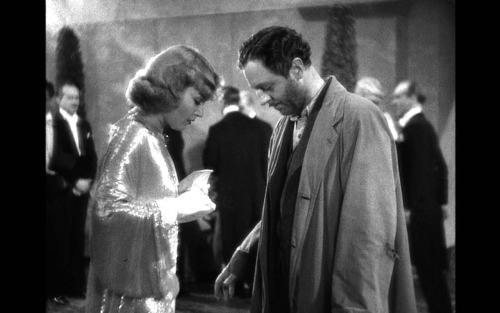
When Irene takes Godfrey to the Waldorf-Astoria Hotel so that the game’s organizers can declare him to be an authentic forgotten man, Godfrey is disgusted by the silly and wealthy people that he sees around him.  After he is authenticated, Godfrey proceeds to loudly denounce everyone in the hotel.  Every one is scandalized, except for Irene.  Irene asks Godfrey if he would like to come home with her and be her family’s new butler.  Reluctant but broke, Godfrey agrees.
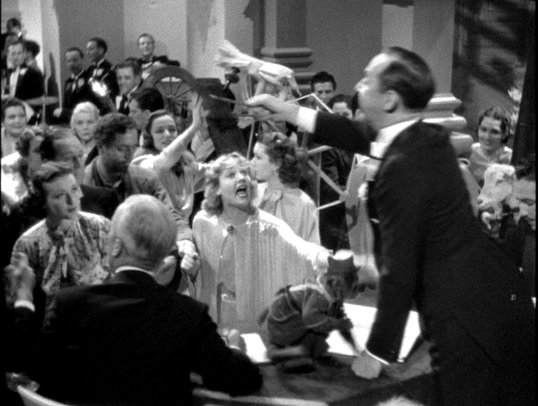
One of the joys of this scene is seeing the other things people found during the scavenger hunt. Love the monkey.

One of the joys of this scene is seeing the other things people found during the scavenger hunt. Love the monkey.

Godfrey, however, is far less amused.

Godfrey, however, is far less amused.

The next morning finds Godfrey in the Bullock mansion, prepared to start his duties as a butler.  He turns out to be a surprisingly adept butler but there’s only one problem.  It turns out that everyone was drunk last night and, as a result, nobody remembers Irene hiring Godfrey.  As Godfrey reintroduced himself to the family, he gets to once again know the Bullocks.

For instance, patriarch Alexander Bullock (Eugene Pallette) is a well-meaning man but he’s incapable of controlling his eccentric family or their excessive spending.  He faces each day with the weary resignation that his household is a disorganized mess and that he’s on the verge of losing his business.

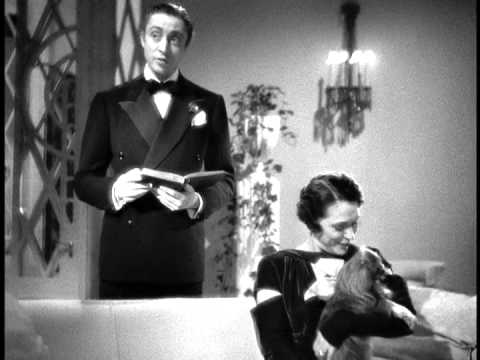
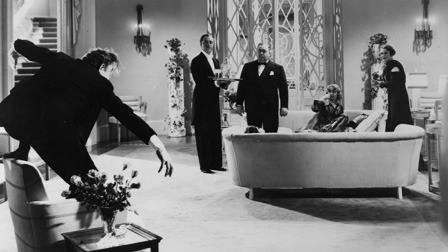
Alexander’s wife, Angelica (Alice Brady), lives in her own world and confronts every problem with nonstop and delusional positivity.  She is very excited to have taken on a protegé, an artist named Carlo (Mischa Auer, who was justifiably nominated for an Oscar for his wonderfully odd performance).  Carlo is often surly and spoiled but he does do a pretty good impersonation of a gorilla.  Whenever the often dramatic Irene is declaring herself to be the most miserable rich girl in the world, Angelica insists that Carlo cheer everyone up by grunting and jumping around the room.
Mischa Auer as Carlo
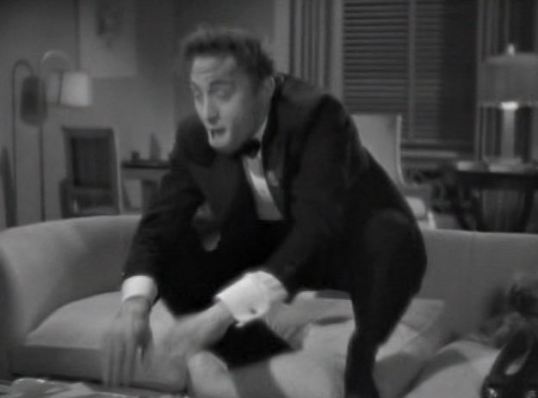
Mischa Auer as Carlo

Mischa Auer as a gorilla

Mischa Auer as a gorilla

(Apparently, the gorilla impersonation was something that Auer used to do at Hollywood parties.  The role of Carlo was specifically created with the idea of capturing Auer’s act on film.  As a result, Auer was one of the first actors to ever be nominated for Best Supporting Actor and he started a new career as a comedic character actor.)

Cornelia is selfish and materialistic.  Though she may not remember much about the scavenger hunt, she does remember Godfrey humiliating her.  From the minute she discovers that Godfrey is the new butler, she starts to conspire against him.  When her necklace disappears, everyone is sure that she hid it herself just to frame Godfrey.  The truth, of course, is a little bit more complicated.

And finally, there’s Irene.  Irene is spoiled but she’s not selfish.  She’s also not as ditzy as everyone assumes.  It’s just that she sees the world in her own unique way.  Almost as soon as Irene remembers that she hired Godrey, she decides that she’s in love with him.  She also decides that Godfrey is her protegé.  After all, if her mother can have a protegé, why can’t she!?
Carole Lombard and William Powell

Carole Lombard and William Powell

Carole Lombard was a masterful comedienne whose career was tragically cut short when she was killed in a plane crash in 1942.  Lombard is absolutely adorable in the role of Irene, a character to whom I very much related.

Of course, there is more to Godfrey and his past than he actually let on.   And, even after he becomes the new butler, Godfrey doesn’t forget where he was living just a few days before.  My Man Godfrey is a hilarious comedy but it’s also a comedy with a social conscience.
my-man-godfrey_592x299

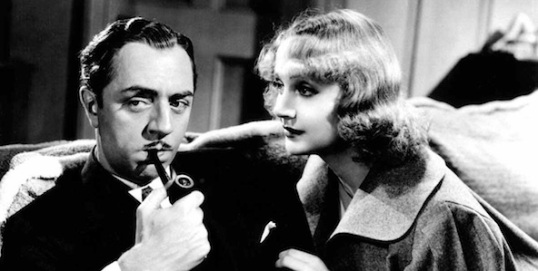
I love this film.  It’s a screwball comedy in the best sense of the term, a film where all of the characters are eccentric while also remaining human.  William Powell and Carole Lombard were briefly married before they teamed up in My Man Godfrey and their chemistry is delightful to watch.  Finally, the supporting cast is memorable in the way that only a collection of great 1930s character actors can be.

My Man Godfrey is a great film.  It may not be from the 1940s but I’m glad it was included.
Godfreyw_bw_original

(By the way, just between you and me — I had a lot of fun watching this movie and writing this review.  It kind of reminded me why I started writing about movies in the first place.)

Cleaning Out The DVR #35: Stage Door (dir by Gregory La Cava)


(For those following at home, Lisa is attempting to clean out her DVR by watching and reviewing 38 films by the end of today!!!!!  Will she make it?  Keep following the site to find out!)

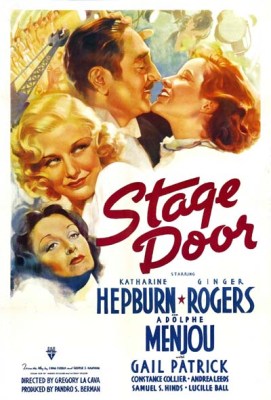
Stage_Door_(1937)

The 1937 film Stage Door is a great example of a unique genre of American film, the Katharine Hepburn Gets Humbled genre.

In the 1930s, Katharine Hepburn went through a period of time where she was considered to be “box office poison.”  She was undeniably talented but it was obvious that the studios weren’t sure how to showcase that talent.  They put her in high-brow films that often did not have much appeal to audiences.  As well, the press hated her.  Katharine Hepburn was outspoken, she was confident, she was a nonconformist, and, too many, her refusal to do interviews and sign autographs marked her as a snob.  Very few people wanted to see a movie starring Katharine Hepburn and therefore, very few people were willing to make a movie starring Katharine Hepburn.

(Interestingly enough, as I sit here typing this, another KH — Katharine Heigl — is pretty much in the exact same situation, with the main difference being that Hepburn was a far more interesting actress.)

Fortunately, Katharine Hepburn was smart enough to recognize the problem and she started to appear in films like Stage Door.  In Stage Door, she essentially played a character who mirrored the public’s perception of her.  Terry Randall is a snobbish and pretentious aspiring actress who comes to New York to pursue her career and moves into a theatrical rooming house.  At first, her attitude makes her unpopular with the other actresses living in the house.  But, as the film progresses, Terry slowly starts to let down her defenses and reveals that she’s just as insecure, neurotic, and vulnerable as everyone else.  She also proves herself to be willing to stand up to manipulative producers and condescending directors.  When she’s cast in her first Broadway show, it turns out that the show is being financed by her father and his hope is that she’ll do such a bad job and be so humiliated that she’ll give up acting.  And, at first, it appears that Terry will be terrible.  During rehearsals, she is stiff and mannered.  (Hepburn was actually quite brave to portray Terry as being such a believably bad actress.)

Of course, Terry isn’t the only actress at the rooming house who has issues to deal with.  For instance, Judy Canfield (Lucille Ball) has to choose between pursuing her career or getting married and starting a family.  Kay (Andrea Leeds) is a once successful actress who is now struggling to find roles, can’t pay her bills, and has become suicidal as a result.  And then there’s Jean (Ginger Rogers), Terry’s cynical roommate and frequent enemy and occasional friend.  Jean is falling in love with Anthony Powell (Adolphe Menjou), the lecherous producer of Terry’s play.

Stage Door is a wonderfully entertaining mix of melodrama and comedy.  You’ll laugh, you’ll cry, and you’ll really find yourself hoping that all of the actresses at the rooming house will have their dreams come true.  While the film is dominated by Hepburn and Rogers, it truly is an ensemble piece.  Not only does the cast include Eve Arden, Lucille Ball and Andrea Leeds (giving the film’s best and most poignant performance) but the great dancer Ann Miller appears as Jean’s equally cynical best friend.  Stage Door may be 79 years old but it’s aged wonderfully.

At the box office, Stage Door was a modest success and it directly led to Hepburn being cast in the classic screwball comedy, Bringing Up Baby.  Stage Door was nominated for best picture but it lost to The Life of Emile Zola.

Film Review: Gabriel Over The White House (dir. by Gregory La Cava)


This is a strange one.

Released in 1933, Gabriel Over The White House is an unapologetic work of propaganda.  It tells the story of President Judson Hammond (Walter Huston), a likable but unimpressive political hack who seems to be blissfully unconcerned with the fact that, as the film begins, the country is mired in an economic depression, crime is out of control (largely as the result of the prohibition of alcohol), and the world is teetering on the edge of another world war. 

As the result of a suspicious car crash, Hammond spends several days in a coma.  When Hammond finally wakes up, he is a changed man.  Not only is he personally more aggressive but he now sometimes seems to be listening to a voice that only he can hear.  His secretaries even catch Hammond apparently talking to himself.  A lot of people would probably suggest that this indicates that Hammond may be going crazy but, in this film, they instead speculate that perhaps he’s talking to (and taking his orders from) the angel who is responsible for bringing him out his coma.  “Gabriel over the White House,” as one of them puts it.

Whether as a result of divine guidance or his own personal psychosis, Hammond quickly sets out to solve the country’s problems by setting himself up as a dictator.  He declares martial law, dissolves Congress, and announces that, from now on, all laws will be made by him.  Instead of legalizing alcohol, he announces that only the government will be allowed to sell it and he deals with poverty by redistributing everyone else’s money.  He also starts a new national police force  that arrests any and all dissenters.  These dissenters are charged with treason and tried by a military tribunal.  Those found guilty are immediately executed.  While delivering one guilty verdict, Judge Franchot Tone takes the time to praise President Hammond for suspending all legal rights.

Here’s the thing that makes this film so different and disturbing.  The movie is totally and completely on the side of President Hammond.  Walter Huston plays the role with a Lincolnesque sort of gravity and the film’s supporting cast spends most of their time assuring us that things have never been better than they are under Judson Hammond’s dictatorship.  In short, this is an American film that says that what the country needs is a dictator who will unite the country by blaming every problem on one group of scapegoats and execute anyone who shows the slightest hint of dissent.

(Even more interestingly, Gabriel Over The White House premiered the same year that Adolf Hitler came to power in Germany.)

This being an election year, it’s tempting to try to draw some sort of parallel between Gabriel Over The White House’s pro-dictatorship message and our own current political situation.  That’s especially true for someone, like me, who naturally distrusts any type of authority.  And I have to admit that, as I watched the film, I did find myself comparing the fictional President Hammond to both a certain real-life president and a certain presidential candidate who, like their cinematic counterpart, often seems to be rather smug in their belief in their own moral superiority. 

But, to be honest, it’s difficult for me to compare Gabriel Over The White House to our current situation because Gabriel Over The White House is so heavy-handed and just so weird that it’s difficult to take seriously.  It’s not so much the idea that a President would become a dictator as much as it’s the fact that, with the exception of a few millionaires and a few bootleggers, nobody else in the film seems to be too concerned about this.  This is a propaganda film.  There’s no room for ambiguity and that lack of ambiguity makes it difficult to take the film seriously as anything other than just wish-fulfillment on that part of elitists who are sick of having to deal with the opinions of those outside of their social circle.

Even while advocating the type dictatorship that would soon be epitomized by the likes of Hitler, Mussolini, and Stalin, Gabriel Over The White House was one of the many pacifist-themed films that were released between the two world wars.  We’ve grown so used to the idea of the world being perpetually at war that it’s easy to forget that, long ago, the world was actually so horrified by the first World War that a lot of very serious, powerful, and intelligent people dedicated themselves to trying to figure out a way to ensure that there would never be another one.  Just as films today are obsessed with environmentalism, the films of this earlier period were obsessed with world peace.  While some films advocated world government and many attempted to recreate the horrors of World War I as the ultimate deterrent, Gabriel Over The White House might be unique as one of the only American films to suggest that world peace could best be achieved by dictatorship.

(It’s interesting to compare these old pacifist films — even vaguely disturbing ones like Gabriel Over The White House — to the current political climate in the United States, where our leaders brag about personally choosing who to kill from week to week.) 

As I stated at the start of this review, Gabriel Over The White House is a strange film.  In fact, it’s one of the strangest films I’ve ever seen.  It’s also an invaluable resource for anyone who is fascinated with history.  It’s a true look into the psyche of a proud nation that’s confidence had been shaken by the twin calamities of war and economic depression.  Watching a film like this, which seems so desperate to try to convince us that not only can the world’s problems be solved but that they can be solved by following a set of very specific steps, it’s a little easier to understand how desperate and shaken people can give up their freedom to a dictator who seems to say all the right things.

Gabriel Over The White House is not the easiest film to see put it pops up on TCM occasionally.  (That’s how I saw it.)  It’s a film so strange that it simply has to be seen.