I know way too much about the crimes of Charles Manson.
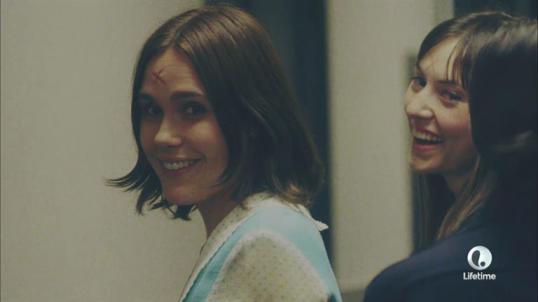
I realized that, earlier tonight, as I watched the latest Lifetime original film, Manson’s Lost Girls. It was one of the better films that I’ve recently seen on Lifetime and it was certainly superior to NBC’s Aquarius, the TV show that tried to turn Manson into some sort of sexy anti-hero. (Memo to NBC: Walter White was a great anti-hero. Charles Manson was just a grubby little serial killer.) Manson’s Lost Girls was well-acted and it did a fairly good job of portraying the 60s without falling back on too many of the usual clichés (at no point was White Rabbit heard on the soundtrack), and it also did a pretty good job of portraying how certain lost people can be brainwashed by one cunning sociopath.
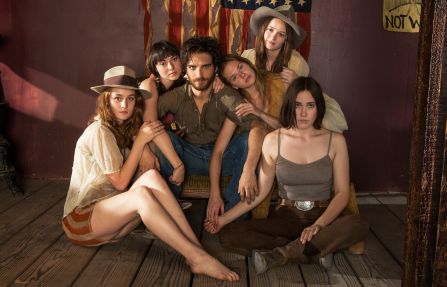
Yet, with all that in mind, I found myself watching the film and thinking, Where is Bruce Davis? Where’s Clem Grogan? What about Catherine Share, whose parents were both members of the resistance during the Nazi occupation of Germany just for their daughter to end up a brainwashed member of Manson’s Family?” For whatever reason, the Family portrayed in Manson’s Lost Girls was considerably smaller than the real-life Family and seriously, how disturbing is that? I mean, the 10-member cult in Mason’s Lost Girls was bad enough but, in real life, there were even more of them! How disturbing is that!? But, in retrospect, it’s even more disturbing that I knew enough about the Family to know that Bruce Davis, Clem Grogan, and Catherine Share were all missing from the film.
(Actually, I just looked at the credits on the imdb and I saw that Diana Irvine is credited as playing Catherine. So, perhaps Catherine Share was included as a character and I just didn’t notice.)
When I was 16, I took a sociology class in high school. One of the class assignments was to do a report on a subculture. I did my report on vampires and the less said about that the better. However, the hot and troubled guy who sat in front of me did his report on the Manson Family. As a part of his report, he handed out a little booklet that had pictures of all the Family members in it. I can remember looking through those pictures and thinking that Charles Manson looked scary and that Tex Watson was kind of hot, in a rebellious son of an evangelical preacher sort of way. (Tex Watson spent a semester at North Texas State University. Four decades later, I went to NTSU — or UNT as its now called. Around the campus, you can find pictures of famous former students like Joe Don Baker, Peter Weller, Pat Boone, and Roy Orbison. For obvious reasons, you will never find a picture of Charles “Tex” Watson.) But, as I listened to the details of Manson’s crimes and his belief that the Beatles were sending him secret messages and that those messages justified murder, I found myself wondering how any of the fresh-faced people in those pictures could have possibly believed a word that Manson said. It just seemed so weird and …. stupid.
(By the end of the presentation, Tex Watson no longer looked hot.)
And I have to admit that I was a bit intrigued by it all. It wasn’t that I had any sympathy for those murderers. But I found myself wondering how they could have done what they did. I wondered how so many different people from different background could come together and all buy into the same stupid bullshit. Though I didn’t realize it at the time, I was struggling to understand the very nature of evil. To most people, it was easy enough to say that Manson and his followers were evil but I wanted to know how they had become evil. I wanted to understand why and, though I may not have wanted to admit it, I wanted to make sure that I never woke up to discover that I had made the same mistake of surrendering my free will to a some nut just because he was able to look at me and tell that I had issues with my father.
By telling the story of Linda Kasabian (played quite well by MacKenzie Mauzy), Manson’s Lost Girls attempts to answer that question. Linda was a young mother who, after her drug dealing husband deserted her, found herself living on the Spahn Movie Ranch with Manson and the Family. Linda spent a month with Manson. At first, she felt as if she had a found a new home and a new family but soon, things started to unravel. In hopes of bringing about a race war (and also looking for vengeance over his own failure to become a rock star), Manson ordered his followers to commit murder. Linda witnessed the tragic and brutal murder of actress Sharon Tate and her friends. After the murders, Linda fled the Family and she would later serve as the prosecution’s star witness in Manson’s murder trial.
Manson’s Lost Girls is told almost totally from Linda’s point of view. It’s through her that we are introduced to Manson and his Family. The film doesn’t quite succeed in giving us a definitive answer as to how Manson could get people to kill for him but, then again, there may not be a definitive answer. Fortunately, Manson’s Lost Girls does provide hints. In her narration, Linda emphasizes that Manson kept everyone perpetually wasted. But, even more importantly, the film highlights that, for these brainwashed future murderers, the Family truly was a family. They were lost. They were rejected by conventional society. And when they met Manson, they were given a chance to belong. The film suggests that need to belong and to be a part of something greater than what they had left all the members of the Family vulnerable to Charlie’s manipulations.
Manson was played by Jeff Ward, who did a pretty good job in the role. Wisely, the film didn’t overplay Manson’s charisma or attempt to turn him into some sort of supervillain. (In short, it didn’t make the same mistake as Aquarius.) Instead, it portrayed him as what he probably was — a grubby hustler with a massive chip on his shoulder. As played by Ward, Manson is less a messiah and more an extremely lucky con artist. Manson’s Lost Girls deserves credit for portraying Manson without a hint of glamour.
The film suggests that Manson’s rampage was largely motivated by his bitterness over not being able to get a record contract. As I watched, I found myself what would have happened if Manson had gotten that contract. Would he now be remembered as one of those obscure musicians from the 60s and 70s whose later career was made up of performing at fairs and cheap clubs? Or, if he had found success, would he have eventually ended up as a mentor on an early episode of American Idol?
Far more importantly, I found myself wondering what the future would have held for his most famous victim, Sharon Tate? Sharon gave a such good performance in Valley of the Dolls, one that suggested she was capable of a lot more than she had been given credit for. Would she have continued to grow and develop as an actress? And what of her unborn son? If not for Manson and his followers, Paul Polanski would now be 46 years old.
Manson’s Lost Girls does not linger on the murders. They largely happen off-screen and, for that, I’m thankful. But, at the same time, it never shies away from the real-life tragedy of Manson’s crimes. And, even if the film did not have all the answers, it did remind us why the questions must be asked. In the end, Manson’s Lost Girls reminds us of what evil can come from surrendering our independence and our free will.
It’s a film that reminds us that no matter how lost we may be, we must always be careful about those who claim to have found us. Instead of waiting for others to find us, we must find ourselves.

 Through the Shattered Lens