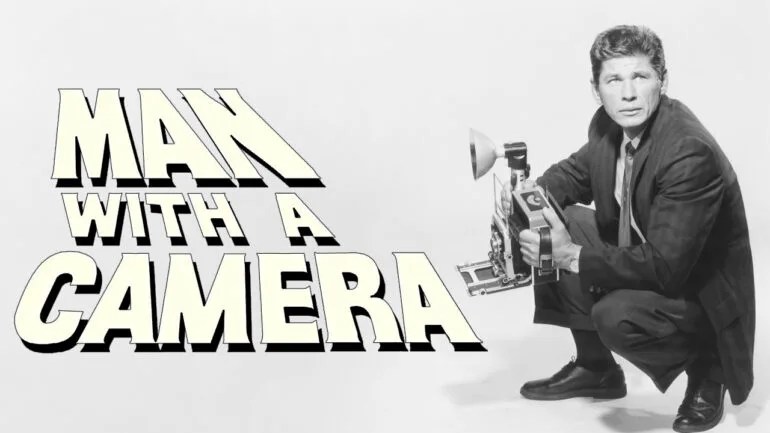
MAN WITH A CAMERA (TV Series) – starring Charles Bronson – S1, E7: Another Barrier


Originally airing on November 28th, 1958, “Another Barrier” opens with free-lance photographer, Mike Kovac (Charles Bronson), in the middle of the California desert working on a photo layout of Major Sandy Dickson (Grant Williams), a hotshot U.S. Air Force pilot who’s in the process of testing the latest X-2 plane. Kovac wants to follow Sandy around for a couple of days leading up the next big test flight, which means he also gets to meet Sandy’s fiancé, Liz (Norma Crane). While having dinner with the couple, Kovac sees just how scared and worried she is about her lover’s dangerous job. Sandy later confides to Mike that Liz has had bad luck with the “men in her life,” in this case being her father and her brother, who both died tragically years earlier. It seems she thinks her love is a curse, and now she’s afraid she’s going to pass it on to Sandy. Maybe she has a point, because on Sandy’s next test flight, his X-2 goes down, losing contact with the control tower ninety-four seconds after being released from its mothership B-50. With the rescue teams looking for Sandy, and with his survival chances being somewhere between slim and none, Kovac tells Liz what happened, and then takes her back to her apartment. Believing it’s her fault that Sandy’s plane went down, as soon as she gets her chance, Liz crawls out on the balcony of the top floor of her multi-story apartment complex. Kovac begins to try his best to convince her not to jump, to at least find out for sure if Sandy is dead or alive. But will anything work on a woman who’s convinced she’s a curse?!

This review may surprise some of my readers, but I didn’t really enjoy this episode at all. I didn’t like its entire concept. I enjoy episodes of the series where Kovac’s pictures help solve crimes, or he’s getting to mix it up with bullies and bad guys. This episode is just melodrama, and boring melodrama at that. Okay, so Sandy loves his job and Liz, and he wants Liz to accept the danger of his job, but she just seems to be a scared and anxious ball of emotions waiting around for him to die. And all Kovac does is take some pictures, listen to Sandy go on and on about Liz, and then beg Liz not to jump once everyone thinks he’s as dead as a doornail. Boring! About the only mildly amusing thing that happens is when Kovac convinces Sandy that a picture of a pilot in his long johns is just what the layout really needs. Boring AND kinda creepy! And I know that Norma Crane is a fine actress, having recently reviewed her episode of ALFRED HITHCOCK PRESENTS: “There Was an Old Woman,” where she also works with Bronson. They were good together in that episode, but neither have anything to work with when it comes to this story. She’s sad and wants to die, and he’s worried and doesn’t want her to jump. The characters barely know each other, having only met the day before, and the drama does not play out convincingly at all. Grant Williams is likewise boring as the “hot shot” Sandy Jackson. If the Air Force wanted to feature a pilot, they should have probably found one with at least a little bit of personality. I’ve always said that I love Bronson so much that I’d pay to watch him read the phone book. Good Lord willing, this episode is the closest I’ll ever get to seeing that happen.

There was one interesting thing that I noted while watching “Another Barrier,” and that’s the connection that its plot shares with a movie that Charles Bronson would star in a few years later, X-15 (1961), the theatrical debut of director Richard Donner. In X-15, which includes narration by the legendary James Stewart, Bronson plays an Air Force pilot with the dangerous job of testing X-planes, and Patricia Owens is his wife who’s worried about him back at home. It’s not one of Bronson’s best, and frankly, it’s kind of boring too. There may be a great movie or show about X-plane test pilots out there. I just know they don’t star Charles Bronson!     

Film Review: Susan Slade (dir by Delmer Daves)


Shortly after this 1961 film begins, 17 year-old Susan Slade (Connie Stevens) announces, “We’ve been sinful!”

She’s talking to her first lover, Conn White (Grant Williams).  You would think that anyone — even someone as unbelievably naive and innocent as Susan Slade — would know better than to ever trust someone named Conn White but no.  From the minute that Conn and Susan met on an ocean liner heading from South America to California, it was love at first sight.  In fact, Susan was so sure of her love that she spent the night in Conn’s cabin, fully knowing that it would mean surrendering her status as an Eisenhower era good girl.

Conn laughs off her concerns about sin.  He also tells her that it makes perfect sense for her not to tell her parents (played by Dorothy McGuire and Lloyd Nolan).  “When we’re married,” he asks, “are you going to tell your mother every time that we make love?”

Wow, Conn still wants to get married even though he’s already had sex with her!?  And he’s also extremely wealthy and stands to inherit control of a multinational corporation!  He sounds like the perfect guy!  Way to go, Susan!

Unfortunately, it turns out that Conn does have one flaw.  He really, really likes to go mountain climbing.  In fact, he’s planning on scaling fearsome old Mt. McKinley.  While Susan and her family settle into life in Monterey, California, Conn heads up to Alaska.  He promises Susan that he’ll keep in touch but, when she doesn’t hear from him, she fears the worse.  Has he abandoned her?  Was he lying when he said he wanted to get married?  Then one day, she gets a call from Conn’s father, informing her that Conn fell off the mountain and died.  Susan’s almost father-in-law tells her that Conn’s body cannot be retrieved from the mountain.  Though it’s neither confirmed nor denied by the film, I decided that this was because Conn faked his own death to get out of having to spend any more time listening to Susan talk about sin.

Anyway, Susan’s single again but, fortunately, she does not lack for suitors.  For instance, there’s the spoiled Wells Corbett (Bert Convy), who is kind of shallow and arrogant but who has a lot of money.  And then there’s Hoyt Brecker (played, in reliably vacuous style, by Troy Donahue), who is poor but honest and who is also an aspiring writer.  “Someday,” Susan declares,”they’ll say that Robert Louis Stevenson, Jack London, and Hoyt Brecker wrote here!”  Who will Susan chose?  The sensitive artist who loves her unconditionally or the arrogant rich boy who smirks his way through the whole film?

Complicating matters is the fact that Susan is …. pregnant!  That’s right, this is another one of those movies from the early 60s where having sex outside of marriage always leads to an unplanned pregnancy.  And, because this movie is from 1961, the only solution is for the Slades to move down to Guatemala for two years, just so they can fool the people on Monterey into believing that the baby is actually McGuire’s and that Susan Slade is not an unwed mother but is instead an overprotective older sister.  Will either of Susan’s two suitors be waiting for her when she and her family return to California?

Now, please don’t get me wrong.  I do understand that there’s a big difference between 1961 and 2019 and that there used to be a lot more scandal attached to sex outside of marriage and unwed pregnancy.  In fact, I guess that difference is really the only thing that makes Susan Slade interesting to a modern viewer.  As soon as we see that this film was directed by Delmer Daves (the poor man’s Douglas Sirk) and that it stars Troy Donahue, we know who poor Susan is going to end up with so it’s not like there’s any real surprises lurking in the film’s plot.  And none of the actors, though Connie Stevens sometimes to be trying, seems to be that invested in the film’s story.  Instead, Susan Slade is mostly useful of a time capsule of the time in which it was made, a time when sex outside of marriage was unironically “sinful” and the only possible punishment was either pregnancy, death, or both.  Indeed, Susan Slade is less concerned about the hypocrisy of a society that would force Susan to lie about her new “brother” and more about whether bland lunkhead Troy Donaue will still be willing to marry Susan even if she’s no longer eligible to wear white at their wedding.  The film seems to be asking, “After being sinful, can Susan Slade become a good girl again?”  As a movie, it’s fairly turgid but as a cultural artifact of a time in which everyone was obsessed with sex but no one was willing to talk about it, Susan Slade is occasionally fascinating.

Poor Susan Slade!  If only she had gotten pregnant in a 1971 film instead of one made in 1961, her story could have been so different.  But no, she was sinful in the early 60s and that means she’ll be have to settle for Troy Donahue.