Horror On The Lens: Revenge of the Creature (dir by Jack Arnold)


For today’s horror on the lens, we present to you 1956’s Revenge of the Creature!

Revenge of the Creature was the first sequel to The Creature From The Black Lagoon.  It turns out that the Gil-Man didn’t actually die at the end of the last film.  Instead, he’s alive, he’s been captured, and he’s now being displayed in an aquarium.

Now, I’m going to be honest: Revenge of the Creature is not as a good as The Creature From The Black Lagoon.  But it’s still kind of fun in a silly 1950s monster movie sort of way.  And, if you keep your eyes open, you might spot a very young Clint Eastwood, playing a lab technician and sporting a truly impressive head of hair.

Enjoy!


Cleaning Out The DVR: Born Yesterday (dir by George Cukor)


Born_yesterday

After I watched Goodbye, Mr. Chips, I decided to watch one more film that I had recorded off of TCM.  The movie I chose was Born Yesterday.

This 1950 film was directed by George Cukor and stars three Academy Award winners.  The lead actor was William Holden, who would win best actor three years after the release of Born Yesterday.  The villain was played Broderick Crawford, just a year after playing his Oscar-winning role in All The King’s Men.  Finally, the true star of the film was Judy Holliday, recreating her Broadway role of “dumb intelligent blonde” Billie Dawn.  For playing Billie, Holliday would win the award for best actress of the year.

In Born Yesterday, Billie is the girlfriend of Harry Brock (Broderick Crawford).  The crude and not particularly intelligent Harry has made a fortune as a “junkman” and, though the film never comes out and explicitly says so, it is suggested that Harry may have ties to the Mafia.  Harry has come to Washington, convinced that he can buy his way into political power.  Harry’s lawyer (Howard St. John) suggests that Harry should marry Billie, specifically because a wife cannot be compelled to testify against her husband.

However, there’s a problem.  Billie is uneducated and lacks formal manners.  Of course, Harry is even worse but then again, Harry is a rich white guy and, therefore, he doesn’t have to be polite or know what he’s talking about  After Billie embarrasses him during a meeting with a congressman, Harry hires journalist Paul Verrall (William Holden) to teach Billie how to fit in with Washington society.  At first, Paul refuses but, ultimately, he takes the job because he needs the money.

As Paul teaches Billie, it quickly becomes apparent that Billie is not as dumb as everyone assumes.  In fact, she has an insatiable desire to learn.  When Paul takes her on a tour of Washington, Billie is excited to learn the story behind every monument and to take a look at every historical artifact.  (When Paul shows her the bill of rights, Billie immediately reads the 2nd Amendment and gets Paul to explain it to her.  As Paul explained that it meant that citizens had the right to bear arms, my sister walked through the room and said, “You got that right.”)  Judy Holliday perfectly captures Billie’s excitement as, for the first time in her life, she’s actually treated like someone with a brain.

Billie also starts to fall in love with Paul.  After reading one of Paul’s articles, an obviously impressed Billie tells him, “I think it’s the best thing I ever read.  I didn’t understand a word.”  At the same time, Paul starts to fall for Billie.

Meanwhile, Harry is not falling for anyone but himself.  He continues to bribe congressmen but now, Billie not only realizes what Harry is doing but also understands that it’s illegal and goes against everything that the authors of the Constitution envisioned.  After a rather nasty scene in which she is repeatedly slapped by Harry, Billie goes down to the Lincoln Memorial, hears the voice of old Abe himself, and is finally ready to stand up for herself, for Paul, and for the American way of life.

(“When you steal from the government, you steal from yourself, you dumb ox!” she yells at Harry.)

Born Yesterday was based on a stage play and, with the exception of the scenes where Paul and Billie explore D.C., the entire film takes place in Harry’s hotel suite.  The film never quite escapes its theatrical origins.  Broderick Crawford bellows his lines out to the last row and William Holden feels miscast.  (That same year, he gave a far more interesting performance in Sunset Boulevard.)

But ultimately, Born Yesterday is mostly designed to showcase Judy Holliday as Billie Dawn.  When the film first started, I have to admit that I had my doubts about Holliday’s performance.  Her character was so stereotypically ditzy and spoke in such a nasal whine of a voice that I found myself wishing that the film had been made with either Marilyn Monroe or even Jayne Mansfield in the Billie Dawn role.  But, as the film progresses, I started to better appreciate Holliday’s performance.  I started to notice the sadness and the insecurity lurking underneath the surface.  I discovered that there was unexpected nuance to both the character and the performance.  By the time she was running through the National Archives and asking Paul questions about George Washington, she had totally won me over.

Still, Holliday’s victory for best actress does seem a little strange.  After all, to win the Oscar, Holliday defeated All About Eve‘s Bette Davis and Anne Baxter and Sunset Boulevard‘s Gloria Swanson.  Holliday’s performance definitely deserved a nomination but it’s a bit more difficult to argue that it deserved the Oscar.  Of course, Davis and Baxter played two tough and sarcastic divas, neither one of whom depended on a man for their success.  Swanson, meanwhile, played an older woman who ends up murdering her much younger lover.  Billie, meanwhile, is never without a girlfriend and doesn’t murder anyone.  Perhaps it’s understandable that certain Academy voters would be more comfortable with Billie Dawn than they would with Norma Desmond or Margo Channing.

Born Yesterday was also nominated for best picture but it lost to All About Eve.

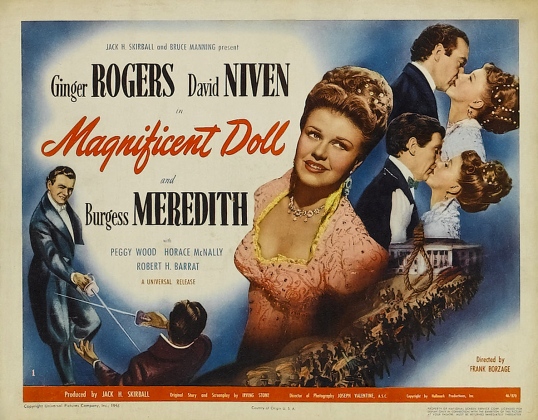
Shattered Politics #8: Magnificent Doll (dir by Frank Borzage)


Poster - Magnificent Doll_02

I’ve always been tempted to write one of those quizzes that you always see on Facebook, “Which American first lady should you be?”  That’s a question that I’ve often asked myself.  I know that I would not want to be any of our most recent first ladies.  (Sorry, Michelle.  Sorry, Laura.  Sorry, Hillary.)  Occasionally, I think that I would have liked to have been Jacqueline Kennedy, if not for what happened in Dallas.  Teddy Roosevelt’s daughter, Alice, is definitely a historical role model for me but it’s debatable whether she could truly be considered a first lady.  And, of course, there’s always Grover Cleveland’s wife Julia but ultimately, for me, there’s really only one choice.

If I could be any American first lady, I would be Dolley Madison.

Dolley, of course, was the wife of James Madison, who was not only our fourth President but also one of the smartest.  Madison was a skilled writer and scholar but he had absolutely no social skills.  Dolley, on the other hand, was vivacious and was, by the standards of the dentistry-free days of the 19th Century, one of the most beautiful women in America. Whereas James was uncomfortable meeting with people and struggled to express himself, Dolley was the world’s greatest hostess, bringing opposing forces together through the sheer force of her own charm and ability to throw a great party.  When the British invaded Washington D.C. during the War of 1812, Dolley was the one who saved the famous portrait of George Washington from being burned with the rest of the White House.

So, yes, I would definitely be Dolley Madison.

(Yes, I know that there’s some debate over whether her name should be spelled Dolly, Dolley, or Dollie.  I spell it Dolley and since I would have been her, I think my opinion counts for something.)

It’s a shame that there haven’t been many movies made about Dolley Madison.  Perhaps the best known is 1946’s Magnificent Doll, which is not a very good movie but which is amusing if you know something about history.

Magnificent Doll opens with young Dolley Payne (Ginger Rogers) being forced to marry John Todd (Horace McNally), a much older lawyer.  (John saved the life of Dolley’s father and, in gratitude, Dolley’s father gave him his daughter.)  Though John falls in love with her, Dolley refuses to show him any sign of affection and good for her!  (Seriously, arranged marriages suck.)  But then John dies of yellow fever and Dolley declares that she did love him all along.

But life goes on!

Soon, Dolley and her mother are running a boarding house in Philadelphia.  Fortunately, they happen to be running it at the same time that the Continental Congress is attempting to write the Constitution.  Several of the delegates are staying at the boarding house and two of them take a romantic interest in Dolley.

First there’s Aaron Burr (David Niven), a charming scoundrel who appeals to Dolley’s wild side.  Aaron does things like take her to a bar and kiss her underneath a staircase.  Aaron is vain.  Aaron is self-absorbed.  Aaron is an ambitious and charismatic brooder whose moods can be unpredictable.  Aaron is exiting!  Aaron is dangerous!  Aaron is a rebel!

And then you’ve got Aaron’s friend, James Madison (Burgess Meredith).  James is shy and gentle.  He’d rather read a book than go out.  He’s the type of smart kid who all the other kids make fun of but he’s also a good, decent man who has a great future ahead of him.  He just needs someone to bring him out of his shell.

In short, Aaron is the type of boy that you hope invites you to prom.  James is the type of boy that you marry.

And, when Dolley does marry James, it sends Aaron Burr into such a tail spin that he nearly prevents Thomas Jefferson from becoming President in 1800…

And, needless to say, this film is in no way historically accurate.  It is true that Aaron Burr was nearly elected President in 1800 and, had he been, Thomas Jefferson would never have been President.  However, most historians seem to agree that has more to do with Aaron Burr being ambitious and nothing to do with Dolley Madison.  In the end, Magnificent Doll may be amusing in its inaccuracies but bad history is still bad history.

That said, there’s still a part of me that enjoyed Magnificent Doll, despite the fact that it moves way too slowly and none of the actors (with the exception of David Niven) appear to be all that invested in their roles.  I think, ultimately, the reason I enjoyed Magnificent Doll was because it really is basically just a YA version of American history and, as a result, it does have some curiosity value.  One gets the feeling that if Magnificent Doll were released today, it would be split into two different films and that it would be promoted on social media with hashtags reading #TeamAaron and #TeamJames.

That said, if there’s any first lady who deserves a biopic (one that’s good as opposed to so-bad-its-interesting) it’s Dolley Madison.  (Personally, I would cast Amy Adams in the role.)  #TeamDolley all the way!