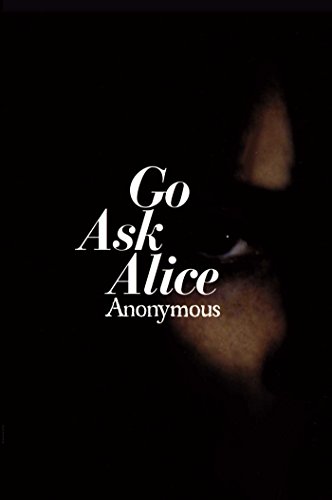
“Another day, another blow job,” writes the anonymous author of Go Ask Alice.
It’s only been a few months since she first dropped acid and smoked weed for the first time and the narrator has already run away from home and turned to prostitution to support her raging drug habit. First published in 1971 and continuously in print since then, Go Ask Alice is presented as being the narrator’s journal, found amongst her belongings after she died of a drug overdose. (Despite popular belief, the narrator is not named Alice. Her name is never actually mentioned in the journal.) That one line — “Another day, another blow job” — pretty much sums up Go Ask Alice. It’s very dramatic. Depending on who is reading it, it’s very shocking. And it’s so perfectly quotable that it’s hard to believe that someone just scrawled it down in a journal.
Of course, some of that’s because Go Ask Alice isn’t actually a diary. Though it’s never been officially confirmed, most researchers believe that it was actually written by Beatrice Sparks, a therapist who originally presented herself as being the diary’s editor. Sparks later went on to “edit” several other anonymous diaries, all written by teenagers who had gotten involved with things like Satanism, eating disorders, and gang violence.
Even if I hadn’t read (on, I’ll admit it, Wikipedia) that Go Ask Alice was not actually written by a 15 year-old girl, it would be obvious just from some of what it is written in the diary. I reread it a few weeks ago and the thing that immediately jumped out at me was that the narrator apparently didn’t write much about anything that didn’t have to do with drugs. There’s none of the banal stuff that you would typically expect to find in someone’s personal journal. The narrator doesn’t mention television or movies or music or books. She barely even talks about the boy she likes, other than to mention that he exists and she’s not sure if he likes her back. Instead, she pretty much goes straight from drinking a coke that’s been dosed with acid to running away to Berkeley. She spend several hundred words meticulously detailing an acid trip but she tells us very little about anyone that she goes to school with. (And I have to say that, for someone who has just taken acid for the first time, she’s remarkably coherent and detailed when it comes to writing about her trip.) She also includes a lot of statistics about how how many people her age are estimated to have experimented with drugs, which doesn’t doesn’t seem like the usual behavior of a 15 year-old addict. It’s not something that I would have done at 15 and, trust me, I was a very smart 15 year-old. (It’s vaguely like something you would expect to hear in an old sitcom. “Can you believe it? That child’s 15 years old and already hooked on speed.” “Oh, honey, it’s not that unusual. I was reading an article that said 40% of children under the age of 16 have tried some sort of narcotic substance.”)
Another thing that I found to be interesting about Go Ask Alice is how generous everyone was with their drugs. Even after the narrator goes through rehab, her classmates still walk up to her and casually drop drugs in front of her. Maybe it’s a generational thing but my experience in high school was the exact opposite. At my high school, the few people who regularly had drugs tended to be pretty stingy with them. They certainly weren’t going to waste any just to play a joke on someone. (Indeed, I’ve never been able to relate to people who claim that people pressured them into trying drugs because, at my high school, everyone was too greedy to share. “You want a hit off this joint? This is mine, get your own!”) But I guess that maybe in 1971, drugs were cheaper and people just had a more generous spirit.
Anyway, Go Ask Alice is a quick read and it fulfills the number one rule of successful propaganda: it takes it story to the worst possible conclusion, even though a less dramatic conclusion would have been more realistic and perhaps more effective. From the minute you start reading the diary, you know that the diarist is going to end up dead of a drug overdose because that’s the type of story that Go Ask Alice is. Over the course of a year, our narrator goes from being sweet and innocent to being dead because stories like this don’t work unless the narrator dies at the end. Simply having the narrator write, “I did a lot of drugs and I wish I hadn’t but now I’m going try to rebuild my life,” just does’t carry the same punch as, “A week later, the writer of this diary was found dead of an overdose.” Go Ask Alice understands the importance of embracing the melodrama and it does so fully. As a result, it’s not as convincing as a realistic look at drug abuse would have been but it’s considerably more entertaining.
Go Ask Alice was a huge success when it was first published. They even turned it into a movie, which can currently be viewed on YouTube and Prime. Somewhat inevitably, William Shatner’s in it. The movie is actually better than the book but you should read the book as well, if just to see what frightened your grandparents back in the day.

 Through the Shattered Lens