
Way back in April, I started on a series of reviews. I announced that I would be watching and reviewing all 50 of the public domain films included in Mill Creek’s Fabulous Forties box set.
At the time, I expected that it would take me maybe two weeks. At the most, two and a half. After all, I wondered, how long can I take? Well, needless to say, it took me a little longer than two weeks. In fact, it took me nearly 3 months. (In my defense, May turned out to be a very busy month for me and I wasn’t able to review a single Fabulous Forties film.) However, what’s important is that, after all this time, I am currently writing up the last of my Fabulous Forties reviews!
(And, right now, you’re reading it.)
On the whole, the Fabulous Forties has turned out to be pretty uneven box set. It contains a few classics, like My Man Godfrey, His Girl Friday, and The Last Chance. There are several good films, like The Black Book and Trapped. And then there’s quite a few mediocre and forgettable films, like The Town Went Wild and Jungle Man. (Dear God, Jungle Man…) As I started on the final film in the set, I wasn’t sure what I was about to see…
Well, no worries! The Fabulous Forties ends on a high note! The 50th film is the wonderfully entertaining 1943 comedy-musical-mystery Lady of Burlesque!

Lady of Burlesque (which was released in the UK under the title Striptease Lady) takes place in an old and somewhat decrepit New York burlesque house, the type of place where the audience is almost all male, the owners are somewhat sleazy, and the performers are a cross between cynical veterans and naive newcomers who are hoping for their first big break.
As quickly becomes apparent, the theater would fall apart if not for its main attraction, Dixie Daisy (Barbara Stanwyck). Dixie serves as a mentor for the newcomers and a confidante for the veterans. She knows how to keep the audience entertained, even when two dancers are loudly screaming at each other offstage. She knows how to deal with the sleazy owners and how to placate the owners of the Chinese restaurant next door. Dixie also knows better than to get romantically involved with any of male comics who perform at the theater but that doesn’t stop her from flirting with one of them, Biff Brannigan (Micahel O’Shea, playing his role with an almost poignant earnestness). As I watched the film, I could tell that Barbara Stanwyck was neither a natural dancer nor singer but it didn’t matter because, whether Dixie was trying to keep peace backstage or performing onstage and singing a song called, “Take It Off The E-String, Play It On The G-String,” Stanwyck totally committed herself to the role.
Plus, her outfits were to die for!

Seriously, as I watched Lady of Burlesque, I totally wanted to get a job dancing in an old timey burlesque house! If only I had a time machine…
Of course, it should be understood that the acts in Lady of Burlesque are risqué but, by today’s standards, they’re also rather innocent. The jokes may be full of double meaning but it’s all hidden in the subtext. The costumes may be sexy but they also stay on. (That probably had more to do with the production code than to do with the realities of 1940s burlesque.)
Anyway, Lady of Burlesque is technically a murder mystery but mostly, it’s just an excuse to show the performances happening onstage and a few comedic (and occasionally dramatic) vignettes of what it was like to be backstage in a burlesque house. Two dancers are murdered but the show must go on. Even as Dixie solves the murders and tries to keep everyone calm, the show must go on. In fact, that’s one of the true joys of Lady of Burlesque. Regardless of what madness might be going on backstage, the show never stops! In fact, the film often seems undecided about whether or not the backstage murders are bad because of the loss of life or the fact that they threaten to interrupt the performances onstage. Lady of Burlesque becomes a tribute to the work ethic of entertainers everywhere!
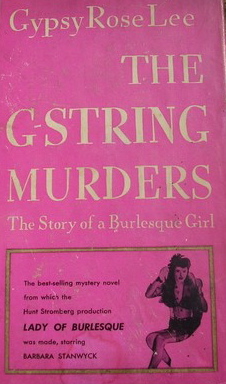
Lady of Burlesque was based on a novel by Gypsy Rose Lee. The name of that novel was The G-String Murders. Not surprisingly, that title was changed for the film version.
Well, that concludes the Fabulous Forties! In a few weeks, I’ll start in on my next Mill Creek box set, the Nifty Fifties! Until then, enjoy Lady of Burlesque!

 Through the Shattered Lens