Lisa Reviews An Oscar Nominee: Lady for A Day (dir by Frank Capra)


The 1933 film, Lady For A Day, tells the story of Apple Annie (May Robson) and Dave the Dude (Warren William), who is perhaps the nicest gangster that you could ever hope to meet.

Of course, when I refer to Dave the Dude as being a gangster, I should make clear that he’s not the type of gangster who guns down his rivals or sells drugs in back alleys.  I mean, I guess he might do that but we certainly don’t see much of evidence of it in the film.  Instead, Dave is just a dapper gambler who travels with a bodyguard named Happy McGuire (Ned Sparks) and whose girlfriend, Missouri Martin (Glenda Farrell), owns a nightclub where, since this is a pre-code film, the acts are slightly racy but not excessively salacious.  The country may be mired in a depression but Dave appears to be doing okay for himself.  Yes, Dave may be a criminal but at least he’s honest about it.

Surviving the Depression has proven to be far more difficult for Apple Annie.  She’s known as Apple Annie because she makes a meager living by selling fruit on the streets of New York City.  Dave is one of her regular customers, as he believes that her apples bring him good luck.  Annie has a daughter named Louise (Jean Parker).  Louise has never met her mother, having spent the majority of her life in a Spanish convict.  Annie regularly steals stationary from a high class hotel so that she can sends letters to Louise.  Not wanting her daughter to be ashamed of her, Annie has always presented herself as being a rich woman named Mrs. E. Worthington Manville.

However, it now appears that Annie’s charade is about to be exposed.  Louise is coming to New York with her fiance, Carlos (Barry Norton) and her prospective father-in-law, Count Romero (Walter Connolly).  Annie knows that when the Louise arrives, she’s going to discover that her mother is not wealthy and that the marriage will probably be called off.  So, led by Dave, Annie’s customers conspire to fool Louise into believing that her mother really is a member of high society.  And if that means that Dave is going to have to not only kidnap (but, let’s be clear, not harm) three nosy reporters and then make a deal with not just the mayor but also the governor to pull of the deception, that’s exactly what he’s going to do.

Though it may be disguised as a sweet and rather simple comedy, Lady For A Day is actually a rather melancholy little film.  Even when Annie and her friends are pretending to be wealthy members of high society, the film is aware that their escape from reality is only temporary.  Eventually, they’ll have to return to the reality of being poor in 1930s America.  At heart, it’s a sad story but May Robson, Warren William, Glenda Farrell, and Guy Kibbee (who plays the pool hustler who is recruited to pretend to be Annie’s husband) all bring such sincerity to their roles that you can’t help but smile while watching it.  Rejected by “polite” society, Annie and her friends have formed a community of outsiders and, throughout the film, the audience is happy that, no matter what, they have each other.

Lady for a Day was the first Frank Capra film to ever be nominated for Best Picture.  Capra was also nominated, for the first time, for best director but he had the misfortune to be competing with Frank Lloyd, who directed Cavalcade.  At the awards ceremony, when host Will Rogers, announced the winner for best director, he said, “Come on up here, Frank!”  An excited Capra ran down to the podium, just to discover that Rogers had actually been talking to Frank Lloyd.  Rogers, seeing what had happened, quickly invited the other nominated director, Little Women‘s George Cukor, to come join Lloyd and Capra at the podium.  Fortunately, one year later, Capra would win the directing Oscar for It Happened One Night.

Cavalcade would go on to win Best Picture but Capra retained so much affection for Lady For A Day that it was the only one of his films that he would subsequently remake.  A Pocketful Of Miracles came out in 1961 and featured Bette Davis in the lead role.  It would be Capra’s final theatrical film.

Pre Code Confidential #28: Edward G. Robinson in LITTLE CAESAR (Warner Brothers 1931)


gary loggins's avatarcracked rear viewer

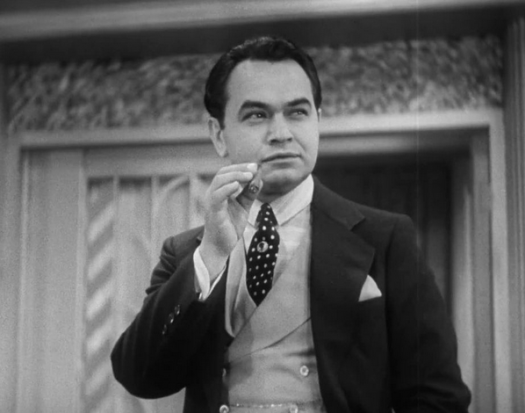
Gangster movies were nothing new in 1931. Josef von Sternberg’s UNDERWORLD (1927), Lewis Milestone’s THE RACKET (1928), and Bryan Foy’s LIGHTS OF NEW YORK (1929) had all dealt with urban organized crime onscreen (and Foy’s drama was the first “all-talking picture” to hit cinemas). But when Edward G. Robinson rat-a-tatted his way through Mervyn LeRoy’s LITTLE CAESAR, the gangster genre had finally arrived – with a vengeance! This highly influential flick opened the floodgates for a variety of films about mobsters, killers, and other assorted no-goodniks, and made an unlikely star out of the pugnacious Eddie G.

The film concerns the rise and fall of Rico “Little Caesar” Bandello, a small-time hood from the sticks who, along with partner in crime Joe Massara, moves to the big city and blasts his way up the ranks to become a gang boss. The diminutive Robinson exudes star power as the psychotic sociopath…

View original post 472 more words

Lisa Cleans Out Her DVR: The Girl In the Red Velvet Swing (dir by Richard Fleischer)


(Lisa is currently in the process of cleaning out her DVR!  How long is it going to take?  Forever!  For instance, she recorded 1955’s The Girl In the Red Velvet Swing off of FXM on February 1st and has now gotten around to actually watching and reviewing it.)

The story of Evelyn Nesbit is an interesting one, even if it is now a largely forgotten one.

In 1901, Evelyn Nesbit was a showgirl in New York City.  While she always claimed that she was 16 at the time, there are some historians that think it more likely that she was only 14.  One night, the beautiful Evelyn was introduced to Stanford White.  At the time, White was 47 years old and the most successful and prominent architect in New York City.  White was also a notorious womanizer and Evelyn soon became his latest mistress.  He moved her into one of his many apartments.  Years later, when the details of their relationship became public knowledge, people were shocked to hear that Stanford White kept a red velvet swing in the apartment and that he enjoyed watching Evelyn swing back and forth.  They would be even more scandalized by the news that Stanford also had a “mirror room.”  As Evelyn would later testify, she “entered the room a virgin” but did not come out as one.

Though Evelyn occasionally claimed that she and Stanford were truly in love, she never married him.  (Indeed, Stanford White apparently never married anyone over the course of his life.)  Instead, she ended up meeting and marrying Harry K. Thaw.  Harry was the heir to a 40 million dollar fortune.  He also had a long history of mental illness.  When he learned that, before meeting him, Evelyn had lost her virginity to Stanford White, he was outraged.

(It’s debatable how well Stanford and Harry knew each other.  Some historians claim that they were barely acquainted.  Other accounts claim that Harry and Stanford were business rivals even before Evelyn Nesbit arrived in New York.)

In 1906, Harry and Evelyn ran into Stanford White at Madison Square Garden.  Harry promptly pulled out a pistol and, in front of hundreds of witnesses, shot Stanford dead.

Harry’s subsequent trial was reportedly the first to ever be described as being “the trial of the century.”  Because hundreds of people had seen Harry Thaw shoot Stanford White and the Thaw family was adamant about not publicizing Harry’s history of mental illness, Harry’s defense team attempted to make the trial about Stanford White.  The defense attempted to portray Stanford as being such a depraved predator that Harry really had no other option but to shoot him in cold blood.  Evelyn took the stand and testified to every single detail of her relationship with Stanford White.  The details appeared in every major newspaper in America.

In the end, Harry was found not guilty by reason of insanity and was committed to the  Matteawan State Hospital for the Criminally Insane.  (Reportedly, due to his great wealth, he had the best room in the hospital.)  Meanwhile, Evelyn became one of America’s first reality stars.  Her notoriety led to her appearing in several silent films.  It’s a fascinating story, one that very much feels ahead of his time.  If Evelyn was a star in 1906, just imagine how famous she would be today.

The Girl in the Red Velvet Swing is about Evelyn Nesbit and her relationships with both Stanford White and Harry Thaw.  It’s a shame that the film isn’t as interesting as the real life story.  Ray Milland plays Stanford White.  Farley Granger is Harry Thaw.  Joan Collins is Evelyn Nesbit.  They all give good performances, especially Farley Granger.  But the film itself is just so bland.  Perhaps because it was made in the 1950s, it leaves out the majority of the sordid details that made the story so fascinating to begin with.  For instance, the red velvet swing appears but, in this film, no time is spent in the mirror room.  This true life story is pure tabloid material but The Girl In The Red Velvet Swing is way too respectful for its own good.  By refusing to come down firmly on the side of Harry Thaw or Stanford White, the film feels shallow and a bit empty.  (All good melodramas — even fact-based ones — need a good villain.)  And poor Evelyn Nesbit!  In real life, she was a savvy self-promoter who knew exactly how to manipulate the press.  In this film, she’s just an innocent ingenue.  Considering the facts of the case, the film version is unforgivably dull.

So, I don’t recommend The Girl In The Red Velvet Swing but I do recommend Paula Uruburu’s fascinating 2008 biography, American Eve: Evelyn Nesbit, Stanford White, The Birth of the ‘It’ Girl, and the ‘Crime of the Century.’  It goes into all of the fascinating details that were left out of this film.

Naughty Or Nice: SUSAN SLEPT HERE (RKO 1954)


gary loggins's avatarcracked rear viewer

susan1

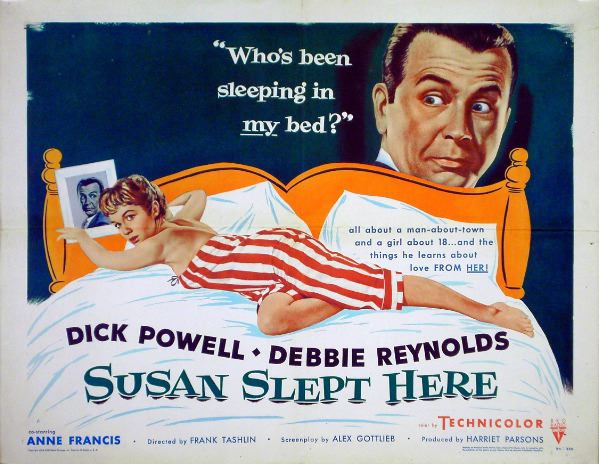
Looking for something a little offbeat in a Christmas movie? Try SUSAN SLEPT HERE, a film that could never get made today, as it concerns the romance between a 17 year old girl and a 35 year old man. I know some of you out there are already screaming “EEEEWWW!!!”, but indulge me while I describe the madcap moments leading to said romance.

susan3

For starters, the movie is narrated by Oscar. Not Oscar Levant, but THE Oscar, the fabled Academy Awards statuette. This particular Oscar was won by Mark Christopher, screenwriter of fluffy Hollywood comedies yearning to pen a dramatic yarn and prove his mettle as a writer. Into his life comes teenage Susan Landis, a juvenile delinquent dumped on his doorstep by two cops who don’t want to lock her up til after the holidays. They figure Mark can watch her and get a good story idea in the process before she…

View original post 693 more words

Cleaning Out The DVR, Again #4: The Talk of the Town (dir by George Stevens)


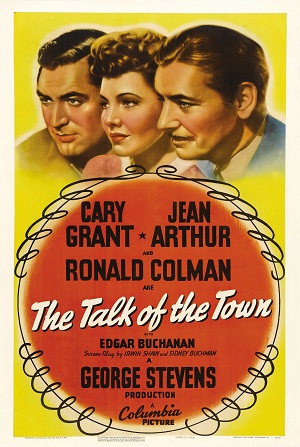
The_Talk_of_the_Town_dvd_cover

The fourth film on my DVR was the 1942 film, The Talk of the Town.  The Talk of The Town originally aired on TCM on March 20th and I recorded it because it was a best picture nominee.  As some of our regular readers undoubtedly know, it’s long been a goal of mine to watch and review every single film nominated for Oscar’s top prize.

The Talk of The Town is an odd little hybrid of comedy, melodrama, and a civics lecture.  Michael Lightcap (Ronald Colman) is a brilliant attorney and legal professor.  He’s been shortlisted for the Supreme Court and he’s also a widely read author.  In fact, he’s even rented a house for the summer, so that he may work on a book.  The owner of the house — teacher Nora Shelley (Jean Arthur) — will also be acting as his secretary.

As well-read as Prof. Lightcap may be, he’s also rather stuffy and out-of-touch with what’s going on outside of the world of academia.  He knows how the law should work but he has little understanding of how the law actually does work.  Fortunately, he gets a lesson in reality when he arrives at the house and eventually meets the gardener, Joseph (Cary Grant).  Joseph turns out to be surprisingly intelligent and very passionate about politics.  Lightcap and Joseph have many debates about whether or not the American legal system actually protects the working man.

What Lightcap doesn’t know is that Joseph is actually Leopold Dilg.  Leopold is a labor activist, the type who you always see in old documentaries, standing on a street corner and preaching about unions.  Leopold is also a fugitive.  He was accused of setting fire to a mill, a fire that apparently led to the death of the foreman.  Despite the fact that he loudly proclaimed his innocence, Leopold was arrested and prosecutors announced that they would seek the death penalty.  Convinced that he would never get a fair trial, Leopold escaped from jail and fled to Nora’s house.

Nora and Leopold went to school together.  They love each other, even though circumstances — mostly his political activism — conspired to keep them apart.  When Lightcap moves into the house, Nora and Leopold’s attorney, Sam (Edgar Buchanan), hope that they can convince him to take on Leopold’s case.  However, they also have to not only convince Leopold to reveal his true identity but also convince Lightcap to put his supreme court appointment at risk by defending a politically unpopular defendant.  Their solution is to trick Lightcap into falling in love with Nora and then convince him to take on the case for her.

However, Nora soons finds herself falling in love with Lightcap for real.  Who will she choose in the end?  Cary Grant or Ronald Colman?  Today, it seems like a pretty easy decision but apparently, in 1942, Columbia Pictures actually shot two different endings for the movie.

The Talk of The Town is an odd little movie.  For the most part, it’s a drama.  But it also has plenty of comedic elements, mostly dealing with the attempts to keep Leopold’s identity a secret.  In the end, it’s a little bit too preachy to really work as either a drama or a comedy.  That said, I still liked The Talk Of The Town because it made a strong case for the importance of due process, which is a concept that a lot of people take for granted.

(At the same time, The Talk of the Town was made in 1942 so you never have any doubt that Lightcap’s belief in the American legal system will eventually be vindicated.  With America having just entered World War II, 1942 was not a time for cynicism.  If Talk of the Town has been made in the 30s, it probably would have been a very different movie.)

Probably the best thing about Talk of the Town is the cast.  It may not be a great film but, when you’ve got Cary Grant and Jean Arthur in a scene together, it almost doesn’t matter.

The Talk of the Town was nominated for best picture but it lost to Mrs. Miniver.