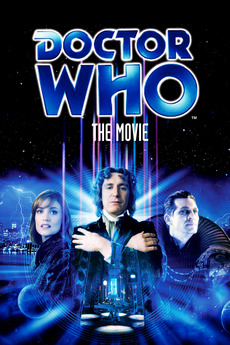
Doctor Who (1996, directed by Geoffrey Sax)


Paul McGann had the potential to be a great Doctor.

There’s a lot of negative things that can be said about the controversial 1996 attempt to reboot Doctor Who but I don’t think anyone can dispute that Paul McGann gave it his best.  Released during the period between the end of the original series and the 2005 revival, the 1996 version of Doctor Who features Sylvester McCoy’s Doctor getting gunned down by a San Francisco street gang and regenerating into Paul McGann.  McGann was a youthful Doctor, in the spirit of Peter Davison’s take on the character.  He played the role with a lot of enthusiasm and optimism.  If the 1996 film had led to the series getting revived, it’s easy to imagine Paul McGann making the role his own and becoming as identified with the Doctor as David Tennant and Matt Smith.

The presence of Sylvester McCoy was another praiseworthy aspect of the television film.  Though the TV movie is rightfully criticized for rewriting a good deal of the show’s continuity, it was still smart enough to bring back both McCoy and the TARDIS.  I wish McCoy had gotten a a more heroic death, though getting gunned down by a street gang is still more exciting than the bump on the head that led to Colin Baker turning into Sylvester McCoy in the first place.

The film features the newly regenerated Doctor trying to stop The Master (Eric Roberts) from using an artificial black hole known as the Eye of Harmony to destroy the Earth.  For some reason, the Eye of Harmony is located inside of the Doctor’s TARDIS and the Master needs to access the TARDIS so he can access the eye.  Meanwhile, the Doctor has just regenerated and doesn’t have all of his memories yet so he’s only fighting at half-strength.  Actually, the less said about the plot, the better.  The plot doesn’t make much sense.  Though Eric Roberts might seem like the perfect choice to play The Master, he doesn’t bring much to the role.  Roberts plays The Master as just being another generic villain, with none of the wit that Roger Delgado, Anthony Ainsley, or even Derek Jacobi brought to the role.

The most controversial part of the movie comes when the Master discovers that the Doctor is half-human, which is something that feels like it was forced on the production by an American television executive.  They probably thought that the audience wouldn’t be able to relate to the Doctor unless he has some human blood but it actually robs the character of the mystery that made him so popular.  Part of the Doctor’s appeal is that he’s an enigma but the television movie gives him an origin that seems like it was lifted from a comic book.  I guess we should just be happy that the people who made the film understood that Doctor Who wasn’t actually the character’s name.

Doctor Who was meant to be a pilot for a revival of the show, one that would have been an American/British co-production.  It didn’t lead to a reboot and I guess we should be happy about that because the weakest moments of the movie are the moments that were obviously designed to appeal to an American television audience, like the Doctor dealing with a very 90s street gang or sharing a kiss with an ER doctor.  It’s easy to imagine that the film would have led to a series that would have had more in common with The X-Files than the original Doctor Who.  With the film not leading to a series, Doctor Who would have to wait another 9 years before finally getting rebooted.

Still, it’s hard not to regret that Paul McGann didn’t get more opportunities to play the Doctor.  With a better script, he could have been one of the great ones.


Short Film Review: When Cary Grant Introduced Timothy Leary to LSD (dir by Geoffrey Sax)


The year in 1959 and Cary Grant (Ben Chaplin) is filming North by Northwest.  From what we see of him, he’s the Cary Grant that we’ve all read about — the handsome, charming, witty, but very guarded movie star who never seems to truly trust anyone.

On set, Grant is visited by a pushy Harvard professor named Timothy Leary (Aidan Gillen).  Leary explains that he’s recently read an interview in which Grant discussed using a new drug called LSD for therapeutic purposes.  Leary believes that the drug could possible be used to help humanity evolve into something better.  He says that he wants to take LSD and he wants Grant to guide him through his trip.  Grant rather stiffly explains that LSD should only be taken under medical supervision.  Leary, however, doesn’t have time for that.

Eventually, Leary and Grant do end up dropping acid together and, as you might have guessed, that’s where things start to get strange.  First off, Leary and Grant find themselves sharing the same trip.  While Grant tries to escape from Leary, they travel through Grant’s poverty-stricken childhood and they even find themselves being chased by the famous North By Northwest cropduster.  They also take a trip to Leary’s future, where he will someday be just as famous as Grant.  Leary proclaims that LSD will be the start of the counter culture while the far more conservative Grant grumbles that Leary is a charlatan and that most people won’t be able to handle the drug.  Along the way, we go through the usual innuendos about both men.  Even under the influence of LSD, Grant remains guarded about his sexuality while Leary struggles to convince Grant that he actually is prophet and not just a con artist looking to get rich through revolution.

Clocking in at just 20 minutes, When Cary Grant Introduced Timothy Leary to LSD is an enjoyably weird little film that makes sense once you realize that Chaplin and Gillen are not actually meant to be playing the real-life Grant and Leary but instead are playing fictionalized versions who both understand that, along with being historical figures, they’re also characters in a film.  By the end of the film, they’re less concerned with dealing with each other and more concerned with convincing those of us in the audience that one of them is right and the other one is wrong.  Ben Chaplin may not look like Cary Grant but he has the right brooding quality to be convincing as a troubled man who often feels trapped by his own persona.  Aiden Gillen, meanwhile, is far more cheerful as Timothy Leary, who he plays as being a bit of a trouble-making sprite.

Interestingly enough, the film is loosely based on fact.  Cary Grant did take LSD for therapeutic reasons and Timothy Leary did later go on to become a public figure as a result of his pro-acid advocacy.  It has been rumored that Leary and Grant actually did meet, though not necessarily during the filming of North by Northwest.  In the end, When Cary Grant Introduced Timothy Leary to LSD is an enjoyably weird short film that shows up occasionally on Showtime so keep an eye out for it.

4 Shots From 4 Films: Star 80, Doctor Who, The Dark Knight, Stalked By My Doctor: The Return


4 Shots from 4 Films is just what it says it is, 4 shots from 4 of our favorite films. As opposed to the reviews and recaps that we usually post, 4 Shots from 4 Films lets the visuals do the talking!

Eric Roberts, who turned 62 years old today, has appeared in over 500 movies since 1978.  Here are 4 shots from 4 of them.

4 Shots From 4 Films

Star 80 (1983, dir by Bob Fosse)

Doctor Who: The Movie (1996, dir by Geoffrey Sax)

The Dark Knight (2008, dir by Christopher Nolan)

Stalked By My Doctor: The Return (2016, dir by Doug Campbell)