(Lisa recently discovered that she only has about 8 hours of space left on her DVR! It turns out that she’s been recording movies from July and she just hasn’t gotten around to watching and reviewing them yet. So, once again, Lisa is cleaning out her DVR! She is going to try to watch and review 52 movies by the end of Sunday, December 4th! Will she make it? Keep checking the site to find out!)
On November 8th, I recorded the 1933 film The Emperor Jones off of Retroplex.
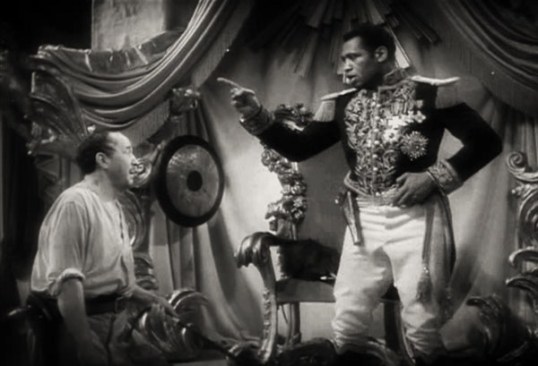
Based on a play by Eugene O’Neill, The Emperor Jones tells the story of Brutus Jones (Paul Robeson). When we first meet Jones, he’s at a small Baptist church. He has recently gotten a job as a Pullman Porter and the church’s congregation has gathered for his send off. He shows off his uniform. He sings a spiritual. The congregation blesses him and Jones swears that he will make them proud. However, soon after he starts working for the railroad, he finds himself in the city. Though he’s a hard worker, he makes the wrong friends. He falls for the beautiful but cold-hearted Undine (Fredi Washington). A fight at a craps gang leads to Jones accidentally stabbing his friend, Jeff (Frank H. Wilson).
Jones is sentenced to hard labor and finds himself working on a chain gang, where he’s watched over by sadistic and racist guards. Jones attempts to serve his time but, eventually, he’s driven to violence by the sight of a white guard beating another prisoner. Jones attacks the guard and then flees. Eventually, he escapes on a steamer ship. Quickly growing tired of shoveling coal in the ship’s engine room, Jones jumps overboard and swims to a nearby island.
On the island, Jones meets Smithers (Dudley Digges). Smithers is an alcoholic merchant who also happens to be the only white man in the island. Working with Smithers, Jones convinces the natives that he has magical powers and overthrows the island’s previous dicttor. Now thoroughly corrupted, Jones declares himself to be the Emperor Jones…
Interestingly enough — and this was probably especially revolutionary in 1933 — almost all of Jones’s corruption is learned from dealing with the white world. It’s through dealing with the condescending and wealthy passengers on the train that Jones comes to understand that money equals power. It’s from dealing with the white guards on the chain gang that Jones learns how people can be controlled through fear and brutality. By the time Jones arrives on the island, he no longer has anything to learn from the white world. Hence, Smithers becomes his servant.
(One thing I found particularly interesting, as I did research for this review, was that The Emperor Jones was banned in cities in both the North and the South. In the North, the film was often banned for its frequent use of the n-word. In the South, it was largely banned because of a scene in which Jones orders Smithers to light his cigarette.)
Seen today, The Emperor Jones is something of an oddity. On the one hand, it’s a very stagey film. The film’s origin as a stage play is obvious in almost every scene. On the other hand, it’s also one of the few films from the 1930s to actually feature black characters as something other than comic relief. If just for that historical reason, The Emperor Jones is still worth watching today.
It’s also worth watching for Paul Robeson’s performance in the lead role. Robeson, whose career was derailed by both his political activism and his refusal to accept roles that he considered to be demeaning, gives a powerful and empathetic performance. Towards the end of the film, Robeson gives a 12-minute monologue as he runs through the jungle. For 12 minutes, it’s just the viewer and Robeson (and the menacing sound of drums in the distance). As Robeson delivers his final monologue, he takes us on a journey through the Emperor’s mind, alternative between periods of delusion and moments of sudden clarity. Even 83 years after it was first filmed, it remains a truly impressive performance.
Keep an eye out for this fascinating historical document.
Louise Beavers and Fredi Washington in Imitation Of Life
The 1934 film Imitation of Life opens with Delilah Johnson (Louise Beavers) standing on the back porch of a house owned by widowed mother Bea Pullman (Claudette Colbert). Delilah says that she’s come for the housekeeping position. Bea tells her that there is no housekeeping position and quickly figures out that Delilah has the wrong address. As Delilah wonders how she’s going to get to the other side of town in time to interview for the job, Bea hears her toddler daughter falling into the bathtub upstairs. After Bea rescues her daughter, she agrees to hire Delilah as a housekeeper.
The rest of the film tells the story of their friendship. It turns out that, because she knows an old family recipe, Delilah can make the world’s greatest pancakes. Bea decides to go into business, selling Delilah’s pancakes and using Delilah as the product’s mascot. Soon Delilah’s smiling face is on billboards and she’s known as Aunt Delilah. When it comes time to incorporate the business, Bea and her partner, Elmer (Ned Sparks), offer Delilah 20% of the profits. They tell Delilah that they’re all going to be rich but Delilah protests that she doesn’t want to be rich. She just wants to take care of Bea and help to raise Bea’s daughter.
Delilah, incidentally, is African-American while Bea is white.
Despite the fact that Imitation of Life is considered to be an important landmark as far as Hollywood’s depiction of race is concerned, I have to admit that I was really uncomfortable with that scene. First off, considering that Delilah was the one who came up with recipe and her face was being used to sell it, it was hard not to feel that she deserved a lot more than just 20%. Beyond that, her refusal felt like it was largely included to let white audiences off the hook. “Yes,” the film says at this point, “Delilah may be a servant but that’s the way she wants it!”
It was a definite false note in a film that, up to that point and particularly when compared to other movies released in the 30s, felt almost progressive in its depiction of American race relations. Up until that scene, Bea and Delilah had been portrayed as friends and equals but, when Delilah refused that money, it felt like the film had lost the courage of its convictions.
However, there’s a shot that occurs just a few scenes afterwards. Several years have passed. Bea is rich. Delilah is still her housekeeper but now the house has gotten much larger. After having a conversation about Delilah’s daughter, Bea and Delilah walk over to a staircase and say goodnight. Bea walks upstairs to her luxurious bedroom while, at the same time, Delilah walks downstairs to her much smaller apartment. It’s a striking image of these two women heading different directions on the same staircase. But it also visualizes what we all know. For all of Delilah’s hard work, Bea is the one who is sleeping on the top floor. It’s a scene that says that, even if it couldn’t openly acknowledge it, the film understands that Delilah deserves more than she’s been given. It’s also a scene that reminds us that even someone as well-intentioned and kind-hearted as Bea cannot really hope understand what life is truly like for Delilah.
The film itself tells two stories, one of which we care about and one of which we don’t. The story we don’t care about deals with Bea and her spoiled child, Jessie (Rochelle Hudson). Jessie develops a crush on her mom’s boyfriend, Steve (Warren William). It’s really not that interesting.
The other story is the reason why Imitation of Life is a historically important film. Delilah’s daughter, Peola (Fredi Washington), is of mixed-race ancestry and is so light-skinned that she can pass for white. Throughout the film, Peola desperately denies being black and, at one point, stares at herself in a mirror and demands to know why she can’t be white. When Peola goes to school, she tells her classmates she is white and is mortified when Delilah shows up at her classroom. When Peola gets older, she attends an all-black college in the South but, eventually, she runs away.
When Delilah tracks her daughter down, Peola is working as a cashier in a restaurant. When Delilah confronts her, she is almost immediately confronted by the restaurant’s owner, who angrily tells her that the restaurant is a “whites only” establishment. Peola pretends not to know her mother.
Beyond the confrontation between Peola and Delilah, that scene in the restaurant is important for another reason. It’s the only time that the film provides any direct evidence as to why Peola wants to pass for white. Oh, don’t get me wrong. We all know why Peola thinks that society will treat her differently if it believes that she’s white. (And we also know that she’s right.) But this scene is the first time that the film itself acknowledges the fact that, in America, a white girl is going to have more opportunities than a black girl. Up until that point, white audiences in 1934 would have been able to dismiss Peola as just being selfish or unappreciative but, with this scene, the film reminds viewers that Peola has every reason to believe that life would be easier for her as a white girl than as an African-American. It’s a scene that would hopefully make audiences consider that maybe they should be angrier with a society that allows a restaurant to serve only whites than they are with Peola. It’s a scene that says to the audience, “Who are you to sit there and judge Peola when you probably wouldn’t even allow Delilah to enter the theater and watch the movie with you?”
Imitation of Life was nominated for best picture of the year and, though it lost to It Happened One Night, Imitation of Life is still historically important as the first best picture nominee to attempt to deal with racism in America. (Despite a strong pre-nomination campaign, Louise Beavers failed to receive a nomination. It would be another 5 years before Hattie McDaniel would be the first African-American nominee and winner for her role as Mammy in Gone With The Wind. Interestingly enough, McDaniel got the role after Beavers turned it down.)
Following the box office success of Imitation of Life, there were several films made about “passing.” The majority of them starred white actresses as light-skinned African-American characters. Imitation of Life was unique in that Fredi Washington, who played Peola, actually was African-American. As will be obvious to anyone who watches Imitation of Life, Fredi Washington had both the talent and the beauty to be a major star. However, she was considered to be too sophisticated to play a maid or to take on any of the comedy relief roles that were usually given to African-American performers. (And, as an African-American, no major studio would cast her in a lead or romantic role.) As such, her film career ended just three years after Imitation of Life and she spent the next 50 years as a stage performer and a civil rights activist. (For an interesting look at the history of African-Americans in the film industry, I would suggest checking out Donald Bogle’s Bright Boulevards, Bold Dreams: The Story of Black Hollywood.)
Like Peola, Washington herself could have passed for white. She was often asked if she was ever tempted to do so. I’m going to end this review with the answer that she gave to a reporter from The Chicago Defender:
“I have never tried to pass for white and never had any desire, I am proud of my race. In ‘Imitation of Life’, I was showing how a girl might feel under the circumstances but I am not showing how I felt. I am an American citizen and by God, we all have inalienable rights and wherever those rights are tampered with, there is nothing left to do but fight…and I fight. How many people do you think there are in this country who do not have mixed blood, there’s very few if any, what makes us who we are, are our culture and experience. No matter how white I look, on the inside I feel black. There are many whites who are mixed blood, but still go by white, why such a big deal if I go as Negro, because people can’t believe that I am proud to be a Negro and not white. To prove I don’t buy white superiority I chose to be a Negro.”

 Through the Shattered Lens