Larry Sutton (Randolph Scott) is an engineer who has been sent to take over operations at a radium mine that is owned by the Ballard family. Previously, Larry’s bother-in-law was in charge of the mine but he has disappeared and is suspected of having murdered the foreman at the Ballard Ranch. With Jim Ballard (George F. Marion) on his deathbed and being cared for by the foreman’s wife (Caroline Dudley, credited as Mrs. Leslie Carter), Ballard’s nieces (Ann Sheridan and Kathleen Burke) and nephew (Howard Wilson) have come to the ranch to find out about their inheritance.
Soon, a cloaked figure starts to murder Ballard’s heirs, one-by-one. Working with eccentric Deputy Sheriff Tex Murdock (Chic Sale), Larry tries to discover the identity of the killer and keep the mine from falling into the wrong hands.
Rocky Mountain Mystery is unique in that it is a Randolph Scott western that takes place in what was then modern times. Even though both Larry and Tex prefer to ride horses, the murderer tries to escape in a car, people use phones, and the entire plot revolves around a radium mine. The film mixes the usual western tropes of grim heroes, eccentric lawmen, and valley shoot-outs with a dark mystery that actually holds your attention while you’re watching the film. Always ideally cast in these type of films, Randolph Scott is both tough and intelligent as Larry Sutton. He may be a cowboy but he’s a detective too. Scott gets good support from a cast of familiar faces. Ann Sheridan is especially good as the niece who knows how to handle a rifle.
These B-westerns can be a mixed bag but Rocky Mountain Mystery held my attention with a plot that was actually interesting and a strong performance from Randolph Scott. Watch it and see if you can guess who the identity of the Ballard Ranch murderer.
The Life of Emile Zola, the winner of the 1936 Oscar for Best Picture of the Year, opens with two French artists living in a drafty apartment.
Emile Zola (Paul Muni) is destined to become one of France’s most popular and important writers. Paul Cezanne (Vladimir Sokoloff) will eventually become one of the most important artists of the post-impressionist movement. But for now, they’re just two struggling artists who have sworn that they will never sell out their principles. They are poor but they’re happy. That changes for Zola after he meets a prostitute named Nana (Erin O’Brien-Moore) and he uses her life story as the inspiration for a novel. The book is controversial and its frank content scandalizes France. The public censor comes close to banning it. But it also becomes a best seller. It’s the book everyone secretly owns but claims to have never read.
Zola writes several more books, all about the conditions of the working class in France. Eventually, he becomes what he claimed he would never be, a wealthy man living in a mansion and having little contact with the poor and oppressed. Cezanne sees Zola one last time, calling him out for having sold his talent for money. Cezanne explains that, on general principle, he can no longer be Zola’s friend.
Meanwhile, a quiet and rather meek family man named Captain Alfred Dreyfus (Joseph Schildkraut) has been arrested and accused of being a spy for Germany. There’s little evidence that Dreyfus is a spy. Indeed, most of the evidence seems to point to a Major Walsin-Esterhazy (Robert Barrat). But, because Dreyfus is considered to be an outsider, he is convicted in a show trial and exiled to Devil’s Island.
(In real life, it’s generally agreed that Dreyfus was a victim of anti-Semitism. As the only Jewish member of the army’s General Staff, Dreyfus was viewed with suspicion by his colleagues even before anyone knew that there was a German spy. The Life of Emile Zola doesn’t specifically state that Dreyfus was a victim of anti-Semitism, with the exception of a brief moment when one of his accusers looks at his personnel file and says, “He’s not one of us,” while pointing at the word “Jew.” Otherwise, the fact that Dreyfuss was Jewish is never mentioned in the film. It’s as if the film is going out of its way to avoid offending the very people that the movie is criticizing.)
After speaking to Dreyfus’s wife (played by Gale Sondergaard, who would later become the victim of a show trial herself when she was blacklisted as a suspected communist), Zola decides to take up Dreyfus’s case. He publishes an open letter — J’Accuse — in which he states that Dreyfus was not given a fair trial and that Dreyfus is innocent of the charges against him. Zola finds himself in court, accused of libel. Zola uses his trial to give Dreyfus the hearing that he never received. While the army boos his every utterance, the people of France rally to his side.
The Life of Emile Zola is an early example of the type of prestige production that today is often referred to as being an “Oscar picture.” It tells a true story. As a film that condemns the treatment of Alfred Dreyfus but avoids stating the obvious reason why Dreyfus was targeted in the first place, it’s political without being radical. And it features a performance from the most acclaimed actor of the era, Paul Muni. Muni gives a powerful performance as Zola, holding the viewer’s attention even during the lengthy trial scenes that take up most the second half of the film. That said, the true star of the film is Joseph Schildkraut, who plays Dreyfus as being a kind and trusting soul who finds himself caught up in a Kafkaesque nightmare. At one point, Dreyfus is given a gun and told that there’s one way that he can avoid being put on trial for treason. Schildkraut played the scene so well that I wanted to cheer when he refused to surrender.
The Life of Emile Zola is a big and, at times, self-consciously important production. It was clearly designed to win a bunch of Oscars and it certainly managed to do that. Compared to some of the other films nominated that year — The Awful Truth,Dead End, A Star is Born, Lost Horizon, Stage Door, In Old Chicago — The Life of Emile Zola can seem a bit stodgy. However, the performances of Muni and Schildkraut continue to make the film worth watching.
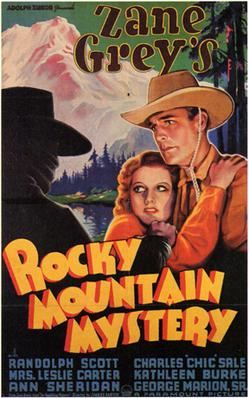 Larry Sutton (Randolph Scott) is an engineer who has been sent to take over operations at a radium mine that is owned by the Ballard family. Previously, Larry’s bother-in-law was in charge of the mine but he has disappeared and is suspected of having murdered the foreman at the Ballard Ranch. With Jim Ballard (George F. Marion) on his deathbed and being cared for by the foreman’s wife (Caroline Dudley, credited as Mrs. Leslie Carter), Ballard’s nieces (Ann Sheridan and Kathleen Burke) and nephew (Howard Wilson) have come to the ranch to find out about their inheritance.
 Through the Shattered Lens