Love On The Shattered Lens: Charming Sinners (dir by Robert Milton and Dorothy Arzner)


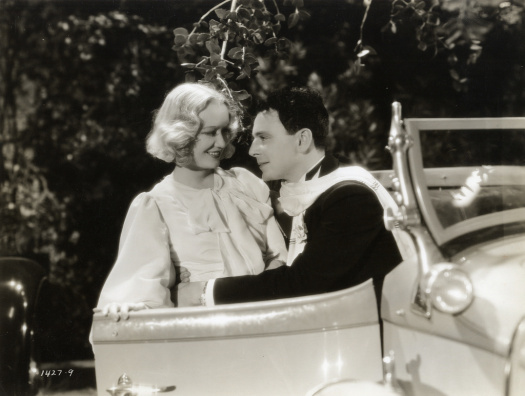
Based on a play by Somerset Maugham, 1929’s Charming Sinners takes place amongst the very rich.

Kathryn Miles (Ruth Chatterton) is married to Robert Miles (Clive Brook).  Robert is wealthy and a respected businessman and, through her marriage, Kathryn is also wealthy and …. well, she’s not quite respected.  The fact of the matter is that everyone is gossiping about the fact that Robert is cheating on Kathryn.  Kathryn denies that Robert is being unfaithful but she knows that he is.  She also knows that Robert is cheating with her best friend, Anne-Marie Whitley (Mary Nolan).  Even when Anne-Marie’s husband, George (Montagu Love), comes to suspect that Anne-Marie is cheating with Robert, Kathryn tells George that it isn’t true and defends her cad of a husband.

Why is Kathryn doing this?  As Kathryn explains it, she doesn’t feel that marriage necessarily means that you have to love someone.  Kathryn married Robert for the money and the status and, as long as she has that, she’s willing to overlook Robert’s dalliances.  Admitting that Robert is cheating would obligate her to go through a divorce and potentially lose everything that she has.  If this film had been released just a few years later than it was, the Production Code would have insisted that Kathryn suffer for her less-than-reverent attitude towards the institution of marriage.  Since this is a pre-code film, Kathryn is portrayed as being strong and determined.  What the Production Code would have deemed a drama, the pre-code era considered to be a comedy.

Still, Kathryn does get revenge on her husband by openly flirting with a former lover, Karl Kraley (William Powell, handsome and suave as ever).  Kathryn also makes some money on her own, proving to her husband that she could be a success even if she hadn’t married him.  Kathryn informs Robert that she is going to be living her own life, even if they are married.  And if Kathryn wants to take a lover, that’s her decision.

And good for Kathryn!  Seriously, Robert is so smug and sure of himself that it’s deeply satisfying to watch as Kathryn reveals that Robert was never as clever as he thought it was.  Though the film does not end with the dramatic divorce that some might expect, it does end with Kathryn taking control of her own life and making her own decisions about how she’s going to live it.  That type of ending is rare enough today.  One can only imagine how audiences in 1929 reacted to it.

But is the film itself any good, you may be asking.  It’s an early sound picture and while the cast all proves their ability to handle dialogue, the largely stationary camera often makes the film feel like a filmed play (which is largely what it was).  Like many pre-code films, the emphasis here is on how the rich have better clothes and better homes than the majority of the people watching the movie.  That’s not a problem for me.  I like looking at nice clothes and wonderfully decorated houses.  Some others may dismiss this film as just being about the problems of the rich but my personal opinion is that everyone has problems.  Wouldn’t you rather have problems as a wealthy person than a poor one?  The most important thing is that the film features two of the best actors of Hollywood’s early Golden Age, Ruth Chatteron and William Powell, and they both give excellent and charming performances.

Charming Sinners is a bit of time capsule and probably not for everyone.  If you’re not interested in the film’s era, it probably won’t hold your attention.  But, to a fashionable history nerd like me, Charming Sinners definitely had its charms.

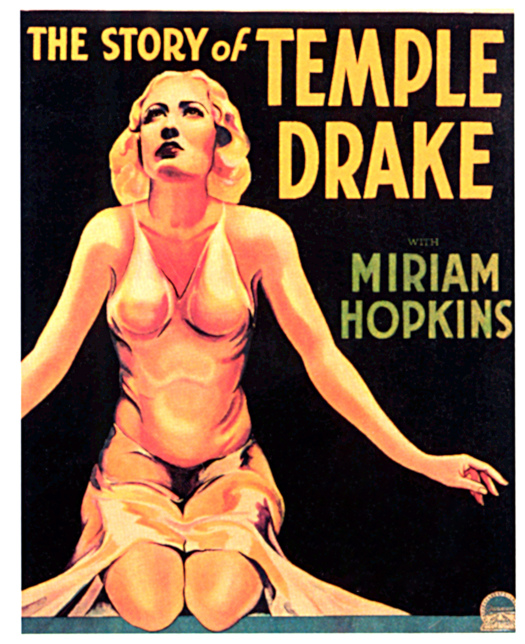
Pre-Code Confidential #24: THE STORY OF TEMPLE DRAKE (Paramount 1933)


gary loggins's avatarcracked rear viewer


I’d heard so much about THE STORY OF TEMPLE DRAKE – that it was so depraved and salacious it almost singlehandedly led to stricter enforcement of the Production Code – that it was almost a letdown when I first viewed it. I say almost because, knowing the era this adaptation of William Faulkner’s SANCTUARY was made, I understand how shocked audiences must have been. THE STORY OF TEMPLE DRAKE could be a TV Movie of the Week today, but in 1933 people couldn’t handle this level of lasciviousness.

Georgia-born Miriam Hopkins is outstanding as Southern belle Temple, though she does lay on the “sho’ nuffs” a little too thick at times. Temple, daughter of a prominent judge, is a wild child, a big tease to all the men in town. Solid, steadfast lawyer Stephen Benbow wants to marry her, but the self-centered Temple thinks he’s too dull, preferring to party…

View original post 661 more words

Lisa Reviews An Oscar Nominee: The Divorcee (dir by Robert Z. Leonard)


Before I get into reviewing the 1930 best picture nominee, The Divorcee, I want to share something that I recently posted on twitter:

I’m not just sharing this because it’s one of the best things that I’ve ever tweeted.  I’m also sharing it because it’s a beyond perfect description of Jerry (played, in an Oscar-winning performance, by Norma Shearer), the lead character in The Divorcee.  (Whenever you tweet something that is beyond perfect, you’ve earned the right to make sure everyone else knows it.)  The Divorcee came out in 1930 so, needless to say, it’s a bit dated but I totally related to the character of Jerry and that’s perhaps the main reason why I enjoyed this film.

The Divorcee tells the type of story that, today, would probably make for a memorable Lifetime film.  It’s a film that follows four friends over several years.  They are the idle rich, the type who go to parties, dance on tables, and cheerfully ignore the ban on liquor.  Jerry (Norma Shearer) loves Ted (Chester Morris).  Dorothy (Helen Johnson) loves Paul (Conrad Nagel).  However, Paul loves Jerry and when Jerry announces that she and Ted are engaged to be married, Paul doesn’t handle it well.  In fact, Paul gets drunk, Paul drives a car with Dorothy in the passenger’s seat, and eventually Paul crashes the car, leaving Dorothy so disfigured that she spends the rest of the movie wearing a black veil.

The years pass.  In order to make up for horribly disfiguring her, Paul agrees to marry Dorothy.  Jerry marries Ted.  They’re happy until they’re not.  On the day of their third anniversary, Jerry discovers that Ted has been cheating on her.  So, Jerry cheats on Ted.  When Ted gets upset, they file for divorce.

Suddenly, Jerry is …. (dramatic music cue) … THE DIVORCEE!

Ted becomes an alcoholic, the type who makes scenes at parties and destroys ornate wedding cakes.  In the past, I assume Jerry would have been forced to wear a scarlet D and she would have made it work because there’s nothing that Jerry can’t do.  However, since this film takes place in the 1920s, Jerry spends her time flirting and plotting to steal Paul away from Dorothy.

And it would have worked too if not for the fact that Dorothy is a complete and total saint…

Drinking, sex, adultery, disfigurement, and Norma Shearer!?  That’s right, this is a pre-code film!  The Divorcee is actually a pretty typical example of a type of film that was very popular during the 1930s and actually remains rather popular today.  This is a film where rich people do stupid things but look good doing it.  When an audience watches a film like this, they can both look down on the rich and vicariously experience their lifestyle.  No wonder these movies are so popular!

Anyway, I liked The Divorcee.  It’s an incredibly silly little film but it’s hard for me not to enjoy something this melodramatic.  Chester Morris and Conrad Nagel are stuck playing heels and Helen Johnson is a bit to saintly but it doesn’t matter because the film is pretty much designed to be a showcase for Norma Shearer, the most underrated of all of the Golden Age actresses.  (Far too often, Shearer is dismissed as simply being Irving Thalberg’s wife.)  Shearer gives a great performance.  She seems to be having the time of her life and it’s fun to watch.

The Divorcee was nominated for best picture but it lost to a far different picture, All Quiet On The Western Front.

the_divorcee_poster