Horror Film Review: The Revenge of Frankenstein (dir by Terence Fisher)


revengetitle

Last year, Gary reviewed the first of the Hammer Frankenstein films, The Curse of Frankenstein.  For today’s horror film review, I’m going to take a look at the second movie in Hammer’s Frankenstein series, 1958’s The Revenge of Frankenstein!

The Revenge of Frankenstein opens where The Curse of Frankenstein ended.  The monster (played by Christopher Lee in the first film) has been destroyed and Baron Frankenstein (Peter Cushing) has been sentenced to be executed for the monster’s crimes.  However, the Baron escapes the guillotine.  Instead, he arranges for a priest to be beheaded in his place.  Working under the name Dr. Stein, the Baron escapes to another village and, after several years, re-establishes himself as a wealthy and respected doctor.  While most of his patients are rich, Dr. Stein also helps the poor and the disabled.  By all accounts, he’s doing wonderful work but he’s also deliberately enigmatic, refusing to join the local doctors council.

Right from the beginning, we’re reminded of just how different Hammer’s Baron Frankenstein was from Universal’s version of the good doctor.  In the Universal films, Dr. Frankenstein — regardless of whether the doctor in question was Henry, Wolf, or Ludwig — was always portrayed as being misguided but ultimately noble.  If any of the Universal Frankensteins had been sentenced to death, it’s probable that they would have put on a stoic face, walked to the guillotine, and allow their head to roll.  In fact, they would have felt so responsible for the actions of the Monster that they probably would feel it was their moral duty to allow themselves to be executed.

That’s not the case when it comes to Hammer’s Baron Frankenstein.  Baron Frankenstein feels no guilt over what the Monster has done.  Go the guillotine?  No way!  Baron Frankenstein is determined to create life and if creating life means that other, lesser mortals end up dead … well, so be it.  As opposed to the Universal Frankensteins, who all developed god complexes after the success of their experiment, Baron Frankenstein has his god complex from the beginning.  And if Baron Frankenstein is a god, why shouldn’t a priest be sacrificed for the good of the Baron’s work?

Anyway, Dr. FrankenStein and his assistant, Dr. Kleve (Francis Matthews) are determined to once again bring the dead back to life.  This time, the plan involves transplanting the brain of hunchback Karl (Oscar Quitak) into a physically strong body (played by Michael Gwynn).  Dr. Kleve is worried that a brain transplant could lead to unforseen complications.  For instance, one of Dr. Stein’s chimpanzees reacts to being given an orangutan’s brain by turning into a cannibal.  However, Stein tells Dr. Kleve not to worry about it.  After all, what could go wrong?

Well, a lot goes wrong.  It’s a Frankenstein movie, after all.

I have to admit that, while I love Hammer’s Dracula films, I’ve never been a huge fan of their take on Frankenstein.  While Peter Cushing always makes for a wonderfully compelling and often chillingly evil Baron Frankenstein, the majority of the Hammer Frankenstein films always seem to move way too slowly.  Whenever I watch one of them, I always find myself growing rather impatient with the endless scenes of grave robbery and body stitching.  “HURRY UP AND BRING THAT DAMN THING TO LIFE!” I’ll find myself shouting.

However, I was actually pleasantly surprised by how well The Revenge of Frankenstein holds up.  That Cushing would give an excellent performance as Baron Frankenstein is to be expected.  But really, the entire film is well-acted and both Oscar Quitak and Michael Gwynn give poignant performances as Frankenstein’s latest experiment.  It’s a visually vibrant and nicely paced horror film, one that never drags like some of the later Hammer Frankenstein films.

The Curse of Frankenstein and The Revenge of Frankenstein make for a great double feature, especially in October!
James Bond Film Review: From Russia With Love (dir. by Terrence Young)


Hi there!  The name’s Bowman, Lisa Marie Bowman.  And tonight, I’m continuing the Shattered Lens’ look at the James Bond film franchise by reviewing 1963’s From Russia With Love.

The 2nd film in the Bond film series, From Russia With Love is considered by many to be one of the best entries in the franchise.  I happen to agree with them.  There’s a lot of talk right now that Skyfall could be the first James Bond film to receive an Oscar nomination for best picture.  Personally, I think From Russia With Love (and not Tom Jones) should have been named the best picture of 1963,  (Seriously, has anyone actually tried to watch Tom Jones recently?)

From Russia With Love opens with a tuxedo-clad James Bond sneaking around outside the type of opulent estate that every Bond villain seems to own.  Suddenly, Bond is attacked by a hulking assassin named Red Grant (played by a pre-Jaws Robert Shaw) and, as the audience watches shocked, Bond is apparently killed.  It’s only after Bond’s dead and on the ground that we learn the truth.  The man in the tuxedo wasn’t James Bond at all — instead, he was just some random henchman in a James Bond mask!  It turns out that Grant works for the villainous organization SPECTRE and this is all part of his training routine.  Now, you would be justified in wondering why SPECTRE would go through the trouble to make a next-to-perfect James Bond mask for a simple training routine but. ultimately, it doesn’t matter.  It’s a great sequence, that manages to be both fun and suspenseful at the same time.  It’s also a great set-up for the rest of the film.

SPECTRE and its mysterious leader (and this is the first time in which we get to see that iconic image of a hand stroking a white cat while a disembodied voice says evil things) want Bond dead.  The job of arranging Bond’s assassination is given to Kronsteen (played by Vladek Sheybal, who has a truly fascinating skeletal face).  When he’s not off being evil, Kronsteen is a chess grandmaster and, not surprisingly, he views his assignment as if it’s just one big chess game.  In order to kill Bond, he knows that he’s going to need a pawn.

That’s where Tatiana Romanova (played by Daniela Bianchi) comes in.  Tatiana is a cipher clerk at the Russian Embassy in Istanbul.  She is approached and given an assignment by Rosa Klebb (Lotte Lenya), a Russian intelligence agent who, unknown to Tatiana, is also working for SPECTRE.  Tatiana contacts MI6 and tells them that she’s willing to defect but only to James Bond.  Tatiana explains that she came across Bond’s picture in a Soviet Intelligence file and the insinuation is that she fell in love (or, at the very least, lust) with that picture.

(Interestingly enough, this parallels the fact that audiences had previously seen Sean Connery in Dr. No and, like Tatiana, spent the year between the two films fantasizing about James Bond themselves.  In that way, Tatiana is the perfect audience surrogate.)

James Bond is sent to Istanbul by M (Bernard Lee) but before he goes, he meets with the head of Q branch.  Desmond Llewelyn makes his first appearance in the Bond franchise here.  In a historic moment of film history, he gives Bond his first booby-trapped briefcase.

When Bond arrives in Istanbul, he meets with station head Kerim Bey (played by Pedro Armanderiz, who tragically committed suicide before From Russia With Love was released).  With the help of Kerim Bey and Tatiana (who Bond first meets with she turns up, naked, in his bed), Bond steals the Lektor decoder device from the Russian consulate.  Though Bond doesn’t realize this, he’s aided in this task by none other than Red Grant.  Grant has been following Bond and perversely, he’s been protecting Bond from KGB assassins so that he might have the chance to kill Bond himself.

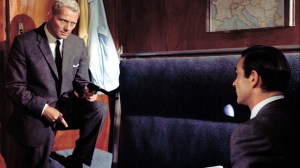
Bringing the Lektor device with them, Bond, Tatiana, and Kerim Bey board the Orient Express.  It’s on the train that they meet Nash, a British agent who says that he’s been sent by MI6 to help make sure that Bond and Tatiana safely make it back to England.  Of course, what the audience knows, is that the somewhat smug Nash is none other then … Red Grant!

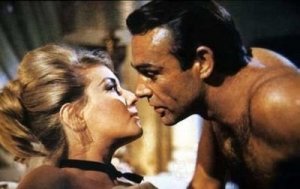
I love From Russia With Love.  Everything that makes the James Bond series so special — romance, memorable villains, spectacular locations, exciting action, and a rather sardonic sense of humor — is present in From Russia With Love.  Playing Bond for the second time, Connery is more confident with the role here than he was in Dr. No and, as opposed to some of his later appearances in the series, Connery appears to be enjoying bringing this iconic character to life.  There’s none of the boredom that marred some of Connery’s later performances.  Instead, Connery is exciting to watch and it helps that he and Bianchi have a very real chemistry in this film.  As opposed to some Bond girls, Tatiana is a believable, multi-layered character and you actually care what happens to her.  The relationship between Tatiana and Bond feels real and, therefore, the film has a surprising emotional resonance to it.

As opposed to Dr. No, with its somewhat bland title character, the villains in From Russia With Love are a fascinating quartet of rogues.  Lotte Lenya brings an unexpected amount of depth to the role of Rosa and her final battle with Bond is one of the best in the history of the franchise.  Even more exciting than Bond’s fight with Rosa is his final fight with Red Grant.  As played by Robert Shaw, Grant comes across as if he’s the literal personification of Bond’s dark side.  Both men are killers and both are rather smug about it but the difference is that Bond is capable of caring about Tatiana whereas Grant has surrendered whatever emotions he may have once had.  Shaw’s performance so dominates the film that, when I rewatched the film, I was surprised to discover that Grant is only in a handful of scenes.

If Dr. No was an enjoyable B-movie, then From Russia With Love was a cinematic masterpiece that transcended the limitations of genre.  If Dr. No established the basic conventions of James Bond, From Russia With Love showed that those conventions could be used to make a great film.

Tomorrow, we’ll be taking a look at the third film in the Bond franchise, Goldfinger.