Earlier this year, when I was sitting in the audience for the unfortunate Nicholas Sparks film The Best Of Me, I found myself staring at the sight of an oil rig worker (played by James Marsden) relaxing by reading Stephen Hawking’s A Brief History of Time. And, before I could stop myself, I laughed out loud and I may have even loudly said something along the lines of, “Oh come on!”
At the time, I got a lot of dirty looks but I stand by my reaction. It’s such a cliché. Any movie character who is meant to be intelligent and soulful will be seen casually reading a copy of Hawking’s book and scrunching up his brow as he considers whatever it is that Hawking has to say. It makes sense, of course. If the current cult surrounding Neil deGrasse Tyson proves anything, it’s that it is currently in to pretend to be fascinated by science.
I have to admit, though — science has never been my subject. The cold logic of it all bores me to tears and there’s no bigger turn-off then listening to someone brag about being a “rational thinker.” (Rational thought is incredibly overrated.) As long as things work like they’re supposed to, the how and the why don’t really concern me. Whenever I hear someone complain that there are “too many unanswered questions,” I think to myself, “Good.” I like unanswered questions. I like irrational feelings. I like mysteries that can never be solved. They fuel imagination. They inspire great art. They make life interesting and unpredictable.
(Please understand, I am not anti-science. I’m anti-pretending-to-care-when-I-don’t.)
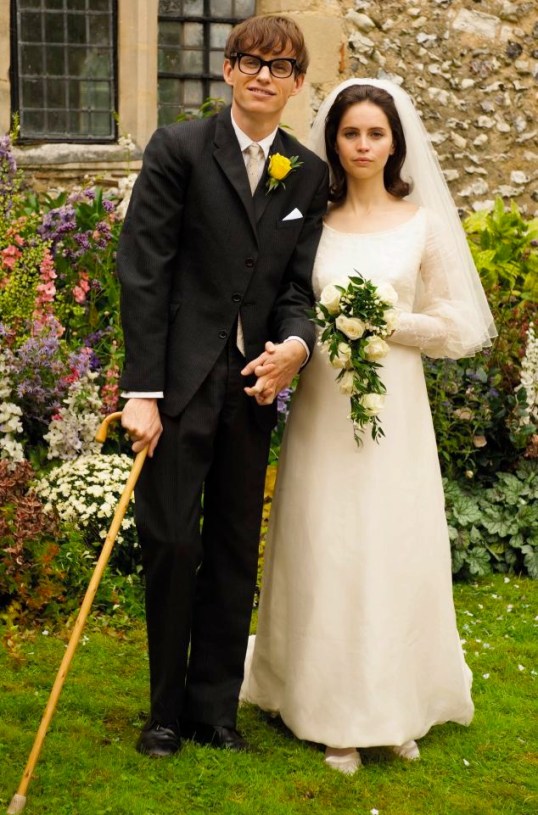
With all that in mind, you might think that I would be bored by The Theory of Everything, the recently released biopic about Stephen Hawking (Eddie Redmayne) and his marriage to Jane Hawking (Felicity Jones). And, I’ll be honest. If not for the fact that the film has been pegged as being a certain Oscar contender, I might not have ever wanted to see The Theory of Everything. However, seeing as how The Theory of Everything is a certain Oscar contender, I did want to see it.
And, up until the final 30 minutes of the film, I was surprised with just how much I liked The Theory of Everything. I have to admit that the film’s science still went over my head. As far as that was concerned, the only thing I really learned is that there’s a difference between General Relativity and Quantum Field Theory but don’t ask me to explain that difference. (And, for the love of all that is good, please don’t try to explain it to me…) But, to be honest, the exact details of Hawking’s theories aren’t really that important to The Theory of Everything. Instead, the film is content to have supporting characters assure us that Hawking’s work is brilliant and important and that’s really all that it has to do. After all, everyone in the audience already knows that Stephen Hawking is a genius. The appeal of The Theory of Everything is not the science but instead the human behind the science.
The Theory of Everything works for two very old-fashioned reasons — it’s well-directed by James Marsh and it’s well-acted by Eddie Redmayne and Felicity Jones. For all the time that the film devotes to people talking about how Hawking challenged the conventional view of the universe, The Theory of Everything is, in many ways, a conventional biopic. But that’s not necessarily a bad thing. A familiar story well-told is still a well-told story.
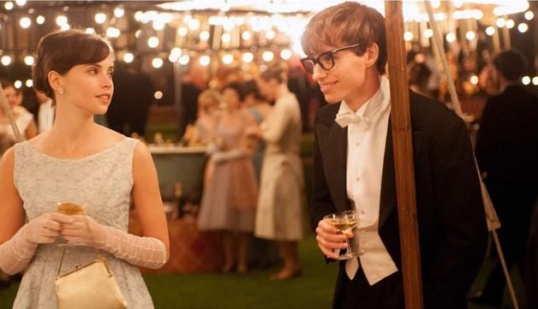
The film starts with Stephen as a student at Cambridge and we follow him as he awkwardly courts Jane and takes her on an amazingly well-filmed and soul-achingly romantic date. Shortly after this, he’s diagnosed with motor neuron disease. (As I discovered while doing some research for this review, Hawking was actually diagnosed before he even met Jane.) Told he only has two years to live, Stephen’s first instinct is to isolate himself from the world but, largely as a result of Jane’s love and support, Stephen instead continues his work and becomes world famous. The film suggests that it took a combination of Stephen’s logical (and skeptical) genius and Jane’s devout and unwavering faith (in both his genius and the God that Stephen doesn’t believe in) for him to eventually become the Stephen Hawking that we all recognize today.
And it’s all extremely well-done and touching, up until the final 30 minutes of the film. Going into the film, I did not know much about Stephen Hawking but (thanks to Wikipedia), I did know that he eventually left Jane for another woman. I have to admit that I did not expect the film to deal with this part of the story. To the film’s credit, it does attempt to deal with the end of Stephen and Jane’s marriage but it does so in such an awkward way that it’s obvious that the filmmakers weren’t quite sure how they should handle the situation.
After all, the film had just spent 90 minutes presenting Jane as being an occasionally frustrated saint and Stephen as being idiosyncratic but likable. And now, suddenly, Stephen is going to have to act like a jerk. The film doesn’t know how to handle this and, as such, those final 30 minutes feel fake in a way that the rest of the film does not. When Stephen tells Jane that he’s leaving her for another woman, it’s presented as being an almost mutual decision made by the two of them. Tears are shed but there’s little visible anger, with the film going so far as to suggest that Stephen is leaving Jane because he wants her to be able to live the life that she put on hold to take care of him. It’s even implied that Stephen was kind enough to pick out a new husband for her.
That new husband is played, quite well, by Charlie Cox. When he first told Jane that he’s attracted to her, I assumed that the scene was included so that Jane could gently rebuff him and show us how devoted she is to Stephen. However, thinking back on it now, it almost feels as if that scene was largely included so it could provide some cover for Stephen. It’s as if the filmmakers are saying, “See? Stephen wasn’t the only one tempted to end the marriage…”
And I have to admit that the way the film handled the end of Stephen and Jane’s marriage felt so false to me and the way Jane was treated and portrayed seemed so unfair that, as soon as I got home, I actually did the following google search: “Was The Theory Of Everything unfair to Jane Hawking?”
Reading the article, I discovered that, according to Jane’s autobiography (upon which the film is ostensibly based), both her marriage to and divorce from Stephen Hawking was far more complex and intriguing than what was presented in the film. For one thing, the marriage ended not with tears of acceptance but instead with a shouting match. And trust me, if any actress could have done justice to Jane Hawking’s anger, it would be Felicity Jones. By the time the film ends, both the character and the actress have earned the right to express their anger. But neither one of them gets that opportunity, largely because that version of the Hawking marriage would also have been far less crowd pleasing.
And, if anything, The Theory of Everything is specifically designed to be a crowd pleaser.
And don’t get me wrong. It’s a good film and it’s one that left me with tears in my eyes. Do I recommend the film? You bet I do.
I just wish that, during those final 30 minutes, the film could have been a little bit more honest with itself. It’s a good film but it’s hard not to regret missing out on the film that it could have been.
 —-
—- Through the Shattered Lens