Eager to get away from her abusive father (Sig Ruman), Connie Heath (Jane Bryan) keeps making the mistake of hanging out with the ultimate bad friend, Hilda Engstrom (Sheila Bromley). Hilda steals a dress from where they work and when the dress is torn, Hilda lets Connie take the blame. When the dress’s owner (Susan Hayward, making her film debut) insists on pressing charges, insurance investigator Neil Dillon (Ronald Reagan) helps Connie get off the hook and out of jail.
Having not learned her lesson, Connie continues to hang out with Hilda and her new boyfriend, Tony Rand (Anthony Averill). This time, Connie gets caught up in a bank robbery. Will Neil be able to get her out of another jam?
63-minutes long, Girl on Probation is a Warner Bros. B-movie. Ronald Reagan is surprisingly mellow as someone falling in love with a woman who keeps getting framed for his crimes she didn’t commit. Sheila Bromley steals the show as the out-of-control dangerous blonde who tells a priest, “I’m about to meet your boss.” The main problem with the film is that Connie is incredibly stupid. How many times can one person be framed? Jane Bryan, who played Connie, ended her acting career when she got married but she and her millionaire husband later helped to bankroll Reagan’s first political campaign and both of them were members of his unofficial “kitchen cabinet” when he was governor of California.
The movie has never been released on DVD and is hard to find. It plays on TCM occasionally, which is where I saw it. Online, the only place it appears to be streaming, ironically enough, is on a Russian site.
Yeah, yeah, I know. That sounds kinda silly, doesn’t it? However, November is traditionally the month that classic film bloggers tend to concentrate on writing about film noir. It provides a bit of grit and cynicism in between the horror fun of October and the holiday schmaltz of December.
I have to admit that I’m a little bit torn when it comes to taking part in Noirvember. On the one hand, I love a good film noir and there’s quite a few obscure and underrated ones available on YouTube right now. On the other hand, as a natural-born contrarian, I don’t like the idea of hopping on any bandwagons.
In the end, my love of film noir won out. So, welcome to my first entry in 30 More Days of Noir.
The 1950 film, Bunco Squad, tells the story of Tony Weldon (Ricardo Cortez), a con man who specializes in using a phony psychic routine to swindle rich people out of their money. He runs a fake enlightenment center and he claims that he can speak to the dead. His latest target is the wealthy Jessica Royce (Elisabeth Risdon). After he finds out that her son was killed during the invasion of Normandy, he and his associates go out of their way to trick her into believing that Tony can contact her son and that her son wants her to leave all of her money to Tony’s organization. It’s actually kind of interesting watching as Tony and his gang manage to track down information about Jessica and her son, asking the most mundane of questions to find out things that Jessica believes only her son would know. Watching Tony operate, I was reminded of those documentaries and news reports that you see about phony faith healers and other people who claim they can speak to the dead but who actually just go on very vague fishing expeditions. (“I’m sensing something about the letter L. Does that mean anything to you?”)
Tony is not just a con artist. He’s also a murderer, one who specializes in cutting brake lines on cars. If you try to expose Tony, you’re probably going to end up driving off of a cliff. I guess you can get away with that when you’re a con artist in California. Myself, I live in North Texas where the land is totally flat. Someone could cut my brake lines and I would probably just keep going forward until I eventually ran out of gas. Once that happened, someone would probably pull over and offer to give me a lift to the nearest gas station. That’s one reason why someone like Tony Weldon could never pull off any of his crimes in my home state.
Fortunately, the detective of the LAPD’s Bunco Squad know what Tony’s doing. The only problem is that they have to get some proof that Tony is swindling Ms. Royce and they have to manage to do it before Tony gets a chance to tamper with all of their brakes. Leading the Bunco Squad is Steve Johnson (Robert Sterling) and you better believe that there’s no way someone named Steve Johnson is going to be anything other than honest and upright. Working with a real-life magician named Dante, Johnson attempts to expose all of Tony’s tricks.
It’s probably open for debate whether or not Bunco Squad is a true noir. On the one hand, Tony and his schemes are very noirish. On the other hand, Steve and the members of the Bunco Squad are so upright that there’s none of the ambiguous morality that you find in the best film noirs. I guess I would call this a half-noir.
The best thing about Bunco Squad is that it’s only 67 minutes long, which is all the time that it needs to tell a compact and occasionally interesting story. There’s no excessive padding to try to force the story out to an unwieldy 90 minutes. Instead, Bunco Squad jumps right into its story and it doesn’t let up until things come to an end. The other good thing about Bunco Squad is that you’ve got Ricardo Cortez, giving a charmingly evil performance as Tony Weldon. The film’s heroes are a pretty dull bunch but Cortez brings a nice charge of danger to the proceedings.
Bunco Squad is an obscure film but it moves quickly and the story is interesting enough to hold your attention for an hour. It can be found on YouTube.
The title of the 1937 film They Won’t Forget works on many levels.
It describes the reaction of a small Southern town, following the brutal murder of teenager Mary Clay (played, in her film debut, by Lana Turner). The town won’t forget Mary and they won’t forget the terror caused by her murder. They also won’t forget that local teacher Robert Hale (Edward Norris) was accused of the crime.
The district attorney, Andrew Griffin (Claude Rains), hopes that the people of his state won’t forget his efforts to see Griffin convicted of that crime. Griffin wants to be elected to the U.S. Senate and he knows that the high profile case could be just what his career needs.
The Governor (Paul Everton) knows that, if he steps into the case and acts on his suspicion that Hale is innocent, the voters of his state will never forget. And they certainly won’t be willing to forgive.
And, on a larger level, the title lets us know that the South and the North will never forget the Civil War and the conflict between the two regions. The film opens with three elderly veterans of the Confederate Army, preparing to march in the town’s annual Confederate Memorial Day parade and admitting to each other that, after all these years, it’s difficult to remember much about the war other than the fact that they’re proud that they fought in it.
It’s while the rest of the town is busy watching Griffin and the governor ride in the parade that Mary Clay is murdered. It’s easy to assume that Hale was the murderer because Hale was one of the few townspeople not to go to the parade. You see, Hale is originally from New York City. When he’s accused of murder, it’s equally easy for Griffin and tabloid reporter William A. Brock (Allyn Joslyn) to convince the town people to blame this Northern intruder for both the murder of Mary Clay and, symbolically, for all of the post-Civil War struggles of the South itself.
Meanwhile, up North, Hale is seen as a victim of the South’s intolerance. A high-profile lawyer (Otto Kruger) is sent down to defend Hale but, as quickly becomes clear, everyone involved in the case is more interested in refighting the Civil War than determining the guilt or innocence of Andrew Hale.
They Won’t Forget is a hard-hitting and fascinating look at politics, justice, and paranoia. It’s all the more interesting because it’s based on a true story. In 1913, a 13 year-old girl named Mary Phagan was murdered in Atlanta. Leo Frank was accused and convicted of the murder. (In Frank’s case, he was born in Texas but was also Jewish and had previously lived in New York before moving to Atlanta, all of which made him suspicious in the eyes of many.) On the word of a night watchmen, who many believe was the actual murderer of Mary Phagan, Leo Frank was convicted and sentence to death. After spending days reviewing all of the evidence and growing convinced that Frank had been wrongly convicted, Georgia’s governor committed an act of political suicide by commuting Frank’s sentence to life imprisonment. Leo Frank was subsequently lynched and the man who had prosecuted the case against him was subsequently elected governor.
Well-acted and intelligently directed, They Won’t Forget is probably one of the best films of which few people have heard. Fortunately, it shows up fairly regularly on TCM and, the next time that it does, be sure to watch. It’s a great film that you won’t easily forget.
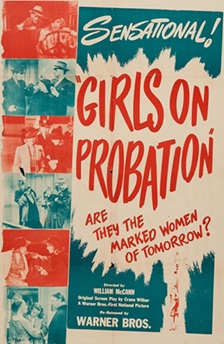 Eager to get away from her abusive father (Sig Ruman), Connie Heath (Jane Bryan) keeps making the mistake of hanging out with the ultimate bad friend, Hilda Engstrom (Sheila Bromley). Hilda steals a dress from where they work and when the dress is torn, Hilda lets Connie take the blame. When the dress’s owner (Susan Hayward, making her film debut) insists on pressing charges, insurance investigator Neil Dillon (Ronald Reagan) helps Connie get off the hook and out of jail.

 Through the Shattered Lens