Love On The Shattered Lens: Hot Saturday (dir by William A. Seiter)


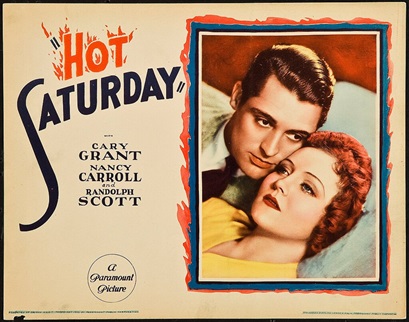
First released in 1932 and featuring Cary Grant in his first leading role, Hot Saturday is a film about gossip and love.

Ruth Brock (Nancy Carroll) is a young bank teller living in a small town.  It’s the type of town where everyone knows everyone else.  For instance, everyone knows that every man in town wants to date Ruth but that Ruth, for her part, is not in any hurry to settle down and get married.  She’s having too much fun going to dances, drinking with her friends, and enjoying life.  Everyone knows that playboy Romer Sheffield (Cary Grant) is interested in Ruth but then again, Romer appears to be interested in everyone.  Romer has scandalized the town by allowing a woman named Camille (Rita LaRoy) to live at his mansion.

Ruth has a date with one of her coworkers, Conny Billop (Edward Woods), but, when Conny refuses to take no for an answer, she gets away from him and ends up at Romer’s estate.  Ruth and Romer spend the night together, just talking.  Still, thanks to Conny and Eva (Lillian Bond), the daughter of Ruth’s boss, the whole town is soon convinced that Ruth is Romer’s lover.  The town is so scandalized that Ruth even loses her job.

Fortunately, Bill Fadden (Randolph Scott) has returned to town.  Bill is a geologist.  He grew up in town, with Ruth.  He’s spent the last seven years on a surveying expedition but now he’s back and he wants to marry Ruth.  How lucky is Ruth?  She not only has two good men in love with her but one of them looks like Cary Grant and the other one looks like Randolph Scott!  However, when Bill hears the rumors, will he continue to love her or will he be yet another person who gives in to the curse of small town gossip?

Hot Saturday is a film that truly took me by surprise.  It’s a pre-code film and it’s one that has all of the usual tropes that one usually associates with the pre-code era.  Everyone’s obsessed with sex.  There’s a lot of kissing.  There’s a lot of drinking.  There’s an emphasis on legs and lingerie.  There’s even a scene where Ruth gets into a wrestling match with her younger sister when she discovers that her sister has taken her new panties.  I’m one of four sisters so I could certainly relate but it’s still not the sort of thing that one necessarily expects to find in a film from the 1930s.  But that’s one reason why I love the Pre-Code era.  Allowed to police itself, pre-code Hollywood made films that were more realistic and open about their subject matter than the films made under the production code but which also still had their own unique innocence to them.  Hot Saturday has an ending that would have never been allowed during the Code era, one that is, dare I say it, rather empowering.

But, beyond all that, Hot Saturday is an intelligently written film that strikes a good balance between drama and character-driven comedy.  Nancy Carroll is beautiful and likable in the lead role.  Cary Grant and Randolph Scott are both as handsome and charming as can be.  Hot Saturday is both a look at the reality and dangers of small town gossip and a touching love story.  I enjoyed it.

An Offer You Can’t Refuse #1: The Public Enemy (dir by William Wellman)


For this month, I’ve decided to review movies about mobsters.

There’s no specific reason for that, beyond the fact that I just happen to love mobster movies.  Of course, a good gangster film is rarely just about crime.  Anyone who has ever seen The Godfather can tell you that.  At their best, American gangster films are about the American dream and the lengths that some will go to achieve it.

Plus, they’re just a lot of fun to watch.  Some of the greatest actors of all time made their mark in gangster films.

Take 1931’s The Public Enemy, for instance.

Produced during the final days of prohibition and the early years of the Great Depression, The Public Enemy tells the story of three boys who grew up poor.  Tom Powers (James Cagney) and his friend, Matt Doyle (Edward Woods) pursued a life of crime, rising through the ranks of organized crime before eventually meeting a tragic end.  The third, Mike Powers (Donald Cook), stayed on the straight-and-narrow path.  He went into the Marines and he rebuked his brother, Tom, when he discovered that Tom’s money was due to “blood and beer.”

The film opens and closes with a title card that basically tells us that Mike Powers has the right idea but, when you watch the film, you can’t help but wonder if maybe Tom had a point about his brother being kind of a sap.  Mike might be a decent citizen and he might have a chestful of medals as the result of his wartime heroics but what else does he have?  Tom Powers, meanwhile, has no education and, it would appear, no conscience, no real friends, and no one that he really loves and yet he becomes a rich man who is acquainted with powerful figures.  While Mike stays at home with their mother, Tom lives in an ornate penthouse.  When his first girlfriend (Mae Clarke) gets on his nerves, Tom shoves a grapefruit in her face and then gets an even more glamorous girlfriend, Gwen (Jean Harlow).  (Meanwhile, even dumb old Matt is doing okay for himself, marrying a woman played by Joan Blondell.)  It’s hard not to imagine that the film’s original audience — who were still reeling from the Stock Market Crash of 1929 — looked at Mike and Tom Powers and quickly decided that they’d much rather be a part of Tom’s life than Mike’s.  Even if Tom is destined for an early grave or a lifetime behind bars, at least he appears to be having fun.  Speaking for myself, I’d much rather go out with the guy who has nice clothe and his own luxury apartment than with the self-righteous dud who is still living at home with his mother.

Of course, another reason why we gravitate towards Tom Powers is because he’s played by James Cagney, who was one of the most charismatic of the stars of Hollywood’s Golden Age and whose performance still holds up today.  Cagney gives a ferocious performance, snarling out his lines and always moving like a caged animal, even when he’s just preparing to have breakfast.  He’s full of an energy that’s both dangerous and exciting to watch.  Cagney also brings a very powerful anger to the role of Tom Powers.  As played Cagney, Tom Power is not just a criminal because he’s greedy.  He’s also a criminal because he has no use for a society that he feels has rejected him since birth and which has never given him a fair chance.  He becomes wealthy not just because he wants money but because he wants to taunt everyone who ever said that he wouldn’t amount to anything.  He’s every crime is more than act of greed.  It’s also an act of rebellion, a joyful to a society that wants to tell people what they’re allowed to believe and do.  He’s the ultimate 1930s rebel, giving the the finger to not only the two Hoovers (Herbert and J. Edgar) but also to the good government leftists would be soon be swept into power with FDR.  Despite the fact that The Public Enemy was made nearly 90 years ago, there’s nothing creaky about Cagney’s performance.  It still feels vital and powerful today and it elevates the entire film.

The Public Enemy holds up surprisingly well.  The film may be close to 90 but Cagney’s ferocious performance still feels fresh and powerfully alive.