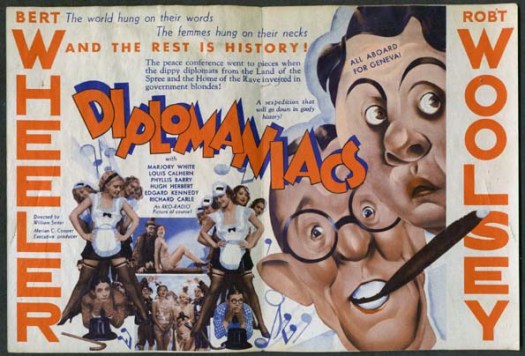
Political satire in film ran rampant during the Pre-Code Era. Somewhere between W.C. Fields’s MILLION DOLLAR LEGS and the Marx Brothers’ DUCK SOUP sits DIPLOMANIACS, Wheeler & Woolsey’s madcap take on war and peace, 1930’s style. It’s purely preposterous, unadulterated farce, and is guaranteed to offend someone, if not everyone.
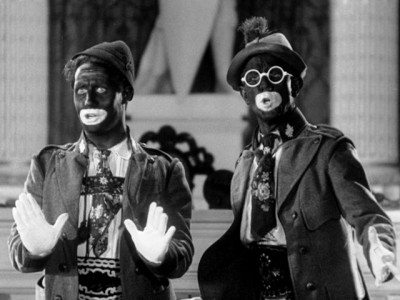
Let’s get it out of the way right now: DIPLOMANIACS is not politically correct in any way, shape, or form. It’s loaded with racist stereotypes, casting Hugh Herbert as a not-so-wise Chinaman (“It is written that it is written that it is written that it is written”), lambastes Jews, Native Americans, and homosexuals, and portrays women as sex objects (spy Marjorie White is delivered in plastic wrap). A bomb tossed into the peace talks causes everyone to turn blackface, leading to a prolonged minstrel number! If you’re already offended, stop reading… but if you can take the heat, by all…
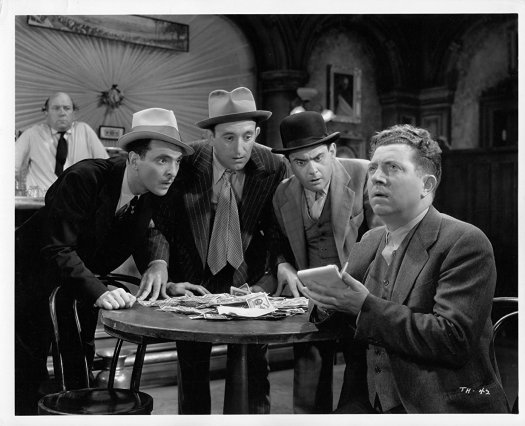
Frank McHugh got a rare starring role in the comedy THREE MEN ON A HORSE, based on the hit Broadway play by George Abbott and John Cecil Holmes. McHugh was usually cast as the funny friend of fellow members of “Hollywood’s Irish Mafia “ James Cagney and Pat O’Brien, but here he takes center stage as a meek, hen-pecked type who has an uncanny knack for picking winning horses – as long as he doesn’t bet on them!
Greeting card writer Erwin Trowbridge is beset by a whiney wife, obnoxious brother-in-law, and bullying boss. After a row with wifey brought on by meddling bro-in-law, Erwin leaves his humble Ozone Park, Queens abode and decides to skip work and get sloshed. Stumbling into a seedy hotel bar frequented by Runyonesque gamblers, Erwin gives them a winning pony – then passes out. The three mugs, Patsy, Charlie, and Frankie, bring him up…
Culver City’s MGM “dream factory” and Gower Gulch’s PRC were miles apart both literally and figuratively. Metro-Goldwyn-Mayer boasted “more stars than there are in heaven”, while tiny Producer’s Releasing Corporation films starred faded names like Neil Hamilton, Harry Langdon, Bela Lugosi , and Anna May Wong. MGM films featured lavish, opulent sets; PRC’s cardboard walls looked like they would fall over if an actor sneezed. Poverty Row PRC movies were dark and grainy; MGM created glossy, gorgeous Technicolor productions. MGM specialized in big budget extravaganzas, whereas PRC rarely spent more than $1.98. Miles apart – so why did major studio MGM purchase and release a movie originally made for minor PRC, HITLER’S MADMAN?
For one thing, it’s a damn good film, and an important one as well. Based on the true-life atrocity of the destruction of Lidice, Czechoslovakia on June 10, 1942 after the assassination of Nazi Reichsprotektor Reinhardt Heydrich, known as “The Hangman of Prague”, HITLER’S MADMAN was…
The comedy team of Wheeler & Woolsey is pretty esoteric to all but the most hardcore classic film fans. Baby-faced innocent Bert Wheeler and cigar-chomping wisecracker Robert Woolsey made 21 films together beginning with 1929’s RIO RITA (in which they’d starred on Broadway), up until Woolsey’s untimely death in 1937. I had heard about them, read about them, but never had the chance to catch one of their films until recently. HOLD ‘EM JAIL makes for a good introduction to W&W’s particular brand of lunacy, as the boys skewer both the prison and college football genres, aided by a top-notch comic supporting cast that includes a 16-year-old Betty Grable.
Football crazy Warden Elmer Jones (slow-burn master Edgar Kennedy ) is the laughing-stock of the Prison Football League. His team hasn’t had a winning season in years, and he sends a message to the president of “the alumni association” to send some new recruits “for the old…
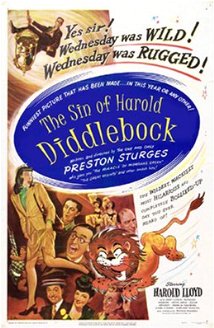
The 42nd film in Mill Creek’s Fabulous Forties box set was a 1947 comedy called The Sin of Harold Diddlebock.
As a classic film lover, I really wish that The Sin of Harold Diddlebock was better than it actually is. The film was a collaboration between two of the biggest names in cinematic comedy history: director/writer Preston Sturges and legendary actor Harold Lloyd. In fact, this was the first film that Sturges directed after leaving the studio system so that he could make bring his unique brand of satire to life without having to deal with interference. He managed to convince Harold Lloyd to come out of retirement to star in the movie and the film even works as a quasi-sequel to one of Lloyd’s most beloved silent comedies, The Freshman. In a perfect world, The Sin of Harold Diddlebock would have been a comedy masterpiece that would have perfectly shown off the talents of both men.
Unfortunately, that’s really not the case. The Sin of Harold Diddlebock is consistently amusing but it’s never quite as funny as you want it to be. This is one of those films that sounds like it should be hilarious but, when you actually watch it, you see that the film is oddly paced and Lloyd never seems to be fully invested in his role. I suppose the natural inclination would be to blame this on interference from the notoriously eccentric Howard Hughes, who co-produced the film with Sturges. After Harold Diddlebock failed at the box office, Hughes withdrew it and spent three years personally reediting the film before re-releasing it under the title Mad Wednesday. However, by most reports, Hughes wasn’t really the problem. If Wikipedia is to be believed (and God do I hate starting any sentence with that phrase), Lloyd and Sturges did not have a good working relationship. As sad as that is, it’s also understandable. Geniuses rarely work well together.
The Sin of Harold Diddlebock does get off to a good start, seamlessly incorporating the last reel of The Freshmen with footage shot for Harold Diddlebock. (Somewhat sweetly, the film starts with a title card informing us that the what we are about to see was taken from The Freshman.) After college freshman Harold Diddlebock scores the winning touchdown in a football game, impressed advertising executive J.E. Waggleberry (Raymond Walburn) offers Harold a job. However, Harold wants to finish college so Waggleberry tells Harold to look him up in four years.
Four years later, recently graduated Harold goes to Waggleberry for a job and discovers that J.E. Waggleberry has totally forgotten him. Harold ends up working in the mailroom but is told that, as long as he is ambitious and smart, he will easily move up in the company. 22 years later, Harold is still working in the mailroom. He is secretly in love with Miss Otis (Frances Ramsden). Of course, he was also in love with each of Miss Otis’s six older sisters, all of whom worked at the company before the current Miss Otis. Harold bought an engagement ring when the oldest Otis sister was with company. Years later, he’s still carrying it with him and dreams of giving it to the current Miss Otis.
However, that might be difficult because Harold has just been fired. J.E. Waggleberry feels that Harold’s unambitious attitude is setting a bad example. As severance, Harold is given a watch and $2,946.12.
The normally quiet and reserved Harold reacts to losing his job by doing something very unusual for him. He goes to a bar and, with the help of a con man (Jimmy Conlin) and a bartender (Edgar Kennedy), he gets drunk. The bartender even creates a special drink called the Diddlebock. Harold drinks it and wakes up two days later, wearing a huge cowboy hat and owning a bankrupt circus…
And it only gets stranger from there….
While The Sin of Harold Diddlebock doesn’t quite work, I appreciated the fact that it not only created its own surreal world but that it just kept getting stranger and stranger as the film progressed. It was Harold Lloyd’s final film and there’s even a scene where he and a lion end up on the edge of a skyscraper that’s almost as good as the famous comedic set pieces from his silent classics. It’s a pity that the film doesn’t really come together but I’d still recommend seeing it just for history’s sake.
— Mrs. Norman Maine (Janet Gaynor) in A Star Is Born (1937)
When I first saw the red neon of the opening credits of the 1937 best picture nominee, A Star Is Born, I thought to myself, “This is a real movie movie.” And I was so impressed by that thought that I even jotted it down in my review notes and now, looking down at my notes, I’m struggling to figure out how to explain just what exactly it was that I meant.
I think that what I was trying to say, in my own way, was that, when we think of a typical big budget Hollywood romance, A Star Is Born is the type of film of which we tend to think. It’s a big, glossy film that is shot in vibrant technicolor and which features a self-sacrificing woman (Esther Blodgett, played by Janet Gaynor) falling in love with a self-destructive but ultimately noble man (Norman Maine, played by Fredric March). It’s a film that has romance, humor, and tragedy. It’s a film that’s designed to make you laugh, cry, and ultimately fall in love. It’s pure melodrama, the type of film that would probably be made for Lifetime today. (And, in fact, it has been remade for Lifetime a number of times, just never under the title A Star Is Born.)
It’s a familiar story that, if I may indulge in a cliché, as old as the movies. Esther is a girl who lives on a farm in North Dakota and she wants to be a star, despite being told by her aunt that she need to start concentrating on finding a man and having children. Esther’s grandmother (Fay Robson) tells Eleanor to pursue her dreams and loans her some money to take with her to Hollywood.
With stars in her eyes, Esther goes out to California and deals with rejection after rejection. (She does, however, manage to rent out an apartment. The weekly rent is $6.00.) Esther does befriend an assistant director (Andy Devine) who gets Esther a job as a waitress at a party. As Esther serves the food, she imitates everyone from Katharine Hepburn to Mae West, all in an attempt to get noticed.
And, amazingly enough, it works! She meets film star, Norman Maine. With Norman’s help, she gets her first screen test and, after her name is changed to Vicki Lester, Esther is put under contract to a studio. She and Norman also fall in love and soon end up married. However, while Vicki Lester is rising to stardom, Norman is descending into irrelevance. He’s an alcoholic who has managed to alienate almost everyone in Hollywood. When Vicki wins her first award, Norman shows up at the ceremony drunk and destroys what little is left of his career.
Will Vicki be able to save Norman from his demons? And will she be able to do so without destroying her own career?
Well, you probably already know the answer. A Star Is Born is one of those stories that everyone seems to know, regardless of whether they’ve actually seen the film or not. (And even if they haven’t seen the 1937 version, chances are that they’ve seen one of the many remakes or ripoffs.) The original Star Is Born is an undeniably familiar and old-fashioned movie but it holds up as a celebration of both old Hollywood glamour and a heartfelt romance.
As I sit here writing this, I’m snowed in, my asthma’s acting up, and our cat is quickly losing patience with me. On the plus side, however, this weather has given me an opportunity to watch some more of the old best picture nominees that I had saved up on my DVR.
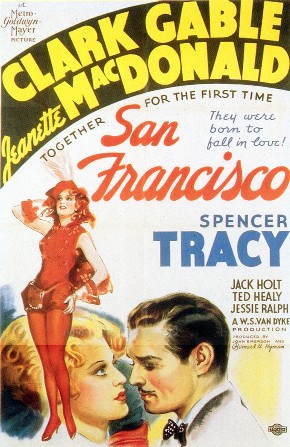
For instance, I just finished watching the 1936 best picture nominee, San Francisco.
San Francisco was one of the first disaster films, a film that follows a group of characters as they attempt to survive the 1906 earthquake that destroyed the town of San Francisco. And it has to be said that, nearly 80 years after the film was first released, the climatic earthquake remains effective and scary. San Francisco, of course, was made long before there was any such thing as CGI. Many of the film’s sets were built on special platforms that were designed to shake back and forth, just like in an actual earthquake. When you see walls and buildings collapsing in San Francisco, you know that those walls are breaking apart and collapsing for real and the extras running for their life are literally doing just that. After the earthquake, Clark Gable, as the film’s hero, walks through the ruins of San Francisco with the haunted look of a true survivor. Gable was such a confident actor that it’s still jarring to see him looking overwhelmed.
Unfortunately, before you get to that spectacular earthquake, you have to sit through the rest of the film. It’s a massive understatement to say that the pre-earthquake portion of San Francisco drags. Clark Gable is Blackie Norton, a notorious gambler and saloon keeper. Blackie may be a rogue but he’s a rogue with a heart of gold. His childhood friend, Father Tim (Spencer Tracy), wants Blackie to run for the board of supervisors. Blackie, however, is more interested in Mary Blake (Jeanette MacDonald), the newest singer at his club.
OH MY GOD, IS THIS WHOLE MOVIE JUST GOING TO BE JEANETTE MacDONALD SINGING!? WHERE'S THE EARTHQUAKE!? #SanFrancisco
— Lisa Marie Bowman (@LisaMarieBowman) March 5, 2015
From the minute she first appears to the very end of the film, Jeanette MacDonald is singing. Even when she’s not at the center of the scene, you can often hear her singing in the background. And, after a little while, you just want her to stop singing. But, whenever that happens, she tries to act and you realize that the only thing more boring than Jeanette MacDonald singing is Jeanette MacDonald acting.
Anyway, the film goes through all of the expected melodrama. Blackie wants to reform. Blackie decides not to reform. Father Tim believes that there’s good in Blackie. Father Tim gives up on Blackie. Father Tim decides to give Blackie another chance. Mary loves Blackie. Mary fears Blackie. Mary leaves Blackie. Mary comes back to Blackie. Mary leaves Blackie again. Mary sings. And sings and sings and sings…
But then, just when you’re about to fall asleep, the city starts to shake and all is forgotten in the wake of a natural disaster. Even earthquakes serve a purpose…
San Francisco was a huge box office success. It was nominated for best picture. Somehow, Spencer Tracy received a nomination for best actor, despite the fact that he’s really not that impressive in the film. (His role is primarily a supporting one and he’s consistently overshadowed by Gable.) The only Oscar that San Francisco won was for best sound recording and it must be said that, after all these years, the earthquake still sounds terrifying.
As for the film itself, I’d suggest skipping ahead to the earthquake. That, after all, is the main reason anyone would be watching the film and, by skipping ahead, you’re spared having to sit through an hour and a half of Jeanette MacDonald singing.





 Through the Shattered Lens