Lisa Reviews An Oscar Winner: The Broadway Melody (dir by Harry Beaumont)


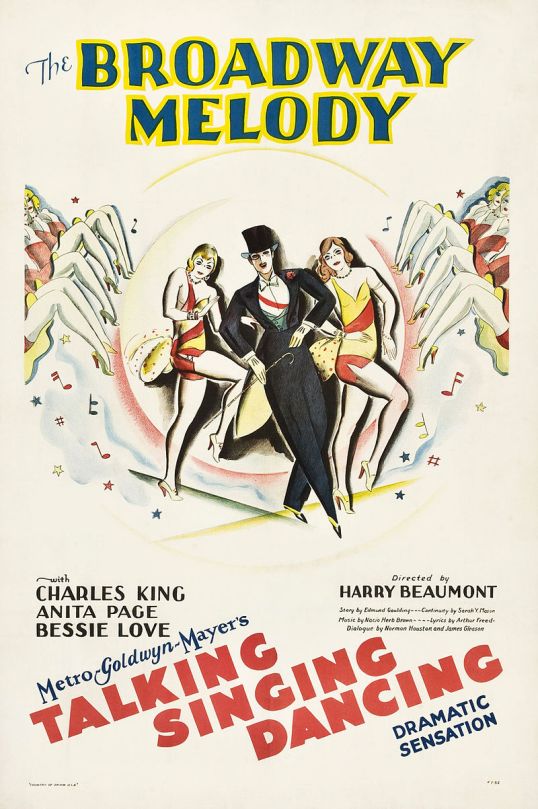
broadway_melody_poster

Oh, The Broadway Melody.

Where to begin?

First released way back in 1929, The Broadway Melody is a historically significant film.  You really can’t talk about the development of film — especially sound film — without taking at least a few minutes to acknowledge The Broadway Melody.  It was the 2nd film to ever win the Oscar for Best Picture (or Best Production, as it was called back then) and it was the first sound film to win the Oscar.  (In fact, it would be 83 years before another silent film won Best Picture and it’s debatable whether or not The Artist can really be considered a silent film in the same way that Wings was silent film.)  It was also the first musical to win best picture and some people consider it to be the first true musical to have ever been produced.  It was such a huge box office success that it could be argued that The Broadway Melody is responsible for nearly every musical that followed it.

To say that The Broadway Melody tells a familiar story would be an understatement.  I’ve read a few reviews that have suggested that the clichés in this film really weren’t clichés until after The Broadway Melody was released but I’ve seen enough silent films to know that this is not the case.  It tells the story of two sisters who want to be stars.  After spending years working in vaudeville, they’ve been invited to perform in a revue that’s being produced by Francis Zanfield (Eddie Kane).

(I assume that Zanfield was meant to be a stand-in for Florence Ziegfeld, himself the subject of a later Best Picture winner, The Great Ziegfeld.)

The sisters are Hank (Bessie Love) and Queenie (Anita Page).  Hank is the driven one.  Hank is the one with the raw talent and she’s also the one who best understands how the business of entertainment works.  Her younger sister, Queenie (Anita Page), may not have Hank’s drive or quite the same level of talent but she does have beauty.  Guess who finds the most success?

Songwriter Eddie Kearns (Charles King) is engaged to marry Hank but soon, both he and Queenie find themselves falling in love.  Not wanting to hurt her sister, Queenie instead runs off with a notorious playboy named Jock Warner (Kenneth Thomson).

As I stated previously, The Broadway Melody has not aged well.  The fact that it’s one of the first sound films just allows contemporary viewers to hear the creakiness of the plot.  As impressive as sound film was to audiences in 1929, it’s obvious today that the cast and crew of The Broadway Melody were still struggling to figure out how to work with the new technology.  As a result the performances are still a bit too broad, which only serves to make the film seem even more melodramatic than it actually is.  As for the songs, they’re not particularly memorable.  I always enjoy backstage musicals but Broadway Melody is no 42nd Street.

I did appreciate the relationship between Bessie Love and Anita Page.  That was one of the few things about the film that felt real to me, perhaps because I have three older sisters.  Interestingly enough, when Anita Page died in 2008, she was the last surviving attendee of the first Academy Awards ceremony.

The Broadway Melody was named the Best Picture of 1929.  This was the year that the winners were selected by a committee and there were no official nominations.  Though the notes from the meeting indicate that there was some consideration given to awarding the Best Actress Oscar to Bessie Love, Best Picture was the only Oscar that The Broadway Melody received.
Cleaning Out The DVR: Yankee Doodle Dandy (dir by Michael Curtiz)


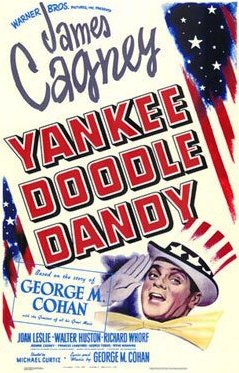
Yankee_Doodle_Dandy_poster

So, today, I got off work so that I could vote in Texas’s Super Tuesday primary.  After I cast my vote (and don’t ask me who I voted for because it’s a secret ballot for a reason!), I came home and I turned on the TV and I discovered that, as a result of spending February recording countless films off of Lifetime and TCM, I only had 9 hours of space left on my DVR.  As a result, the DVR was threatening to erase my recordings of Bend It Like Beckham, Jesus Christ Superstar, American Anthem, an episode of The Bachelor from 2011, and the entire series of Saved By The Bell: The College Years.

“Acgk!” I exclaimed in terror.

So, I immediately sat down and started the process of cleaning out the DVR.  I started things out by watching Yankee Doodle Dandy, a film from 1942.

Yankee Doodle Dandy is a biopic of a songwriter, signer, and dancer named George M. Cohan.  I have to admit, that when the film started, I had absolutely no idea who George M. Cohan was.  Imagine my surprise as I watched the film and I discovered that Cohan had written all of the old-fashioned patriotic songs that are played by the Richardson Symphony Orchestra whenever I go to see the 4th of July fireworks show at Breckenridge Park.  He wrote You’re A Grand Old Flag, The Yankee Doodle Boy, and Over There.  Though I may not have heard of him, Cohan was an American institution during the first half of the 20th Century.  Even if I hadn’t read that on Wikipedia, I would have been able to guess from watching Yankee Doodle Dandy, which, at times, seems to be making a case for sainthood.

And that’s not meant to be a complaint!  74 years after it was originally released, Yankee Doodle Dandy is still a terrifically entertaining film.  It opens with George (played by James Cagney) accepting a Congressional Gold Medal from President Franklin D. Roosevelt.  (We only see Roosevelt from behind and needless to say, the President did not play himself.  Instead, Captain Jack Young sat in a chair while FDR’s voice was provided by impressionist Art Gilmore.)  Cohan proceeds to tell Roosevelt his life story, starting with his birth on the 4th of July.  Cohan tells how he was born into a showbiz family and a major theme of the film is how Cohan took care of his family even after becoming famous.

The other major theme is patriotism.  As portrayed in this biopic, Cohan is perhaps the most patriotic man who ever lived.  That may sound corny but Cagney pulls it off.  When we see him sitting at the piano and coming up with the lyrics for another song extolling the greatness of America, we never doubt his sincerity.  In fact, he’s so sincere that he makes us believe as well.  Watching Yankee Doodle Dandy, I found myself regretting that I have to live in such an overwhelmingly cynical time.  If George M. Cohan was alive today, he’d punch out anyone who called this country “Murica.”

Yankee Doodle Dandy is an amazingly positive film.  There are a few scenes where Cohan has to deal with a few Broadway types who are jealous of his talent and his confidence but, otherwise, it’s pretty much one triumph after another for Cohan.  Normally, of course, there’s nothing more annoying than listening to someone talk about how great his life is but fortunately, Cohan is played by James Cagney and Cagney gives one of the best performance of all time in the role.

Cagney, of course, is best remembered for playing gangsters but he got his start as a dancer.  In Yankee Doodle Dandy, Cagney is so energetic and so happy and such a complete and totally showman that you can’t help but get caught up in his story.  When he says that, as a result of his success, things have never been better, you don’t resent him for it.  Instead, you’re happy for him because he’s amazingly talented and deserve the best!

Seriously, watch him below:

James Cagney won the Oscar for Best Actor for his performance here.  Yankee Doodle Dandy was also nominated for best picture but lost to Mrs. Miniver.

I’m really glad that I watched Yankee Doodle Dandy today.  In this time of overwhelming negativity, it was just what I needed!