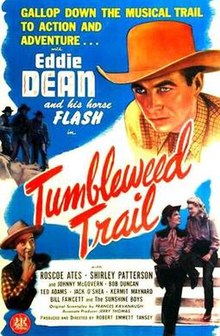
Tumbleweed Trail (1946, directed by Robert Emmett Transey)


I know that I said yesterday that I was done with Eddie Dean westerns but I decided to watch one more, just because it was short and, based on the other Eddie Dean films I had seen, I assumed that it would be undemanding. 

(I was right.)

Tumbleweed Trail opens with Brad Barton (Bob Duncan) and his group of colorfully named henchmen (one is named Dead-Eye) ambushing and apparently killing a rancher named Bill Ryan (Kermit Ryan), who also happens to be Barton’s half-brother.  Barton wants to take control of Ryan’s ranch and he’s even forged a will to to convince the land office to give it to him instead of Ryan’s children.  If this plot sounds familiar, it’s because much of it was recycled for Black Hills.

What Barton did not count on was the arrival of singing cowboy Eddie Dean (played by real-life singing cowboy Eddie Dean) and his sideick, Soapy (Roscoe Ates).  Eddie and Soapy get jobs working on Ryan’s ranch.  Eddie finds time to sing a few songs and to fall for Bill’s daughter, Robin (Shirley Patterson).  Everyone loves Eddie’s singing but he’s not make much progress when it comes to proving that Barton’s will is a fake.  Just when it seems like not even Eddie and Soapy will be able to stop Barton, there’s a “surprise” ending that you’ll see coming from a mile away.

This one is uninspired, though some of my reaction could be due to having already seen Eddie Dean go through a similar plot in Black Hills.  Eddie sings a lot but that’s about all he does in this routine poverty row western.  Bob Duncan is a generic villain.  Of the three Eddie Dean films that I’ve watched, Tumbleweed Trail was the most forgettable.  It’s for fans of the genre only.

Eddie’s horse in Tumbleweed Trail is played by Flash.  Flash gets second billing, above Roscoe Ates.

This, I’m pretty sure, was my final Eddie Dean movie.

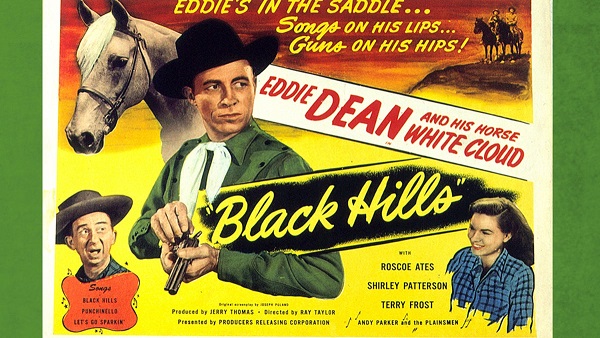
Black Hills (1947, directed by Ray Taylor)


Times are hard and rancher John Hadley (Steve Clark) is running the risk of losing his ranch. When Hadley finds gold on his property, he think that all of his problems have been solved. He makes the mistake of revealing the existence of the gold to his friend, Terry Frost (Dan Kirby). Terry’s not much of a friend because he shoots and kills Hadley and then, working with a corrupt county clerk (William Fawcett), he tries to steal Hadley’s property away from the rancher’s children and rightful heirs.

Luckily, singing cowboy Eddie Dean (played by real-life singing cowboy Eddie Dean) rides up and, with the help of his comic relief sidekick (Roscoe Ates), helps to get things sorted out. Even with Terry trying to frame Eddie for a murder he didn’t commit, Eddie still finds time to sing a few songs.

This was Eddie Dean’s final feature film before he moved into television. Black Hills is better than Romance of the West, the Eddie Dean movie that I reviewed yesterday. The plot actually has a few interesting twists and, though it doesn’t appear that he was ever much of an actor, Eddie Dean appears to be more comfortable with his role here than he was in Romance of the West. Black Hills emphasizes that Eddie could throw a punch just as well as he could sing and veteran western actor Dan Kirby is a credible villain. It makes Black Hills into an entertaining if not exactly memorable western diversion.

One final note about Black Hills: Eddie’s horse, White Cloud, gets second billing in the credits.

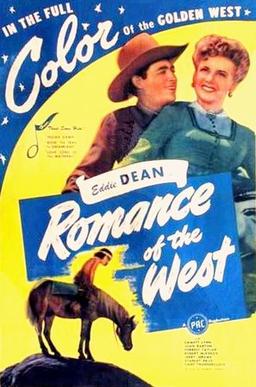
Romance of the West (1946, directed by Robert Emmett Tansey)


In California’s Antelope Valley, the local Indian tribe lives peacefully alongside the recently arrived white settlers.  However, some of the settlers want to end that peace and deliberately try to provoke the Indians into raiding a nearby town.  When the Indian village is attacked and a young boy is turned into an orphan, the tribe prepares or war.  It falls on the new Indian agent, a singing cowboy named Eddie Dean (played by real-life singing cowboy Eddie Dean) to capture the real culprits and maintain peace in Antelope Valley.

Romance of the West was the first of many films that Eddie Dean made in which he played a character named Eddie Dean.  Dean had a good singing voice and an amiable screen presence but he was also a pretty stiff actor.  That’s particularly obvious in Romance of the West, where he breaks out into a huge grin whenever he has to deliver any of his dialogue.  Even when he talks about something as serious as finding a home for an orphan, he still smiles like someone who has found a month’s worth of moonshine.   With the exception of Forest Tucker (who plays a sympathetic priest), the rest of the cast isn’t much better.  Eddie looks convincing in a gunfight and on a horse but whenever he has to speak or show emotion, the action comes to a halt.

Compared to other westerns of the period, Romance of the West is sympathetic to the Indians, with Dean speaking up for them every chance he gets and telling one bad guy that the Indians are more American than he’ll ever be.  But the movie also features a lot of scenes of the Indians speaking in exaggerated broken English.  After an Indian child is orphaned, Eddie refuses the chief’s offer to raise the child, saying that it would be better that the child go to the church orphanage so he “can be raised right.”  The film should be commended for rejecting the “savage” stereotype but then it goes too far in other direction, portraying the Natives as being almost child-like and without any agency of their own.  Always, it falls on Eddie Dean to explain things to everyone and hold together the fragile peace.

Seen today, the most interesting thing about Romance of the West is that it was shot in color, at a time when that was a rare occurrence.  Unfortunately, Eddie Dean was just as boring in color as he was in black-and-white.

On a final note, the singing cowboy genre has always been a strange one to me.  Did no one in the old west find it strange that men were riding through the wilderness and singing songs of love to their horses?  For some reason, singing cowboys were always appointed to positions of importance, like town marshal or Indian agent.  Were people that impressed by a banjo?