4 Or More Shots From 4 Or More Films is just what it says it is, 4 shots from 4 of our favorite films. As opposed to the reviews and recaps that we usually post, 4 Shots From 4 Films lets the visuals do the talking!
128 years ago, on this date, Douglas Sirk was born in Germany. He would start out his career as a stage director in Germany before coming to the United States in 1937. In the U.S., he made his mark as the director of a series of lushly visualized and often over-the-top melodramas. Never a critical favorite, Sirk was rediscovered and his reputation rehabilitated when film students and critics started to reexamine his work in the late 60s and the 70s. Once dismissed as the maker of tawdry (if popular) melodramas, Douglas Sirk is now seen as a subversive master of irony, one who used his melodramas to comment on American society. It’s fair to say that, without the films of Douglas Sirk, there would be no Lifetime today.
It’s time for….
4 Shots From 4 Douglas Sirk Films
Magnificent Obsession (1954, dir by Douglas Sirk, DP: Russell Metty)
All That Heaven Allows (1955, dir by Douglas Sirk, DP: Russell Metty)
Written on the Wind (1956, dir by Douglas Sirk, DP: Russell Metty)
Imitation of Life (1959, dir by Douglas Sirk, DP: Russell Metty)
4 Or More Shots From 4 Or More Films is just what it says it is, 4 shots from 4 of our favorite films. As opposed to the reviews and recaps that we usually post, 4 Shots From 4 Films lets the visuals do the talking!
126 years ago, on this date, Douglas Sirk was born in Germany. He would start out his career as a stage director in Germany before coming to the United States in 1937. In the U.S., he made his mark as the director of a series of lushly visualized and often over-the-top melodramas. Never a critical favorite, Sirk was rediscovered and his reputation rehabilitated when film students and critics started to reexamine his work in the late 60s and the 70s. Once dismissed as the maker of tawdry (if popular) melodramas, Douglas Sirk is now seen as a subversive master of irony, one who used his melodramas to comment on American society. It’s fair to say that, without the films of Douglas Sirk, there would be no Lifetime today.
It’s time for….
4 Shots From 4 Douglas Sirk Films
Magnificent Obsession (1954, dir by Douglas Sirk, DP: Russell Metty)
All That Heaven Allows (1955, dir by Douglas Sirk, DP: Russell Metty)
Written on the Wind (1956, dir by Douglas Sirk, DP: Russell Metty)
Imitation of Life (1959, dir by Douglas Sirk, DP: Russell Metty)
Culver City’s MGM “dream factory” and Gower Gulch’s PRC were miles apart both literally and figuratively. Metro-Goldwyn-Mayer boasted “more stars than there are in heaven”, while tiny Producer’s Releasing Corporation films starred faded names like Neil Hamilton, Harry Langdon, Bela Lugosi , and Anna May Wong. MGM films featured lavish, opulent sets; PRC’s cardboard walls looked like they would fall over if an actor sneezed. Poverty Row PRC movies were dark and grainy; MGM created glossy, gorgeous Technicolor productions. MGM specialized in big budget extravaganzas, whereas PRC rarely spent more than $1.98. Miles apart – so why did major studio MGM purchase and release a movie originally made for minor PRC, HITLER’S MADMAN?
For one thing, it’s a damn good film, and an important one as well. Based on the true-life atrocity of the destruction of Lidice, Czechoslovakia on June 10, 1942 after the assassination of Nazi Reichsprotektor Reinhardt Heydrich, known as “The Hangman of Prague”, HITLER’S MADMAN was…
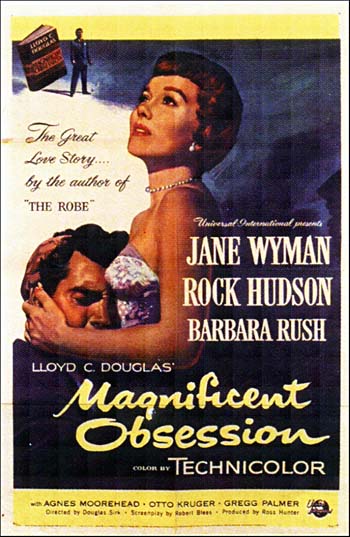
There’s a scene early on in the 1954 melodrama Magnificent Obsession in which formerly carefree millionaire Bob Merrick (Rock Hudson) meets with an artist named Edward Randolph (Otto Kruger). We know that Randolph’s brilliant because he speaks in a deep voice, tends to be unnecessarily verbose, and often stares off in the distance after speaking. Bob wants to know about a dead doctor who was a friend of Randolph’s. Randolph explains the late doctor’s philosophy of doing anonymous good works. Bob’s mind is blown. (Hudson, who was never the most expressive of actors, conveys having his mind blown by grinning.)
“This is dangerous stuff,” Randolph warns him, “One of the first men who used it went to the cross at the age of 33…”
And a heavenly chorus is heard in the background…
And that one line pretty much tells you exactly what type of film Magnificent Obsession is. It’s a film that not only embraces the melodrama but which also holds on tight to make sure that the melodrama can never escape. There’s not a single minute in this film that is not hilarious overwritten. It’s not just Randolph who tends to be portentous in his pronouncements. No — everyone in the film speaks that way!
The dead doctor is dead specifically because of Bob. Apparently, the doctor had a heart attack but the local hospital’s only resuscitator was being used to save the life of Bob who, while the doctor was dying, was busy recklessly driving a boat.
Helen (Jane Wyman), the doctor’s widow is, at first, bitter towards Bob and when Bob offers to donate $250,000 to the hospital, Helen refuses to accept his check. This leads to Bob doing a lot of soul-searching and eventually having his life-changing conversation with Randolph. Excited at the prospect of doing anonymous good works for the rest of his life, Bob tracks down Helen and tries to tell her that he’s a changed man. Helen, however, wants nothing to do with Bob and ends up getting hit by a car while running away from him. Helen survives but now, she’s blind!
Now, at this point, you might think that Bob has done enough to ruin Helen’s life. At least, that’s the way that Helen’s family views it and when Bob attempts to visit her in the hospital, they order him to go away.
Eventually, Helen comes home from the hospital and starts to adjust to a life without eyesight. One day, she meets a man on the beach and they start up a tentative romance. What she doesn’t realize, at first, is that the man is Bob! By the time she does realize who the man is, Helen has fallen in love with him. However, she feels that it wouldn’t be fair to Bob to pursue a relationship with him and she leaves him.
So, of course, Bob’s response is to go to medical school and become a neurosurgeon. Many years later, Helen has a brain tumor and needs an operation to survive.
Can you guess who her surgeon turns out to be?
Magnificent Obsession is almost a prototypical 1950s melodrama. It’s big, it’s glossy, it’s self-important, and undeniably (and occasionally unintentionally) funny. Even the total lack of chemistry between Hudson and Wyman somehow adds to the film’s strange charm. It’s hard not to admire a film that starts out over-the-top and just grows more excessive from there.
Watching Magnificent Obsession is a bit like taking a trip into a parallel, technicolor dimension. It’s strange, fascinating, and far more watchable than it should be.


 Through the Shattered Lens