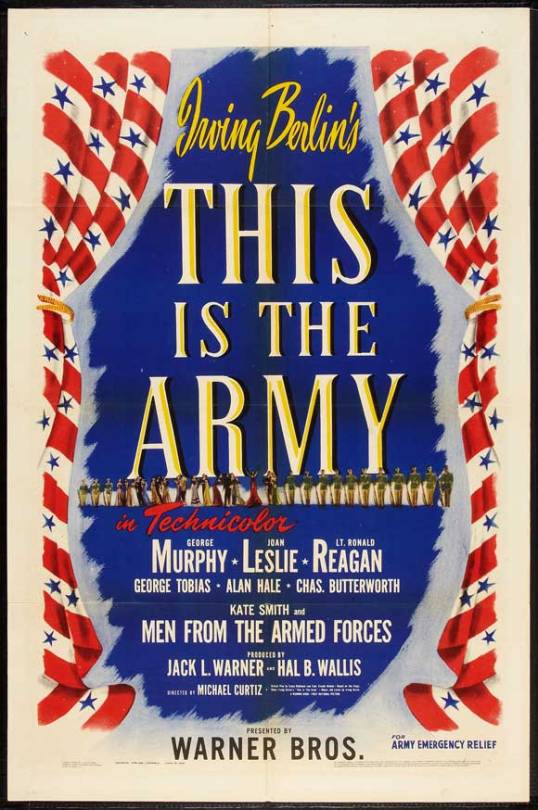
The 34th film in Mill Creek’s Fabulous Forties box set is the 1943 musical, This is The Army.
This Is The Army is based on a Broadway musical that was specifically conceived and written by Irving Berlin as a way to boost wartime morale. The show, which was a collection of patriotic songs and comedic skits, was performed by members of the U.S. Army. The film version starts with dancer Jerry Jones (George Murphy) being drafted at the start of World War I and putting together an all-army revue called Yip Yip Yaphank. (Interestingly enough, this was also the name of a real-life show that Irving Berlin put together during World War I.) The show is a big hit and, when the soldiers in the cast receive their orders to head to France, they literally march off the stage and out the theater. It’s actually a pretty rousing scene but it’s almost immediately followed by a very sad one, in which we learn that only three members of the cast survived the war. Jerry Jones is shot in the leg and when he returns home, the former dancer now walks with a cane.
Twenty-five years later, another world war has broken out. Jerry’s son, Johnny (Ronald Reagan), has joined the army. Johnny is ordered to put together another revue, in the style of Yip Yip Yaphank. At first, Johnny is reluctant but orders are orders. Soon, Johnny and the cast of This Is The Army are touring the U.S. and even performing in front of President Roosevelt (played by Jack Young, though, from a historical perspective, wouldn’t it be neat if President Roosevelt had appeared as himself in a film with Ronald Reagan?). Along the way, Eileen (Joan Leslie) tries to convince Johnny to marry her even though Johnny wants to wait until the war is over.
It’s really not much of a plot but then again, the film is about showcasing the musical performances. The soldiers sing. The soldiers dance. The soldiers tell jokes and imitate people who were famous in 1943. There are several scenes that attempt to wring laughs from soldiers dressed up like women. What’s interesting is that, at a time when the army was still segregated, the performances in This Is The Army feature both white and black soldiers. Irving Berlin apparently demanded that black soldiers be allowed to appear in both the stage show and the film and, as a result, the unit that performed This Is The Army was, for a time, the only integrated unit in the U.S. Army.
Of course, that makes it even odder that there’s an extended sequence in which white soldiers perform while wearing blackface and standing on a set that’s been designed to resemble a pre-Civil War plantation. It’s a scene that pops out of nowhere and then it keeps going and going and going and I could only stare at the screen in shocked horror as it played out. It’s an odd contradiction that the same Irving Berlin who demanded that black soldiers be honored on stage and screen was also apparently the same Irving Berlin was put a minstrel show sketch into the middle of This Is The Army.
Interestingly enough, George Murphy later retired from acting and was elected to the U.S. Senate in 1964. Murphy’s success inspired his co-star, Ronald Reagan, to run for governor. If Murphy had never been a senator, Reagan would probably never have been a president. Both Reagan and Murphy give likable performances in This Is The Army and it’s easy to see how that likability, while it may not have often translated into great acting, did eventually lead to political success.
This Is The Army is a time capsule film, one that is mostly interesting as a view into the psyche of 1940s America. The humor is often corny and the storyline is predictable but there’s also a very sad subtext to the film. Since both the film and the stage show were performed by actual enlisted men, you watch with the knowledge that some of the men singing and joking on stage won’t return from the war. Often times, during the performances, we see random people in the audience crying as they realize the same thing. Even in an otherwise light-hearted film, the sobering realities of life during wartime are right beneath the surface.
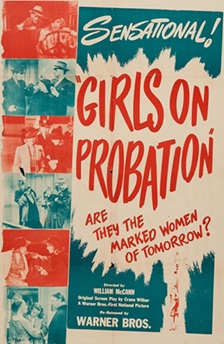 Eager to get away from her abusive father (Sig Ruman), Connie Heath (Jane Bryan) keeps making the mistake of hanging out with the ultimate bad friend, Hilda Engstrom (Sheila Bromley). Hilda steals a dress from where they work and when the dress is torn, Hilda lets Connie take the blame. When the dress’s owner (Susan Hayward, making her film debut) insists on pressing charges, insurance investigator Neil Dillon (Ronald Reagan) helps Connie get off the hook and out of jail.
 Through the Shattered Lens