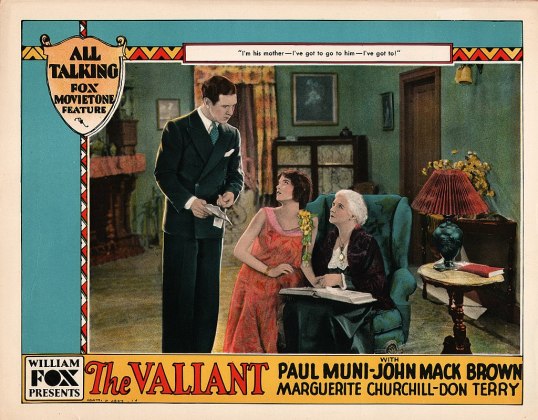
Film Review: The Valiant (dir by William K. Howard)


In the days after World War I, a man (Paul Muni) stumbles out of an apartment building and then walks down to the local police station.  He informs the officer on duty that he just shot a man.  He refuses to explain why he shot the man and, when asked for his name, he identifies himself as James Dyke.  The office notices a poster for “Dyke & Co.” on the wall and realizes that the man made up his name.  The man is convicted and sentenced to be executed.

The years pass as the man waits for his execution date.  He is a model prisoner, working hard in the garden and writing editorials for the newspapers in which he warns young readers about pursuing a life of crime.  The money he makes, he puts into Liberty Bonds.  He continues to refuse to tell anyone his first name.

In a small town, an old woman (Edith Yorke) sits in her rocking chair and has visions of all the men who went to war and never returned.  When the woman sees a picture of James Dyke in a newspaper, she thinks that he looks like her son, Joe, who long ago went missing.  The woman’s daughter, Mary (Marguerite Churhill), realizes that her mother is planning to make the trip to the prison to see him before he is executed.  Mary decides to go herself.  She tells her fiancé (John Mack Brown) that she could never get married if it turned out her brother was a murderer.  Meanwhile, the old woman continues to have visions of soldiers marching to war.

At the prison, James Dyke tells Mary that he has no family and he has no past.  But he did serve in World War I and during that time, he met her brother and he saw him die heroically in battle.  Dyke tells her to write to the army for the details of her brother’s death but to be aware that they might not even know whether or not he actually served because the war was such a confusing time that “they don’t know what happened to half the men out there.”  Dyke and Mary continue to talk as the hour of execution draws near….

An adaptation of a one-act play, The Valiant was released in 1929, at a time when America was still coming to terms with the horror of the Great War and Hollywood was still trying to adjust to the arrival of sound.  Though many had assumed that sound films would just be a fad, it turned out that audiences really did like to hear the dialogue as opposed to just reading it.  The Valiant is the type of melodrama that was popular during the silent era and the film does feature title cards that appear between scenes.  “A city street — where laughter and tragedy rub elbows,” one card reads.  Another one announces, “Civilization demands its toll.”  At the same time, it is a sound picture.  The first five minutes of the film are just the Man walking through the city and listening to the sound of cars honking and people talking.  Like many of the early sounds films, it’s obvious that the majority of the cast was not quite sure how they should handle delivering their dialogue.  Some people talk too loudly.  Some talk too softly.  Quite a few deliver their dialogue stiffly and without emotion.  Others use way too much emotion.

The only actor who seems to be fully confident in his ability to perform with sound is Paul Muni, making his screen debut in the lead role.  Muni gives a strong and empathetic performance, one that makes even the most melodramatic of dialogue feel naturalistic.  Muni shows an instinctive knowledge of how to deliver his lines with emotion without going over the top, which was a skill that many of the actors who tried to make the transition to sounds films never learned.  Paul Muni was the first great actor of the sound era, as well as one of the first screen actors to use what would eventually become known as the Method.  Among the actors who were directly inspired by Muni were John Garfield, Montgomery Clift, and Marlon Brando.  Much of modern acting owes a huge debt to the work of Paul Muni.

Seen today, the contrast between Paul Muni’s performance and the film’s staginess can make The Valiant seem like a rather surreal film.  While Muni captures the screen and confidently delivers his lines, everyone else seems hesitant and unsure of how to reply.  The end result is that, to modern audiences, The Valiant can almost seem like a filmed dream.  From the shot of Muni walking down the noisy city street to the sudden appearance of a swing band playing in the prison cafeteria, the film can seem almost Lynchian in its oddness.

The Valiant was a box office success and, according to the notes in the Academy archives, Paul Muni was among the actors considered for the second Best Actor Oscar.  (That year, there were no official nominations and only the winners were announced.)  The Oscar went to Warner Baxter for In Old Arizona but Muni would go on to have an amazing career.

Lisa Reviews An Oscar Nominee: Alibi (dir by Roland West)


1929 was a transitional year for Hollywood.

On the one hand, more people were going to the movies than ever.  The studio moguls were getting rich and directors, many of whom were influenced by German expressionism, were experimenting with new ways to visually tell their stories.  The days when an motionless camera would just be planted on the floor so that it could record actors moving in and out of the frame were over.

At the same time, Hollywood was also struggling to adjust to the arrival of sound.  Though many assumed that sound would just be a fad, it quickly turned out that audiences preferred sound pictures to the old silent melodramas.  Films that had been originally conceived as being silent were reshot with sound and the results were often mixed as Hollywood technicians struggled to figure out how to get the best and clearest recording possible.  Even harder hit were the actors, who had spent decades giving silent performances but who were now expected to adapt, overnight, to an entirely new style of acting.  Some actors saw their career abruptly end because their voice didn’t match their appearance or because they simply couldn’t memorize the dialogue that they were now required to actually speak.  Even the actors who could handle delivering their dialogue often struggled to find the right balance between acting too much and acting too little.

Take Alibi, for instance.  This crime film was released in 1929 and visually, it’s often a marvel.  But whenever the actors open their mouths and start to recite their dialogue …. yeesh!

Based on a Broadway play, Alibi tells the story of Chick Williams (Chester Morris, whose brooding good looks go a long way towards making up for his awkward screen presence).  Chick is a career criminal who has just been released from prison.  Because he’s a “jailbird,” (as they used to put it in 1929), Sgt. Pete Manning (Purnell Pratt) is convinced that Chick has hooked back up with his old gang and that he’s responsible for a recent robbery that left one policeman dead.  However, Chick has an alibi.  It turns out that, after getting out of prison, one of the first that Chick did was get married.  Chick’s new wife is Pete’s daughter, Joan (Eleanor Griffith)!  And Joan swears that, on the night of the crime, Chick was with her at the theater.

Despite his alibi, Pete is convinced that Chick had something to do with both the robbery and the murder.  Pete decides to send in an undercover cop, Danny McGann (Regis Toomey).  Pretending to be a permanently drunk businessman, Danny works his way into Chick’s mob.  But can Danny find the proof needed to take Chick down?

So, here’s what’s good about Alibi.  First off, it’s a pre-code film, which means that the characters are allowed to occasionally curse and that the gangsters all spend their time at a nightclub, watching the floor show.  It also means that Joan is allowed to openly discuss why she distrusts the police and the film shows the police being brutal in a way that would never be allowed during the production code years.  Secondly, from the very first scene, director Roland West creates an almost dream-like atmosphere, full of looming shadows and art deco sets and close-ups of menacing faces.  West’s camera prowls through the streets and clubs with a restless energy.

But then, as I mentioned earlier, someone will open their mouth and start to speak and the entire film comes to a halt.  The cast — some of whom went on to have long and successful careers — was obviously still struggling to figure out how to act in a sound film and the results are definitely mixed.  Eleanor Griffith delivers all of her lines in the same angry tone while Purnell Pratt stiffly defends the police force.  Regis Toomey, meanwhile, goes so overboard as Danny that you find yourself hoping that he’ll blow his cover and be forced out of the film.  Though he’s occasionally awkward, Chester Morris probably does the best out of the entire cast.  At the very least, he manages to communicate some genuine menace.

Seen today, Alibi is mostly interesting as a historical document.  It represents both the best and the worst of the early sound era.  When it was first released, Alibi was a hit at the box office.  Though no official nominees were announced for the 2nd Academy Awards, notes from the era indicate the Alibi was among the films considered for Best Picture and it’s usually listed as being a nominee.  The award itself was given to Broadway Melody.

Embracing the Melodrama Part II #3: The Big House (dir by George Hill)


The_Big_House_film_poster

The 1930 Best Picture nominee The Big House opens with a black Model T car slowly pulling up to the front of a large and imposing prison.  Handcuffed in the back seat of the car is a handsome, nervous-looking young man named Kent (Robert Montgomery).  Kent is led into the prison where he is forced to hand over all of his possessions to a grim-looking guard.  We find out that Kent has been convicted of manslaughter, the result of hitting someone while driving drunk.  For the next ten years, this prison (which, we’re told, was designed to house 1,800 but actually holds 3,000) will be Kent’s home.

Kent finds himself sharing a cell with two lifers.  Butch (Wallace Beery) is a coolly manipulative sociopath who alternatively counsels and abuses Kent.  Meanwhile, Morgan (Chester Morris) tries to protect Kent and even helps him get his cigarettes back from Butch.  These three prisoners represent the three faces of prison: Butch is the unrepentant criminal who is actually more at home in prison than in the “real” world.  Morgan is the former criminal who has changed his ways but who is apparently destined to spend the rest of his life paying for his poor decisions.  And Kent is the young man who has to decide if he’s going to be like Butch or if he’s going to be like Morgan.  The Big House makes the still-relevant argument that the American prison system is more likely to turn Kents into Butches than into Morgans.

When the film began, I assumed that Kent would be the main character but actually, he’s secondary to most of the action.  From the moment he first shows up, Kent is not particularly sympathetic and he becomes steadily less likable as the film progresses.  Instead, the film is more focused on the always-scheming Butch and the regretful Morgan.  While Morgan makes plans to escape from captivity and ends up falling in love with Kent’s sister (Leila Hyams), Butch spends his time plotting ways to take over the prison.  For his performance as Butch, Wallace Beery won an Oscar but, seen today, it’s obvious that the film’s heart and soul belongs to Chester Morris’s Morgan.

Like a lot of films from the period, The Big House feels undeniably creaky when viewed through modern eyes.  The Big House was made at a time when Hollywood was still trying to make the transition from silent to sound films.  As such, the film’s pacing is slower than what contemporary audiences are used to and a few of the performances are undeniably theatrical.  I can honestly say that I’m never been more aware of how much I take for granted nonstop background music than when I watch a movie from the early 30s.

That said, once you’ve adapted to the different aesthetic, The Big House holds up fairly well.  Director George Hill films the prison like a town in a German expressionist horror film and Chester Morris’s performance remains sympathetic and compelling.  If the plot seems familiar, it’s important to remember that The Big House is the film first introduced a lot of the clichés that we now take for granted.

The film’s best moments are the ones that deal not with Kent, Butch, and Morgan but instead just the ones that show hordes of prisoners — all anonymous and forgotten men — going about their daily life.  It’s during those scenes that you realize just how many people have been crammed into one tiny space and why that makes it impossible for prison to reform the Kents of the world.

Gandhi once said that the true value of any society can be determined by how that society treats its prisoners and The Big House certainly makes that case.