Retro Television Review: The American Short Story #14: Rappaccini’s Daughter


Welcome to Retro Television Reviews, a feature where we review some of our favorite and least favorite shows of the past!  On Saturdays, Lisa will be reviewing The American Short Story, which ran semi-regularly on PBS in 1974 to 1981.  The entire show can be purchased on Prime and found on YouTube and Tubi.

This week, we have an anemic adaptation of a Nathaniel Hawthorne short story.

Episode #14: Rappaccini’s Daughter

(Dir by Deszo Magyar, originally aired in 1980)

This week’s episode is an adaptation of one of Nathaniel Hawthorne’s more intriguing short stories.  Giovanni (Kristoffer Tabori) is a young scholar who, in 18th Century Italy, falls in love with the beautiful and mysterious Beatrice (Kathleen Beller).  Beatrice has been raised in a garden that is full of poisonous plants that have been developed by her father, Dr. Rappaccini (Leonardo Cimino).  As a result, Beatrice is immune to the plants but she herself is poisonous.  Giovanni falls in love with her and is willing to become poisonous himself but it ultimately turns out that everything comes with a price.

Hawthorne’s short story was not only an early example of gothic literature but it was also a well-deserved parody of the nature-loving, self-righteous transcendentalists.  (The story came out at the same time as Henry David Thoreau’s Walden.)  Unfortunately, this particular adaptation really doesn’t do the story justice.  It moves extremely slowly and the performances are not particularly memorable.  Kristoffer Tabori and Kathleen Beller have very little chemistry and, in the end, the adaptation misses the satirical nature of the story altogether.  There’s a reason why Vincent Price made for an excellent Dr. Rappaccini in 1963’s Twice Told Tales.

Retro Television Review: In The Lion’s Den 1.1 “The Pilot”


Welcome to Retro Television Reviews, a feature where we review some of our favorite and least favorite shows of the past!  On Thursdays, I will be reviewing In The Lion’s Den, which aired on CBS in 1987.  The entire show is currently streaming on YouTube!

Episode 1.1 “Pilot”

(Dir by James Burrows, originally aired on September 4th, 1987)

When she lived in New York City, Dana (Wendy Crewson) had an apartment, a boyfriend, and a job working as a producer on a very successful game show.  But then she got fired and everything changed.  Now, she has moved to San Antonio so she can work as the new associate producer of Lion’s Den, a PBS program featuring a lion puppet named Maynard.

The man behind the puppet is Keith (Dennis Boutsikaris), an infamously temperamental actor who, every day, announces that he’s quitting show business and storms off the set.  Previously, it was up to Jerry (Jack Blessing) to coax Keith into returning to the set and shooting the show.  But now that Jerry has a job with Steven Spielberg, it’s up to Dana to keep Keith happy.

Despite having hired her, Keith does not know who Dana is when she shows up on the set.  He proceeds to re-interview her for the job, which means leering at her legs and trying to convince her to hug the puppet.  Keith, I think, was meant to come across as being a charming rogue but, every time he talked to Dana, I had flashbacks to interviewing for jobs after college and all of the guys who stared at my chest and legs while I explained my passion for art history.  Keith is a creep and the fact that he’s only nice when he’s talking through Maynard does nothing to change that.

It’s an eventful first day for Dana.  One of the show’s sponsors (played by Fred Applegate) offers to allow Dana to rent his house but it soon turns out that he’s a bit of a sleaze.  A neurotic writer (Brian Backer) fears that he’s going to lose his job because he wrote a script about football.  (“I hate football!” Keith yells.  Good luck living in Texas.)  Proving the everyone had to start somewhere, Marcia Gay Harden plays the receptionist who helps Dana get out of having to talk to her ex-boyfriend.  (“She’s meetin’ Willie Nelson.”)  Harden plays the role with a Texas accent and, while it’s definitely exaggerated, she does a good job with it overall.  (A quick check with Wikipedia revealed that, though born in California, Harden spent time in Texas when she was growing up and graduated from the University of Texas.)  Eventually, Keith throws his daily tantrum and Dana has to find her own way to keep him from quitting show business.

The main problem with the pilot is that Keith is too much of a jerk.  It’s hard to really care about someone who throws a tantrum every day, is abusive to his coworkers, and how uses an adorable puppet to sexually harass a woman who hasn’t even figured out where she’s going to be living in her new city.  Personally, I think Dana should have quit as soon as Maynard demanded a hug.

And audiences agreed.  This pilot aired once and that was it for In The Lion’s Den.

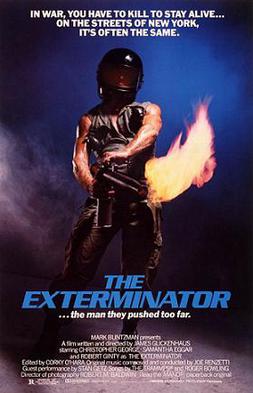
The TSL Grindhouse: The Exterminator (dir by James Glickenhaus)


First released in 1980, The Exterminator begins during the Vietnam War.

Two soldiers, John Eastland (Robert Ginty) and Michael Jefferson (future Cannon Film mainstay Steve James) have been captured by the Viet Cong and can only watch as a third soldier is beheaded by his captors.  (The graphic beheading, in which the camera lingers on the head slowly sliding off the neck, is an early warning of what this film has in store for its audience.)  Jefferson manages to free himself from his bonds and kills most of the enemy soldiers.  After Jefferson frees him, Eastland fires a bullet into the still twitching body of the VC commander.

The film jumps forward to 1980.  Living in New York City, Jefferson and Eastland are still best friends and co-workers at a warehouse.  For a second time, Jefferson saves Eastland’s life when the latter is attacked by a gang calling themselves the Ghetto Ghouls.  When the Ghouls get their revenge by tracking down Jefferson and piecing his spine with a meat hook, Eastland gets his revenge by killing …. well, just about everyone that he meets.

Though The Exterminator was obviously inspired by Death Wish, a big difference between the two films is that Eastland doesn’t waste any time before starting his anti-crime crusade.  In the original Death Wish, Paul Kersey (played by Charles Bronson) starts out as a self-described “bleeding heart” liberal who was a conscientious objector during the Korean War.  Even after his wife and daughter are attacked (and his wife killed) by Jeff Goldblum, Kersey doesn’t immediately pick up a gun and start shooting muggers.  Indeed, it’s not until the film is nearly halfway over that Kersey begins his mission and, in one of the film’s more memorable moments, he reacts to his first act of violence by throwing up afterwards.  While one could hardly call Death Wish an especially nuanced film, it does at least try to suggest that Kersey’s transformation into a vigiliante was a gradual process.

The Exterminator, on the other hand, goes straight from Eastland informing Jefferson’s wife about the attack to Eastland threatening a tied-up Ghetto Ghoul with a flame thrower.  When did Eastland kidnap the Ghetto Ghoul?  Why does Eastland have a flame thrower?  Where exactly has Eastland tied up the Ghetto Ghoul?  None of this is explained and the film’s abruptness gives it an almost dream-like feel.  The film plays out like the fantasy of everyone who has ever been mugged or otherwise harassed.  Magically, Eastland suddenly has the skills and the resources to outsmart not just the criminals but also the police who have been assigned to stop him.  Even the CIA is assigned to take down Eastland because his anti-crime crusade is inspiring people to wonder why the President hasn’t been able to reduce crime.  The film plays out like the type of daydreams that Travis Bickle had when he wasn’t driving his taxi.

Eastland is ruthless in his kills but fortunately, everyone he kills is really, really bad.  The Ghetto Ghouls clubhouse is decorated with a poster of Che Guevara but Che’s revolutionary rhetoric isn’t worth much when the Exterminator’s after you.  A mob boss makes the mistake of not telling Eastland about the Doberman that’s guarding his mansion so into the meat grinder he goes.  New Jersey loses a state senator when Eastland discovers him torturing an underage male prostitute.  The film was shot on location in New York City and the camera lingers over every grimy corner of the city.  A scene where Eastland walks through Times Square takes on a cinéma-vérité feel as people jump out at him and try to entice him to take part in everything the city has to offer.  If Death Wish suggested that Paul Kersey’s actions were saving New York, The Exterminator suggests that we should just let John Eastland burn the whole place down.

With his youthful face, Robert Ginty looks more like a mild-mannered seminarian than a hardened veteran of both Vietnam and the mean streets of New York but, ultimately, that works to the film’s advantage.  If anything, it explains why everyone who meets him trends to underestimate what he’s capable of doing.  B-movie vet Christopher George overacts in his usual amusing way as he plays the detective who has been assigned to catch The Exterminator.  Samantha Eggar plays a doctor who starts dating George for no discernible reason.  The scenes featuring George and Eggar often seems as if they belong in a different film but they do provide some relief from the rather grim and gruesome scenes of The Exterminator killing almost everyone who he meets.

The Exterminator was controversial when it was originally released and it still retains the power to shock.  It’s easy to laugh at some of the film’s more melodramatic moments but there were still more than a few scenes that I watched with my hands over my eyes.  The film’s hard edge grabs your attention from the start and the idea of the CIA sending assassins to take out a neighborhood vigilante is so over the top and ridiculous that it’s kind of hard not to appreciate it.  That the film totally buys into its paranoid worldview (“Washington will be pleased.”) makes the whole thing far more compelling than it should be.

As ludicrous as it all is, The Exterminator is a film that defies you to look away.

Cleaning Out The DVR, Again #30: The Inherited (dir by Devon Gummersall)


(Lisa is currently in the process of trying to clean out her DVR by watching and reviewing all 40 of the movies that she recorded from the start of March to the end of June.  She’s trying to get it all done by the end of July 11th!  Will she make it!?  Keep visiting the site to find out!)

The-Inherited

The 30th film on my DVR was broadcast on the Lifetime Movie Network on June 5th.  It was aired under the title The Inherited but, according to the imdb, it was originally called Stranger In The House.  I imagine that Lifetime changed the title in order to keep viewers from confusing it with a previous Lifetime film that happened to have the same title.

Anyway, regardless of the title, this is a very confusing movie.  That’s not necessarily a bad thing.  This is just one of those films where, in order to truly understand what’s happening, you have to be willing to give the film some thought.  It’s a film that raises many questions but doesn’t always supply easy answers.  The answers are there but you have to be willing to look for them.

Unfortunately, because this film demands a certain amount of focus on the part of the audience, commercial television is probably the worst place for it to show up.  When the action stops every fifteen minutes for a 3-minute block of commercials, it makes it a little bit difficult to remember what’s happened from one scene to another.

Stranger In The House/The Inherited tells the story of Eve (Jenn Liu) and Tom (Nathan Darrow).  Eve and Tom has just gotten married.  Eve lost her parents when she was younger and — well, to be honest, I’m not sure why the film opens with Eve’s parents dying.  (Later, we find out that Tom’s parents also died when he was young.  Maybe it’s all connected, maybe it isn’t.  I honestly don’t know.)  Tom is a widower.  His first wife died but, in her will, she left Tom her family’s home on the condition that Tom never sell the house.

As soon as Tom and Eve move into the house, strange things start to happen.  Eve thinks that she hears strange noises and she’s upset to discover that Tom has secrets that he hasn’t told her about.  When his former sister-in-law, Wendy (Tammy Blanchard), comes over for dinner, she and Tom get into a huge argument that ends when Wendy’s necklace suddenly tightly wraps around her neck.  Eve thinks there is something terrible in the house but Tom continually says that she’s imagining things.  Fortunately, the housekeeper (Annabella Sciorra) believes Eve and even shares the fact that Tom cooked all of his first wife’s meals before she mysteriously fell ill and died.  Suddenly, Tom’s cooking for Eve…

Soon, Eve doesn’t know who she can trust.  Is the house haunted or is she going crazy?  Is Tom trying to murder her or is Eve just going crazy?  Is the housekeeper Eve’s friend or is Eve just going crazy?  Could the film be any more of a Rebecca rip-off or is Eve just crazy?  Is this film Gaslight or is it The Haunting?

I had to watch the ending a few times before I could tell you for sure.  The Inherited is not always an easy film to follow.  It’s directed in a deliberately dream-like manner, which leads to some memorably surreal scenes but which can also be frustrating when you’re trying to figure out what the Hell’s going on.  Personally, I liked The Inherited because it had a lot of atmosphere, some good acting, and a lot of twists and turns.  But it’s definitely not a film for everyone.  You have to be willing to accept the fact that the movie is never going to make much sense.

On  final note, Jenn Lui not only wrote this film but she also gave herself the lead role.  That was a smart decision because the script is definitely written to her strengths as a performer.  She gives a great performance, one that helps to hold this somewhat uneven film together.