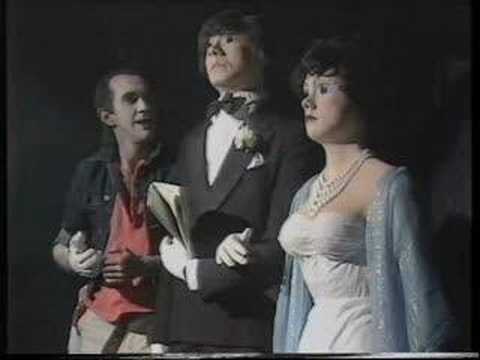
Comedians (1979, directed by Richard Eyre)


“Laugh, you buggers, laugh!”

Set in Manchester, Comedians is about a group of working class men who are enrolled in an evening class for aspiring comedians.  Sammy Samuels (Linal Haft) and Mick Connor (David Burke) both tell jokes about being a member of a minority in England.  (Sammy is Jewish while Mick is Irish.)  George McBrain (Derrick O’Connor) works on a loading dock and tells stereotypically racist and sexist jokes.  Phil and Ged Murray (James Warrior and Edward Peel) are brothers and a tense comedy team.  Phil is desperate to become a star and escape Manchester while Ged is more laid back.  Finally, Gethin Price (Jonathan Pryce) is an aggressive comedian who is willing to take risks on stage.  Teaching the class is Eddie Water (Bill Fraser), a veteran comic who was a star during World War II but who has since faded into obscurity.  Gethin says that he’s lost his edge.

Bert Challenor (Ralph Nossek), a retired stand-up and an old colleague of Eddie’s, is in town.  Challenor is now the President of the Comedy Federation and he is scouting new talent.  Eddie’s class will be performing, between games, at a bingo hall.  Before the performance, Eddie admonishes all of them to stay true to themselves and to not pander to the audience with cheap, racist, or sexist jokes.  However, when Challenor drops by the class, he gives the comedians the opposite advice.  He tells them that getting laughs is the most important thing and the only way to do that is to make the audience like you.  Stick to the acceptable targets, move quickly from one joke to the next, and don’t make any of your humor too personal.

The bingo hall performance is the highpoint of Comedians.  Each student performs and each one has to make their own decision whether to follow Challenor’s advice or to stay true to what Eddie told them.  Some sell out and some don’t.  One act implodes on stage.  The bravest performance of the night is greeted by stony silence from the audience.  Each performance allows a look into the mind of the man telling the jokes, even the ones who are trying to hide behind Challenor’s advice.  After the performance, the students return to the classroom and consider what they’ve done and they’ve become.  Challenor comes to the class to offer some of the comedians a contract while dismissing the others as not being ready or worthy of his time.

Comedians started life as a play by Trevor Griffiths.  It opened in London in 1975, where it was directed by Richard Eyre.  Just as he would in the eventual film, Jonathan Pryce played the role of Gethin Price.  When the play moved to Broadway in 1976, Mike Nichols took over as director and Pryce was the only actor to make the transition from New York to London.  Pryce would go on to win his first Tony for his performance in Comedians.  In 1979, when Comedians was filmed for the BBC’s Play For Today, Richard Eyre returned to direct and Pryce, again, played the role of Gethin Price.

As a debate about what makes comedy “good,” Comedians feels especially relevant today.  The debate about how comedians should view their audience and the role that comedy should play in an unstable world is still going on today.  As opposed to the current argument that comedy should always “punch up,” Challenor encourages all of the students to punch down and to get laughs by appealing to the prejudices of the audience.  As Challenor suggests when giving his notes to the students, it’s more important to get laughs than to actually be funny.  As unsympathetic a character as Challenor is, Comedians does acknowledge that the students who got those easy laughs are also the same ones who going to escape the drudgery of working dead end jobs in Manchester.  Comedians like Gethin Price may stay true to themselves but they’ll also probably never become a star.

Very much a filmed version of a theatrical production, Comedians is undeniably stagey.  But the dialogue and the themes remains sharp and Pryce’s performance is still electrifying.  Unfortunately, several of the BBC’s Play For Today productions have been lost or destroyed but Comedians survived and can be viewed on YouTube.

Film Review: Cut Bank (dir by Matt Shakman)


cb

The image at the top of this post is taken from the film Cut Bank and features Teresa Palmer and Liam Hemsworth.  It’s a striking picture, isn’t it?  If there’s anything positive that can be said about Cut Bank, it’s that it’s a visually striking film.  Some of the film’s images compare favorably with the work of the Coen Brothers in  No Country For Old Men and Fargo.

(Perhaps not surprisingly, the film’s director, Matt Shakman, previously directed two episodes of the Fargo tv series.)

Of course, it’s not just the film’s visual style that will remind you of the Coens.  The plot is full of Coen DNA as well and that’s a bit of a problem.  The thing that sets the Coen Brothers apart from other directors is that only they seem to understand how to best pull off their unique brand of ironic quirkiness.  It’s difficult to think of any other director who could have done A Serious Man, Burn After Reading, or any other Coen film.  It’s telling that whenever other directors have attempted to film a Coen Brothers script — whether it was Angelina Jolie with Unbroken or Steven Spielberg with Bridge of Spies — the resulting film has almost always been overwhelmingly earnest.  (If you try, you can imagine a Coen-directed version of Bridge of Spies, one with Josh Brolin in the Tom Hanks role, Steve Buscemi as Rudolph Abel, and maybe Bruce Campbell as a CIA agent.)  The Coen style is one that has inspired many a director but ultimately, it seems to be something that only the Coens themselves are truly capable of pulling off.

(Though Ridley Scott came close with the underrated The Counselor…)

Plotwise, Cut Bank has everything that you would normally expect to find in a Coen Brothers film.  For instance, it takes place in Cut Bank, Montana and, much as in Fargo and No Country For Old Men, a good deal of time is devoted to detailing the oddness of life in the middle of nowhere.  Also, much as in Fargo and No Country For Old Men, the entire film revolves around an overly complicated crime gone wrong.

Dwayne McLaren (Liam Hemsworth) has spent his entire life in the Montana town of Cut Bank and is looking for a way to get enough money to move out to California with his beauty pageant-obsessed girlfriend, Cassandra (Teresa Palmer).  Dwayne learns that the U.S. Postal Service will pay a reward to anyone who provides information about the death of a postal worker.  One day, while filming one of Cassandra’s pageant audition videos, Dwayne accidentally films both the shooting of mailman Georgie Wits (Bruce Dern) and the theft of his mail truck.

Wow, what luck!

Sheriff Vogel (John Malkovich) throws up as soon as he hears about the murder.  After all, he’s never had to investigate one before.  Town weirdo Derby Milton (Michael Stuhlbarg) is upset that the stolen mail truck contained a parcel that he was waiting for.  Meanwhile, Big Stan (Billy Bob Thornton), who happens to be both Cassandra’s father and Dwayne’s boss, seems to be suspicious about how Dwayne just happened to be in the field at the same time that Georgie was getting killed…

Dwayne’s efforts to collect his reward are stymied by the fact that postal inspector Joe Barrett (Oliver Platt) doesn’t want to hand over any money until Georgie’s body has been found.  Unfortunately, it’s going to be difficult for anyone to find Georgie’s body because Georgie is still alive!  That’s right — Georgie’s been working with Dwayne the whole time…

Meanwhile, it turns out that Derby is not someone you want to mess with.  In fact, he’s just as efficient a killing machine as Javier Bardem in No Country For Old Men.  And Derby is determined to retrieve his parcel…

Cut Bank got an extremely limited release in April of this year and it didn’t get much attention.  To a certain extent, I can understand why.  It’s a film that has its moments but ultimately, it’s never as good as you want it to be.  The best thing about the film is that it features a lot of eccentric actors doing their thing.  Any film that allows Bruce Dern to interact with Michael Stuhlbarg deserves some credit.  Unfortunately, Dwayne and Cassandra are not particularly interesting characters and Hemsworth and Palmer give rather one-dimensional performances.  Since you don’t care about them, you don’t really care if Dwayne’s scheme is going to work out.  William H. Macy may have been a despicable loser in Fargo but you could still understand what led to him coming up with his phony plan and you felt a strange mix of sympathy and revulsion as everything spiraled out of his control.  The same can be said of Josh Brolin in No Country For Old Men.  Dwayne, however, just comes across like someone who came up with a needlessly complicated plan for no good reason.

In 2013, the script for Cut Bank was included as a part of the Black List, an annual list of the “best” unproduced scripts in Hollywood.  What’s odd is that, for all the hype that goes along with being listed, Black List scripts rarely seem to work as actual films.  Oh sure, there’s been a few exceptions.  American Hustle was on the Black List, for instance.  But a typical Black List film usually turns out to be something more along the lines of The Beaver or Broken City.  Watching Cut Bank, I could see why the script generated excitement.  The story is full of twists and all of the characters are odd enough that I’m sure readers had a lot of fun imagining which beloved character actor could fill each role.  Unfortunately — as so often happens with Black List films — the direction does not live up to the writing.  Yes, the plot is twisty and there’s a lot of odd moments but the film never escapes the long shadow of the films that influenced it.