April True Crime: Our Guys by Bernard Lefkowitz and Our Guys (dir by Guy Ferland)


If there’s any true crime book that I recommend without hesitation, it’s Our Guys by Bernard Lefkowitz.

First published in 1997, Our Guys deals with a terrible crime that occurred in the leafy suburban community of Glen Ridge, New Jersey.  In 1989, it was an affluent community that loved its high school football team and where conformity and financial success were the most valued qualities the someone could have.  On March 1st, a 17 year-old girl was invited to a house party where, after she was convinced to head down to the basement, she was raped with a broomstick and a baseball bat by several members of the football team.  The girl was intellectually disabled and was later determined to have an IQ of 64.  Her name has never been revealed to the public.  In his book, Lefkowitz assigned her the pseudonym of Leslie Faber.

The crime was terrible.  So was the aftermath.  When one of the witnesses went to a teacher with what he saw happen in the basement, the town responded by rallying around the accused.  Initially, Leslie was accused of lying.  Then, as it became clear that something actually had happened in that basement, Leslie was accused of bringing it on herself.  Leslie, who was desperate to have friends and who was later determined to be psychologically incapable of saying “no” or even understanding what consent meant, was cast as a wanton seductress who led the members of the football team astray.  A girl who went to school with Leslie even tape recorded a conversation with Leslie in which Leslie was manipulated into saying that she had made the entire thing up.  It also undoubtedly didn’t help that some of the accused boys had fathers who were on Glen Ridge’s police force.

It’s a book that will leave you outraged.  Lefkowitz not only examined the crime itself but also the culture of the town and its general attitude that “boys will be boys.”  Despite the fact that they had a losing record and the fact that one of them was infamous for exposing himself every chance that he got, the football team was viewed as being made up as winners.  They were allowed to party every weekend with their parties becoming so legendary that they bragged about them in their yearbook quotes.  With a group of supportive girlfriends doing their homework for them, the football team was free to do whatever they wanted and, by the time they were seniors, they were infamous for being voyeurs.  While one football player would have sex, all the others would hide in a closet and watch.  When one of the football players stole $600 from one of his classmates, his father paid back the money and no one was ever punished.  In a town that valued material success above all else and viewed being different as a sign of weakness, Leslie and her family were treated as being outcasts.  In the end, three of the football players were sentenced to prison.  One was sentenced to probation.  A few others accepted plea deals and had their arrests expunged from the record.  Years later, one of the guys who was in the basement but not charged would murder his wife while home on leave from the military.
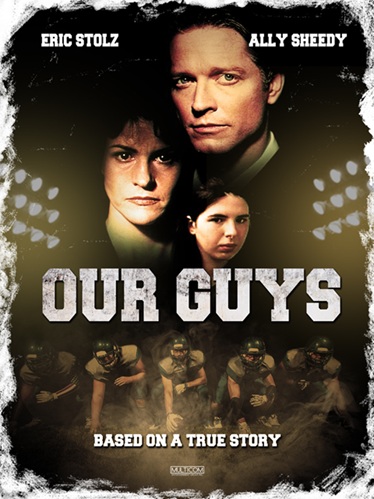
In 1999, Our Guys was adapted into a made-for-television movie.  Featuring Heather Matarazzo as Leslie, Ally Sheedy as the detective who investigated her rape, Eric Stoltz as the lawyer who prosecuted the case, and Lochlyn Munro as a cop who starts out on the side of the football team before realizing the truth, Our Guys simplifies the story a bit.  While the book focused on Glen Ridge and the culture of celebrating winners no matter what, the film focuses on Sheedy as the detective and her disgust with the suburbs in general.  Unfortunately, by not focusing on the culture of the town, the film presents the rape as being the bad actions of a group of dumb jocks as opposed to an expression of Glen Ridge’s contempt for anyone who was viewed as being on the outside.  What Lefkowitz showed through a precise examination of the town and its citizens, the film quickly dispenses by having Stoltz and Sheedy make a few pithy comments about how much the town loves it football team.  The story will still leave you outraged and Heather Matarazzo gives a heart-breaking performance as Leslie.  But, for those wanting the full story of  not only what happened in Glen Ridge but also how it happened, the book is the place to find it.

Film Review: Crawlspace (dir by David Schmoeller)


Before moving into a new place, always do a little research.

That would seem to be the main lesson that one can take from the 1986 horror film, Crawlspace.  As the film begins, Lori Bancroft (Talia Balsam) thinks that she’s found the perfect little apartment.  It’s clean.  It’s roomy but cozy.  It’s got space for all of her stuff.  It’s perfect for hosting friends.  You can bring a date back to the place without feeling embarrassed.  The apartment even comes with a charmingly eccentric landlord, an older German gentleman named Karl Gunther.  Gunther is played by Klaus Kinksi and….

Wait …. he’s played by who?

Klaus Kinski?  You mean the infamously difficult actor who appeared in not only a countless number of horror films and spaghetti westerns but also Doctor Zhivago?  Would this be the same Klaus Kinski who was briefly Werner Herzog’s muse?  That Klaus Kinski?

Uh-oh.  That’s not good.

It soon turns out that Gunther is not quite the friendly man that he pretends to be.  Gunther’s got some issues.  For instance, he spends a lot of time intentionally burning his hand and then smiling afterwards.  And there’s his habit of playing Russian Roulette.  Throughout the film, we see him sitting at a table and putting one bullet in a gun, just so he can then point it at his head and take his chances.

Gunther also has a thing for ventilation shafts.  He loves to crawl around in them, specifically so he can spy on his tenants.  When we first meet him, he’s obsessed with Sophie (Tane McClure) but he soon turns his attention to Lori.  Often, he’ll release rats into a tenant’s apartment.  When Lori merely laughs at the rat as opposed to screaming in fear, Gunther is impressed.

Of course, Karl Gunther wasn’t always a landlord.  He used to be quite a respectable doctor.  Of course, then all of his patients started dying and Gunther’s career went downhill.  Gunther, of course, claims that he only murdered his patients because they were in pain and suffering.  However, it could be more likely that his actions had something more to do with the fact that Gunther’s father was a Nazi war criminal, a doctor who justified his crimes with the same excuses as Gunther.

If all that’s not enough to convince you that Gunther’s got some issues, you should just take a look in the attic.  That’s where Gunther spends most of his time, writing in his journals.  It’s also where he keeps jars that are full of body parts.  One jar has a tongue in it.  A pair of eyes float in the other.  There’s a finger in another.  The attic is also where Gunther keeps one of his previous tenants in a cage.  Gunther says that he likes to talk to her, despite the fact that he long ago removed her tongue….

Plot-wise, Crawlspace is pretty much your standard low-budget 80s horror film.  There’s not much here that could really be called surprising but director David Schmoeller does find some creative ways to film all of the expected mayhem and the frequent shots of Kinski crawling through the ventilation shafts are genuinely creepy.  Kinski, giving a performance that’s even more unhinged than usual, is the best thing about the film and the main reason to see it.  By making Karl Gunther the self-loathing son of a war criminal, Schmoeller and Kinski bring an interesting subtext to the film.  Gunther is more than just a slasher movie villain.  Instead, he’s the embodiment of Hitler’s hateful legacy.

As I mentioned at the start of this review, Klaus Kinski was a legendary for being difficult.  Years after both the release of Crawlspace and Kinski’s own death, director David Schmoeller released a 9-minute documentary about the experience of making a film with Kinski.  The title of that film: “Please kill, Mr. Kinski.”  Apparently, this was a request that several members of the crew made to Schmoeller over the course of filming.  (Interestingly enough, Werner Herzog would make his own Klaus Kinski documentary — My Best Fiend — in which he mentioned that, during the shooting of Fitzcarraldo in Brazil, a native chief offered to have Kinski killed.)  Please Kill, Mr. Kinski is a fascinating look at not only low-budget exploitation filmmaking but also what it’s like to have to work with a talented monster.  As of this writing, it can be viewed on YouTube.