The TSL’s Daily Horror Grindhouse: The Sweet House of Horrors (dir by Lucio Fulci)


Mary and Roberto Vivaldi (played by Lubka Lenzi and Pascal Persiano) would appear to have a perfect life, perhaps because they do.  They’re young.  They’re attractive.  They’re in love.  They’re rich.  They have a really nice house and they have two children, a boy and a girl.  What could go wrong, right?

Well, they could come home from a party and discover that their house is being burglarized.  And the burglar could then proceed to graphically and viscously murder them, smashing in Robert’s head and, since this is a Lucio Fulci film, popping out Mary’s eye.  In fact, the opening murder is so graphic and so disturbing that it’s somewhat surprising to learn that this movie was made for television.

Of course, what’s even stranger is that the rest of the film is oddly tame, particularly for a Fulci film.  Perhaps they only had enough money in the budget for one graphic gore scene.

Anyway, the parents are now dead and the children are now orphans.  At the funeral, the children shock everyone by playing and laughing.  However, a few seconds later, they’re standing over the grave and crying.  Some people would call this an inconsistency but I think it’s the most realistic part of the film.  When you lose someone who you love, you do strange things.  There is no one proper way to grieve.  As someone who suffered through his share of personal tragedy, this was something that Fulci probably understood.

The parents may be dead but they’re not gone!  Instead, they’re haunting the house.  The children are overjoyed but their new guardian, Aunt Marcia (Cinzia Monreale, who was Emily in Fulci’s The Beyond) is not.  Marcia freaks out upon realizing that the house is haunted and it certainly doesn’t help that she’s attacked by a gigantic fly in the attic.  Her husband, the incredibly dense Carlo (Jean Christophe Bretigniere), doesn’t think anything strange is happening.  Still, Carlo does agree that it would be a good idea to sell the house and move the children elsewhere.

Nope!  The parents have no intention of letting that happen!  Of course, the dead parents main concern to kill the man who killed them but, once he’s dead (it doesn’t take that long), they’re free to spend their time pushing a real estate agent down a flight of stairs, harassing Marcia and Carlo and eventually causing an exorcist’s hand to melt.

If you’re getting the feeling that both the dead parents and the living children are pretty obnoxious, that’s because they are.  I mean, it’s one thing to not want to be separated.  That’s something we can all relate to.  It’s another thing to melt a man’s hand and then laugh about it.  Add to that, neither Marcia nor Carlo come across as being particularly villainous.  It’s not like they’re planning on murdering the kids for their inheritance or sending them to a Dickensian orphanage or anything like that.  They just want the kids to stop conducting black magic ceremonies and they want to live in a house that isn’t haunted.  No matter how much sympathy you may have for the parents or the kids, it’s hard to deny that Marcia and Carlo aren’t being all that unreasonable.

(It also doesn’t help that the film ends with the suggestion that the dead parents can stay with the kids regardless of whether the house is sold or not.)

And yet, I can’t help but like The Sweet House of Horrors.  Even though it doesn’t make much sense and it’s hampered by a low-budget (just check out the floating flames that represent the dead parents), there’s a sincerity to The Sweet House of Horrors.  The parents really do seem to love their obnoxious children and the film actually does provide some insight regarding the way that children use imagination to deal with grief.  Like many of his later film, The Sweet House of Horrors is hit-and-miss but Lucio Fulci still comes up with a few good visuals, suggesting that his heart may have been in this film in a way that it wasn’t in some of the other films he made during the final years of his storied career.  Just the fact that The Sweet House of Horrors tells such an openly sentimental story makes it unique in Fulci’s filmography.

The Sweet House of Horrors cannot be compared to such Fulci classics as The Beyond, The House By The Cemetery, The Black Cat, or Zombi 2.  But still, it’s an interesting little film and provides a hint that, even during his decline, Fulci still possessed some of the talent that made his earlier films so iconic.

the-sweet-house-of-horror-1989-movie-1

The Films of Dario Argento: Deep Red


I’ve been using this year’s horrorthon as an excuse to watch and review all (well, almost all) of Dario Argento’s films!  Today, I take a look at one of Argento’s best — 1975’s Deep Red!

profondo_rosso_poster

After the successful release of Four Flies on Grey Velvet in 1971, Dario Argento announced his retirement from the giallo genre.  His next film was 1973’s The Five Days of Milan, a historical comedy-drama with a political subtext.  The Five Days of Milan was a huge box office flop in Italy and, to the best of my knowledge, it was never even released in the United States.  To date, it is Argento’s most obscure film and one that is almost impossible to see.  In fact, it’s so obscure that, in two of my previous posts, I accidentally called the film The Four Days of Milan and apparently, no one noticed.

Forgotten Argento

Forgotten Argento

After the failure of Five Days, Argento returned to the giallo genre.  And while he was undoubtedly stunned by the failure of his previous film, Argento ended up directing one of the greatest Italian films of all time.  If The Bird With The Crystal Plumage and Four Flies on Grey Velvet were both great giallo films, Deep Red is a great film period.  It is Argento at his over the top best.

Now, before I go any further, I should point out that there are many different versions of Deep Red floating around.  For instance, it was released in the United States under the title The Hatchet Murders and with 26 minutes of footage cut from the film.  For this review, I watched the original 126-minute Italian version.  I’ve always preferred the original to the shorter version that was released in America.  Oddly enough, Argento has said that he prefers the shorter version.

hatchetmurders

Deep Red opens with a blast of music that both announces Argento’s return to the giallo genre and also provides some hints to his future as a filmmaker.  Whereas his previous films had all featured an excellent but rather serious score by Ennio Morricone, Deep Red was the first Argento film to be scored by Goblin.  There’s a gothic, almost operatic playfulness to Goblin’s work on the film.  (If the Phantom of the Opera had ended up working in Hollywood and writing film scores, the end result would have sounded a lot like Goblin.)  Goblin’s deafening score works as the perfect sonic companion to Argento’s constantly roving camera and vibrantly colorful images.  (The blood spilled in Deep Red is the reddest blood imaginable.)

deepred6511

Deep Red‘s protagonist is Marcus Daly (David Hemmings) and, like so many Argento protagonists, he’s both an artist and a man without a definite home.  At one point, he explains that he was born in England, grew up in America, and now lives in Italy.  He’s a jazz pianist but he supports himself by giving music lessons.  In a scene excised from the American cut, Marcus tells his students that, while classical music should be respected and appreciated, it’s also necessary to be willing to embrace art that some critics would dismiss as being “trashy.”  Marcus, of course, is talking about jazz but he could just as easily be Dario Argento, defending his decision to return to the giallo genre.

deepred4k3

While Marcus plays piano and tries to help his alcoholic friend, Carlo (Gabriele Lavia), a German psychic named Helga Ulmann (Macha Meril) is giving a lecture when she suddenly announces that someone in the audience is a murderer.  Later, Helga is brutally murdered by a gloved, hatchet-wielding attacker.

deep-red-hatchet

(Helga’s murder scene is always difficult for me to watch, even if Argento doesn’t — as Kim Newman pointed out in a review written for Monthly Film Bulletin — linger over the carnage in the way that certain other horror directors would have.  I have to admit that I also always find it interesting that Helga is played by the same actress who, that same year, would play the evil Lady On The Train in Aldo Lado’s The Night Train Murders.  Playing one of the Lady’s victims was Irene Miracle, who later co-starred in Argento’s Inferno.)

deepredscream1655_copy0_original

The only witness to Helga’s murder?  Marcus Daly, of course.  He’s standing out in the street, having just talked to Carlos, when he looks up and sees Helga being murdered in her apartment.  Marcus runs up to the apartment to help, arriving just too late.  And yet, Marcus is convinced that he saw something in the apartment that he can’t quite remember.  Deep Red is yet another Argento film that deals with not only the power of memory but the difficulties of perception.  Marcus knows that he saw something but what?

deep-red-12

Well, I’m not going to spoil it for you!  In this case, the mystery and its solution makes a bit more sense than the mysteries in Argento’s first three films.  Argento isn’t forced to resort to debunked science, like he did in both Cat o’Nine Tails and Four Flies on Grey Velvet.  One reason why Deep Red is so compulsively watchable is because, for perhaps the first time, Argento plays fair with the mystery.  After you watch the film the first time, go back and rewatch and you’ll discover that all the clues were there.  You just had to know where to look.

dr

That said, the way that Argento tells the story is still far more important than the story itself.  Argento’s first three films may have been stylish but Deep Red finds Argento fully unleashed.   The camera never stops moving, the visuals are never less than stunning with the screen often bathed in red, and Goblin’s propulsive score ties it all together.  This is one of those films from which you can’t look away.  It captures you from first scene and continues to hold you through the gory conclusion.  Deep Red is an undeniably fun thrill ride and, even today, you can easily see why Argento frequently refers to it as being his personal favorite of his many films.  In fact, Argento even owns a store in Rome that is called Profondo Rosso.

03_42

But you know why I really love Deep Red?

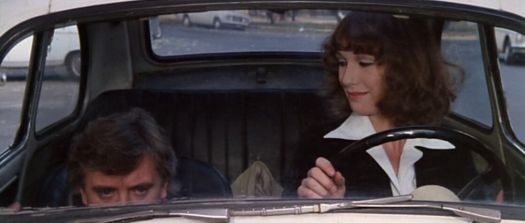
It’s all because of the relationship between David Hemmings and Daria Nicolodi.  Daria Nicolodi plays Gianna Brezzi, a reporter who helps Marcus with his investigation.  After three films that featured women as either victims or killers, Gianna is the first truly strong and independent woman to show up in an Argento film.  I know that some people have criticized the scenes between Hemmings and Nicolodi, feeling that they drag down the pace of the movie.  I could not disagree more.  Both Hemmings and Nicolodi give wonderful performances and their likable chemistry feels very real.

Gianna and Marcus arm westle. (Gianna wins. Twice.)

Gianna and Marcus arm westle. (Gianna wins. Twice.)

To me, that’s what sets Deep Red apart.  You care about Marcus and you care about Gianna.  Yes, the mystery is intriguing and the murder set pieces are brilliantly choreographed, and Deep Red is definitely Argento at his best.  But for me, the heart and soul of the film will always belong to the characters of Marcus and Gianna and the performers who brought them to life.

deep-red

deep-red-2

Deep Red was the start of Dario Argento and Daria Nicolodi’s long and often contentious relationship.  (Dario and Daria’s daughter, Asia Argento, was born around the same time that Deep Red was released and has directed two films, Scarlet Diva and Misunderstood, that deal with her often chaotic childhood.)  This relationship would play out over the course of six films and, as much as I love those six films, it’s always a little sad to consider that, when watched in order, the provide a portrait of a doomed and dying romance, one that did not particularly end well.  (It is possibly not a coincidence that, with the exception of Deep Red and Tenebrae, Daria Nicolodi suffered some type of terrible death in every film she made with Argento.)

But, regardless of what may or may not have been going on behind the scenes, Deep Red remains a triumph for both its director and its stars.

david-daria-dario