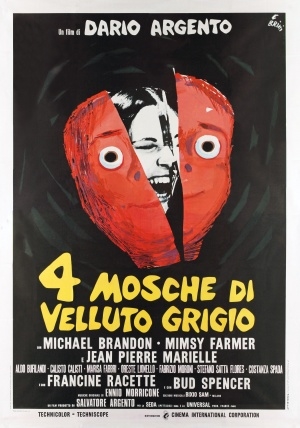
After the good but somewhat generic Cat o’Nine Tails, Dario Argento returned to form with his third film, 1971’s Four Flies on Grey Velvet.
It’s not particularly easy to describe the plot of Four Flies because, much like The Bird With The Crystal Plumage, the storyline is less important than the way that Argento tells it. The film tells the story of Roberto Tobias (Michael Brandon), a drummer with an up-and-coming rock band in Rome. In many ways, Roberto is a typical drummer. He’s the guy who, even though he’s often obscured in the background, keeps things balanced. He has a loving wife, Nina (Mimsy Farmer), a nice house, and worldly, politically woke friends who smoke weed and praise art. Admittedly, one of those friends does tell a rather gruesome story about witnessing a beheading in Saudi Arabia which leads to Roberto having a reoccurring nightmare but otherwise, Roberto would appear to have a great life.
(Incidentally, Roberto’s nightmares are Argento at his best.)
So, why is this stable and easy-going guy suddenly being followed by a mysterious man in a suit? And why, when Roberto confronts the man, does he discover that there’s yet another mysterious figure — this one wearing a mask — following him and taking pictures?
That’s the mystery that opens Four Flies on Grey Velvet but it’s not the only mystery to be found in the film. In fact, this movie finds Argento at both his most macabre and his most playful. At times, he literally seems to be seeing just how far he can push and how complicated he can make things before totally losing his audience. The film may start with Roberto being followed and having nightmares but eventually, it comes to involve everything and everyone from Nina’s enigmatic cousin, Dalia (Francine Racette) to a beatnik named God (played by none other than spaghetti western mainstay, Bud Spencer) to a flamboyant private investigator (Jean-Pierre Marielle). (By today’s standards, the portrayal of the gay detective has a few cringey moments but you have to remember that Four Flies On Grey Velvet was made in 1971. It was nothing less than revolutionary for an Italian film of that era to portray an openly gay contemporary character in any type of positive light.) To top it all off, the solution to the film’s main mystery is discovered through optography, the long-since discredited idea that an eye will “save” the last image seen before death. It’s ludicrous but Argento pulls it off with a cheerfully over-the-top style that perfectly matches the film’s twisted plot. After the toned down Cat o’Nine Tails, Four Flies was Argento’s way of reminding viewers of who he truly was as a filmmaker.
The film’s brilliant opening sets the tone for the entire film. Watch it below and thank me later:
It’s rare that anyone every really discusses the acting in an Argento film. Argento has himself admitted that he doesn’t worry much about actors and many of his films have been released in badly dubbed versions, which often makes it difficult to fairly judge any of the performances. That said, Roberto Tobias is one of my favorite Argento protagonists and it’s all due to Michael Brandon’s performance. Brandon makes Roberto into such a nice guy and does such a good job of capturing his descent into paranoia that it’s impossible not to get caught up in his story. (I would even argue that the long-haired and politically concerned Roberto is almost an autobiographical stand-in for Argento himself.) Though I can’t really explain why without running the risk of spoiling a major part of the movie, Mimsy Farmer is also excellent. Reportedly, Argento originally wanted to cast Mia Farrow and you can imagine a post-Rosemary’s Baby pre-Woody Allen Farrow in the role. But I’m glad that Argento couldn’t get her because Mimsy Farmer gives a close to perfect performance.
Four Flies was the third and final part of Argento’s “animal trailer,” and, at the time, Argento declared that Four Flies would also be his final giallo film. He followed up Four Flies with The Four Days, a historical comedy that was considered to be such a failure that, after its release, Argento returned to the safety of the giallo genre and gave the world one of his greatest triumphs, Deep Red. However, if The Four Days had been a success and Four Flies had been Argento’s final giallo film, it would have been a triumphant note to go out on.
Here’s the very misleading trailer that was used for Four Flies On Grey Velvet‘s American release.
And here’s the even more obscure European trailer!

 Through the Shattered Lens