In 2002, a man named Christian Longo was arrested in Mexico. Longo, who was on the FBI’s 10 Most Wanted List, was charged with murdering his wife and his three children. When he was arrested, he was using the name of Michael Finkel, a real-life travel writer for the New York Times. When asked why he had been using Finkel’s name, Longo explained that he admired Finkel as a writer.
At the same time that Christian Longo was getting arrested, Michael Finkel was in the process of watching his career fall apart, the result of his having fabricated part of a story. Fired from the New York Times, Finkel found himself unemployable. When he discovered that Longo had been using his name, Finkel arranged to meet with him. Not only was he curious as to why Longo wanted to be him but he also saw Longo as potentially being the story that could relaunch his career.
During their initial meeting, Longo told Finkel that he was a long-time admirer. Longo agreed to tell Finkel his side of the story in exchange for writing lessons and Finkel’s promise to keep the details of their conversations a secret until after the trial. Finkel agreed and soon, the two men became unlikely friends.
At first, Finkel believed that Longo was innocent. But then, on the first day of the trial, Longo was asked how he pled to four charges of murder. Longo entered two pleas of not guilty and two pleas of guilty and Finkel found himself forced to reexamine everything that he had previously believed about his new friend…
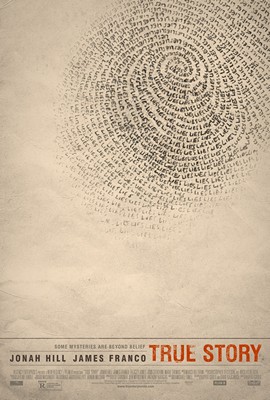
Amazingly enough, that’s a true story. It’s also the subject matter of a recently released film called True Story.
In True Story, Michael Finkel is played by Jonah Hill and Christian Longo is played by James Franco. Both Franco and Hill (who, despite having 3 Oscar nominations between them, remain oddly underrated actors) give the type of excellent performances that can elevate an entire film. Interestingly enough, they’re both playing dramatic versions of their own typically comedic personas. Hill plays up his trademark nerdy aggressiveness while Franco brings his own deliberately ambiguous persona to Christian Longo. Just as James Franco enjoys leaving people guessing about who he really is, Longo seems to get a perverse pleasure out of keeping Finkel guessing about whether or not he really killed his family. When Longo takes the stand in his own defense and gives his version of what happened on the night of the murders, he does it with a perverse gleam in his eye. Longo may be facing the death penalty but mostly, he’s just enjoying being in the spotlight.
Hill and Franco are famous for being off-screen friends and they bring a lot of their own real-life chemistry to their shared scenes. As played by Hill and Franco, Finkel and Longo develop a relationship that is nearly co-dependent. Longo wishes that he could be a writer like Finkel. Finkel wishes that he could be as personable and outwardly confident as Longo. When Longo writes Finkel an 80-page letter that’s full of crude drawings, Finkel responds by taping each page to the wall of his office until he’s literally encircled by Longo’s words, much as how someone like me may have once been tempted to tape pictures of James Franco to the wall of her college dorm room.
With Franco and Hill both giving great performances, it’s a bit disappointing that the rest of the film isn’t always as strong. Director Rupert Goold makes his feature film debut here and, at times, it feels as if he’s struggling to keep up with his actors. There’s a lot of slow motion scenes of people walking down hallways and getting out of cars. As well, too much of Finkel and Longo’s relationship is portrayed via montage. We see countless rapidly-edited montages of Longo and Finkel speaking but, instead of actually hearing what the two of them are talking about, we instead listen to Marco Beltrami’s score. Goold gets a lot of perfectly lit visuals but True Story is a film that could have used a rougher edge.
Even more unfortunate is that the film totally wastes Felicity Jones. Playing Finkel’s wife, she doesn’t get to do much beyond looking pensive and concerned. It’s a role that anyone could have played and it’s frustrating to watch because Felicity Jones is capable of doing so much more than just playing a worried wife. Towards the end of the film, there’s a great scene where Longo and Jill talk on the phone and, at that moment, Felicity Jones finally gets to show some strength and personality. James Franco, as well, seems to be relishing the chance to play up Longo’s manipulative side. (It’s interesting to listen to the perversely flirtatious tone that he takes with her as opposed to the passive aggressive flattery that he uses on Finkel.) The scene works wonders but then, the film makes the mistake of having Jill face Longo face-to-face and it falls flat precisely because Jill isn’t deep enough a character for us to feel any real satisfaction in watching her tell him off.
In the end, True Story is worth watching. James Franco and Jonah Hill both give great performances. If you’re a true crime fan like I am, you’ll find a lot of True Story to be intriguing. Ultimately, if True Story is frustrating, it’s because it’s a good film that should have been great.
 Through the Shattered Lens