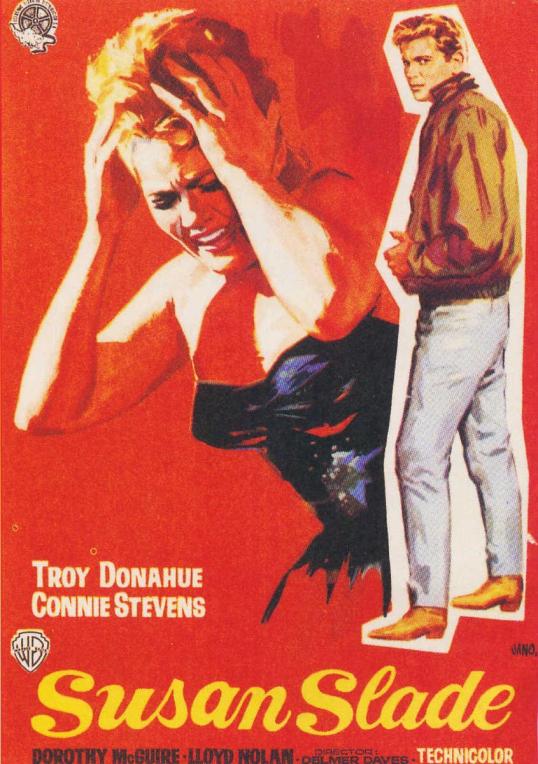
Film Review: Susan Slade (dir by Delmer Daves)


Shortly after this 1961 film begins, 17 year-old Susan Slade (Connie Stevens) announces, “We’ve been sinful!”

She’s talking to her first lover, Conn White (Grant Williams).  You would think that anyone — even someone as unbelievably naive and innocent as Susan Slade — would know better than to ever trust someone named Conn White but no.  From the minute that Conn and Susan met on an ocean liner heading from South America to California, it was love at first sight.  In fact, Susan was so sure of her love that she spent the night in Conn’s cabin, fully knowing that it would mean surrendering her status as an Eisenhower era good girl.

Conn laughs off her concerns about sin.  He also tells her that it makes perfect sense for her not to tell her parents (played by Dorothy McGuire and Lloyd Nolan).  “When we’re married,” he asks, “are you going to tell your mother every time that we make love?”

Wow, Conn still wants to get married even though he’s already had sex with her!?  And he’s also extremely wealthy and stands to inherit control of a multinational corporation!  He sounds like the perfect guy!  Way to go, Susan!

Unfortunately, it turns out that Conn does have one flaw.  He really, really likes to go mountain climbing.  In fact, he’s planning on scaling fearsome old Mt. McKinley.  While Susan and her family settle into life in Monterey, California, Conn heads up to Alaska.  He promises Susan that he’ll keep in touch but, when she doesn’t hear from him, she fears the worse.  Has he abandoned her?  Was he lying when he said he wanted to get married?  Then one day, she gets a call from Conn’s father, informing her that Conn fell off the mountain and died.  Susan’s almost father-in-law tells her that Conn’s body cannot be retrieved from the mountain.  Though it’s neither confirmed nor denied by the film, I decided that this was because Conn faked his own death to get out of having to spend any more time listening to Susan talk about sin.

Anyway, Susan’s single again but, fortunately, she does not lack for suitors.  For instance, there’s the spoiled Wells Corbett (Bert Convy), who is kind of shallow and arrogant but who has a lot of money.  And then there’s Hoyt Brecker (played, in reliably vacuous style, by Troy Donahue), who is poor but honest and who is also an aspiring writer.  “Someday,” Susan declares,”they’ll say that Robert Louis Stevenson, Jack London, and Hoyt Brecker wrote here!”  Who will Susan chose?  The sensitive artist who loves her unconditionally or the arrogant rich boy who smirks his way through the whole film?

Complicating matters is the fact that Susan is …. pregnant!  That’s right, this is another one of those movies from the early 60s where having sex outside of marriage always leads to an unplanned pregnancy.  And, because this movie is from 1961, the only solution is for the Slades to move down to Guatemala for two years, just so they can fool the people on Monterey into believing that the baby is actually McGuire’s and that Susan Slade is not an unwed mother but is instead an overprotective older sister.  Will either of Susan’s two suitors be waiting for her when she and her family return to California?

Now, please don’t get me wrong.  I do understand that there’s a big difference between 1961 and 2019 and that there used to be a lot more scandal attached to sex outside of marriage and unwed pregnancy.  In fact, I guess that difference is really the only thing that makes Susan Slade interesting to a modern viewer.  As soon as we see that this film was directed by Delmer Daves (the poor man’s Douglas Sirk) and that it stars Troy Donahue, we know who poor Susan is going to end up with so it’s not like there’s any real surprises lurking in the film’s plot.  And none of the actors, though Connie Stevens sometimes to be trying, seems to be that invested in the film’s story.  Instead, Susan Slade is mostly useful of a time capsule of the time in which it was made, a time when sex outside of marriage was unironically “sinful” and the only possible punishment was either pregnancy, death, or both.  Indeed, Susan Slade is less concerned about the hypocrisy of a society that would force Susan to lie about her new “brother” and more about whether bland lunkhead Troy Donaue will still be willing to marry Susan even if she’s no longer eligible to wear white at their wedding.  The film seems to be asking, “After being sinful, can Susan Slade become a good girl again?”  As a movie, it’s fairly turgid but as a cultural artifact of a time in which everyone was obsessed with sex but no one was willing to talk about it, Susan Slade is occasionally fascinating.

Poor Susan Slade!  If only she had gotten pregnant in a 1971 film instead of one made in 1961, her story could have been so different.  But no, she was sinful in the early 60s and that means she’ll be have to settle for Troy Donahue.
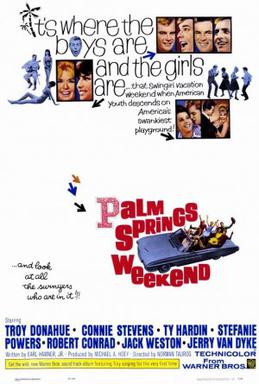
 

Film Review: Palm Springs Weekend (dir by Norman Taurog)


The 1963 film Palm Springs Weekend asks the question, “When is a beach film not a beach film?”

When it takes place in the freaking desert!

That’s right, Palm Springs Weekend takes place in the middle of the California desert.  There’s no ocean in sight nor are there any beaches on which to frolic.  Instead, there’s just a cheap motel and a swimming pool.  That said, Palm Springs Weekend pretty much follows the same formula as all of the beach films that were released in the early 60s.  A group of college students hop on a bus and head off for the weekend.  One student is wacky.  One student is rich, wild, and dangerous to know.  And, of course, one student is clean-cut, responsible, boring, asexual, and studious and all about doing the right thing.

Troy Donahue, the blandest teen idol of all time, plays the clean-cut student.  His name is Jim and he’s a college basketball star.  Even when he’s on the bus traveling to Palm Springs, he’s still got a book to study.  Jim’s the type who wears a suit and a tie to the pool.  He ends up falling in love with Bunny Dixon (Stefanie Powers) and the two of them spend a lot of time talking about sex in the most chaste way possible.  Bunny’s father (played by Andrew Duggan) is the chief of police and he doesn’t want any crazy college kids causing trouble in his town!  Well, it’s a pretty good thing that all he has to worry about is Troy Donaue asking his daughter if she wants to take a moonlight stroll in the middle of the desert.

(Trust me.  I’ve spent enough time in the desert to know that the last thing you want to do when you live near rattlesnakes is take a moonlight stroll.)

Jim’s best friend is Biff (Jerry Van Dyke).  Biff is the wacky college student, which means that he plays the ukulele and he gets all the comedic moments.  In this film, that amounts to getting babysitting an annoying boy and, at one point, falling into an extremely sudsy pool.  Luckily, Jim’s there to deliver CPR, which leads to soap bubbles floating out of Biff’s mouth and …. you know what?  I’m tired of writing about Biff.

Anyway, Biff and Jim really aren’t that important.  The entire film pretty much belongs to Robert Conrad and Connie Stevens, largely because they’re the only two actors who are allowed to break out of the trap of always either being bumbling and innocent or dramatic and self-righteous.  Robert Conrad plays Eric Dean, who is a spoiled rich kid who owns an expensive and fast car and who is basically a fun-loving sociopath.  Meanwhile, Connie Stevens plays Gail, who is a high senior and who is pretending to be a college student.  And while the film insists that we should somehow be disappointed in Gail because she’s acting wild and breaking curfew and doing more than just talking about whether or not it’s appropriate to kiss on the first date, she’s actually the most compelling character in the film because, at the very least, she’s actually setting her own rules and making her own decisions.  Since Palm Springs Weekend was made in 1963, it ultimately feels the need to try to punish Gail for thinking for herself but that doesn’t change the fact that she’s still a far more interesting character than the blandly innocent Bunny.  Gail’s a rebel.  Gail’s the future.  All hail Gail!

Anyway, Palm Springs Weekend is pretty forgettable and it’s never as much fun as any of AIP’s old Beach Party films.  That said, I’d still recommend it if you’re a history nerd like me.  It’s definitely a film of its time, a time capsule of an era.

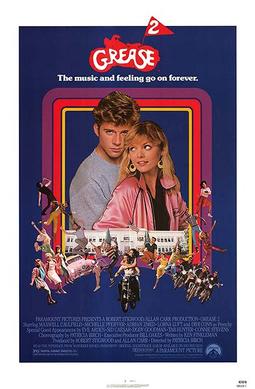
Back to School Part II #14: Grease 2 (dir by Patricia Birch)


Grease_2


So, the whole reason that I watched Grease last week was so I would be prepared to watch the 1982 sequel Grease 2 over the weekend.  As I’ve mentioned many times on this site, I absolutely hate Grease and I know what you’re probably asking yourself:

“But Lisa, if you hate Grease so much, why did you want to see Grease 2?”

Well, there’s a very good answer to that question but I’m not going to reveal it.  I’m going to encourage you to learn to love the mystery.  For whatever reason, I wanted to watch Grease 2.  Perhaps it was because I’ve heard that Grease 2 is the worst sequel ever made.  I really didn’t see how that was possible.  How, I wondered, could a film be any worse than the original Grease?

And, so, I watched Grease 2 on Netflix and yes, it was really, really bad.  But you know what?  It was so bad that it became almost compulsively watchable.  Unlike the first Grease, which is full of slow spots, Grease 2 is oddly exciting in its mediocrity.  I watched much of it in open-mouthed horror, wondering if things could possibly get any worse.  And, with each scene, it did get worse.  It was so overwhelmingly and shamelessly bad and so thoroughly misguided that, strangely enough, I really want to rewatch it.

Grease 2 takes place in 1961.  There’s a whole new gang of students at Rydell High!  Well, actually, Frenchy (Didi Conn) has returned.  You may remember that, in the previous film, Frenchy dropped out of high school and went to beauty school.  (She was also visited by Satan, who came to her disguised as the Teen Angel.)  But now Frenchy is back, trying to pass a chemistry class so she can … well, I’m not really sure what the whole deal with Frenchy was.  I imagine that Didi Conn was probably free for a weekend.

The T-bird and the Pink Ladies are still around but they have a whole new membership.  The head of the Pink Ladies is Stephanie Zinone (played, in her film debut, by Michelle Pfeiffer).  Her boyfriend, Johnny Nogorelli (Adrian Zmed), is the chain-smoking leader of the T-birds.  Actually, Johnny is now her ex-boyfriend.  He cheated on her over the summer.

And there’s a new boy at Rydell!  He’s originally from England and he’s Sandy’s cousin!  His name is Michael Carrington (superhandsome Maxwell Caulfield, who is perhaps fated to always be best known for playing Rex Manning in Empire Records) and, when we first meet him, he’s getting off a school bus and he’s wearing a suit!  Michael really likes Stephanie but you have to be a T-bird if you’re going to date a Pink Lady and…

AGCK!

Sorry, that was a primal scream.  Trying to describe the plot of Grease 2 inspires a lot of primal screams.

Anyway, this is a film is also a musical but apparently, none of the original Grease composers were involved with the sequels.  All the songs kinda sound like something you would hear in a parody of Grease, as opposed to a sequel.  Also adding to bizarre feel of this sequel is that everyone delivers their lines as if they’re appearing in a stage production, projecting to the back of the theater and overenunciating every single syllable.  This may have made sense for Grease, which was adapted from an actual stage show and, despite efforts to open up the action, was still deliberately stagey.  Grease 2, meanwhile, is an adaptation of a stage show that never actually existed.

The film starts with a 7 minute production number called Back To School Again.  As the Pink Ladies and the T-birds and all the other students show up outside of Rydell, they sing, “Woe is me!  The Board of Education took away my parole.”  And the scene just keeps going and going, until you start to wonder if Rydell High is a cult compound.

This is followed by a song about bowling (!) that’s called “Score Tonight.”

And it just keeps getting worse from there.  The film becomes sickly fascinating as you find yourself trying to predict how much more worse it can possibly get.  You may be tempted to give up but you’ll definitely want to stick around for the scene in which Michael discovers that Stephanie wants a “cool rider.”  How does he know that?  She sings a song about it!

Naturally, Michael gets a motorcycle, a helmet, and pair of goggles and he starts to romance Stephanie.  Stephanie doesn’t know who that Michael is the mysterious motorcyclist, despite the fact that Michael is just wearing a helmet and a pair of goggles.  Though you have to admire Pfieffer’s commitment to her role (and she gives a fairly good performance, considering the material she was working with), you can’t help but feel that Stephanie might not be the smart.  Especially after she sings, “Who’s that guy?”

Uhmmm … it’s Michael.  It’s not like he’s dressed up like a bat or wearing the Iron Man armor.  He’s just got a helmet and goggles on.  Add to that, while Maxwell Caulfield doesn’t give a bad performance (he seems to be doing the best he can with what he’s been given to work with), he also doesn’t attempt to act any differently when he’s the mysterious motorcyclist than when he’s Michael.

There are other things going on as well.  The film is full of vignettes about life in 1961, all featuring the students and teachers at Rydell High.  For instance, former teen idol Tab Hunter shows up as a substitute teacher and sings a song about reproduction.

And again, it’s so bad that you can’t look away and you watch knowing that you’ll never get the images and the songs out of your head.  So compulsively watchable is this bad movie that I may have to watch it again after I finish this review.  (Then again, I’ll probably just rewatch the fifth season of Degrassi…)

(That said, I would actually argue that Grease 2 is a better directed film than the first Grease.  Grease 2 was directed by Grease‘s choreographer and, as opposed to the first film, the dance numbers are actually framed with modicum of care.)

(By the way, I’ve always wanted to use the phrase “modicum of care” in a review.)

Anyway, Grease 2 apparently bombed at the box office and, as a result, there have been no further Grease films.  It’s a shame because you so know that Grease 3 would have taken place in 1967 and featured hippies.

Oh well.

We’ll survive…