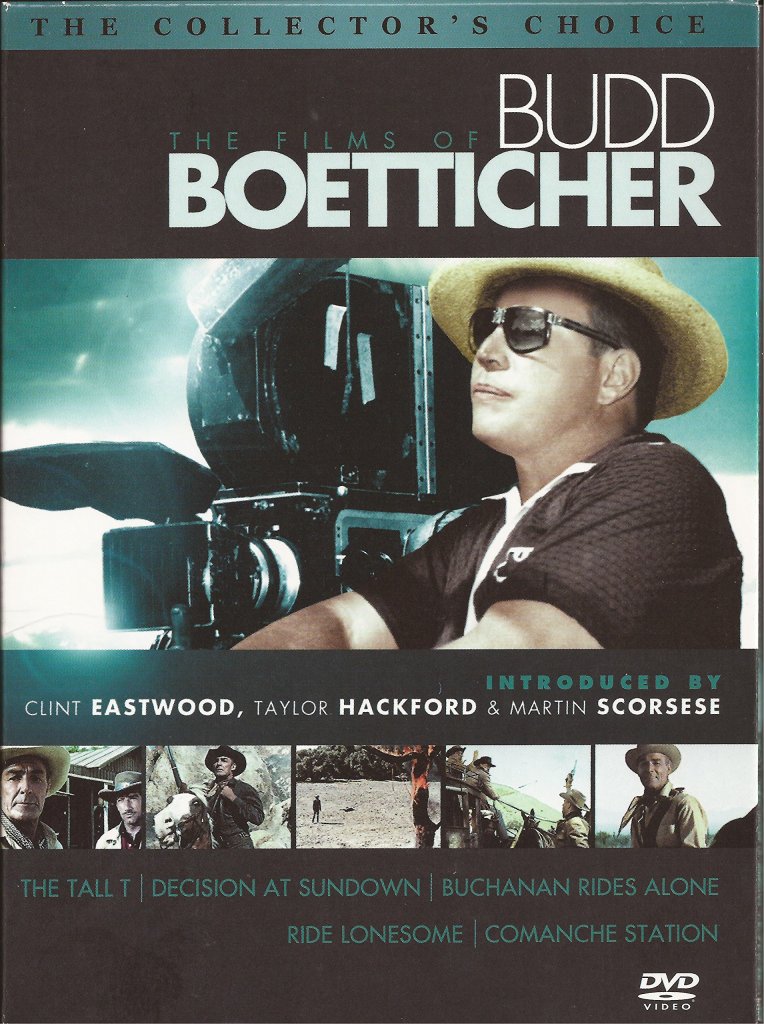
There was a time in my life, before streaming existed, where it seemed like I wanted to buy every movie that interested me in the slightest. The main ways I looked for new movie releases was to go to a store like the Hastings Entertainment Superstore and look at their inventory, or look at the new and recent releases on Amazon’s online store. I could spend hours looking for movies in either location, and I did. Sometime in 2008, I ran across a DVD box set described as “The Films of Budd Boetticher” that contained introductions by the likes of Martin Scorsese, Taylor Hackford, and Clint Eastwood. The films included on the box set were THE TALL T, DECISION AT SUNDOWN, BUCHANAN RIDES ALONE, RIDE LONESOME, and COMANCHE STATION. I remember seeing the names of these movies at various times in my life in my movie books. They had never really caught my attention, although I do remember that they would receive good reviews. This set did catch my attention, however, based on the interesting packaging and the fact that Scorsese and Eastwood were both singing the praises of the films. I did a little bit of quick research and decided to just buy the boxset. I’m glad to report that these films have turned into some of my very favorite movies, and I sing their praises to anyone who will listen.
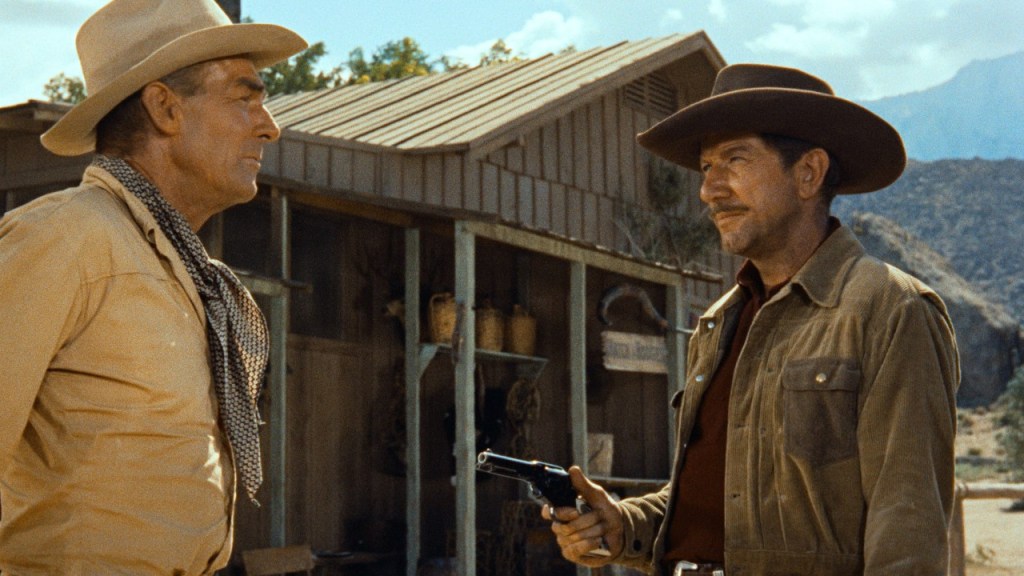
The earliest movie in this set is THE TALL T from 1957, which is based on Elmore Leonard’s short story, “The Captives.” The story opens with our hero Pat Brennan (Randolph Scott) stopping by the Sassabee Stagecoach Station and visiting with the owner Hank (Fred Sherman) and his son, Jeff (Christopher Olsen). Brennan seems like a good-natured guy who has a nice visit with the two and even agrees to purchase young Jeff some striped candy when he stops in the town of Contention later that day. Brennan heads on to Contention where we meet Ed Rintoon (Arthur Hunnicutt), a stagecoach driver who has been hired to take Willard and Doretta Mims (John Hubbard and Maureen O’Sullivan) to Bisbee for their honeymoon. Rintoon and Brennan are clearly old friends. As part of their various conversations, we learn that Doretta Mims is the daughter of Old Man Gateway, the man with the richest copper claim in the territory. After saying goodbye to Rintoon and buying young Jeff his striped candy, Brennan continues on to Tenvoorde’s (Robert Burton) ranch, in hopes of buying a seed bull for his own start-up ranch. For many years, Brennan had been the ramrod on Tenvoorde’s ranch, and the old man clearly wants him to come back. Tenvoorde offers Brennan a chance to get his bull for nothing, but he has to ride the bull to a stand still. If he can’t do it, then Tenvoorde keeps the bull and Brennan’s horse. Brennan takes him up on the offer, falls off the bull, dives into water trough to avoid getting stomped by the bull, and then heads back towards his ranch with nothing but his wet clothes and saddle. As he’s walking down the road, Rintoon comes by on his stagecoach with Mr. and Mrs. Mims. They pick Brennan up and give him a ride. When they stop back at the Sassabee Stagecoach Station, Hank and Jeff are nowhere to be seen. Rather, a voice from inside the station says “Drop your guns and come on down.” Frank Usher (Richard Boone) and young Billy Jack (Skip Homeier) emerge from the station with their guns drawn. When he’s getting down off the stagecoach, Rintoon goes for his shotgun and is shot down by another man, Chink (Henry Silva), whose been waiting in the shadows. These three men are waiting to rob the next stagecoach that comes along. They’ve already killed Hank and Jeff, and are planning to kill every person on this coach, when Willard tells them that his wife Doretta is from the richest family in the territory. Willard tells the three outlaws that Old Man Gateway will pay good money to get his daughter back, if they will just let them live. Usher, the leader of the bunch, likes this idea and sends Billy Jack and Willard back to Contention to request $50,000 from Gateway for the safe return of his daughter. With the endgame changed, Usher takes Brennan and Mrs. Mims to their hideout to wait to get their money from Gateway. Brennan knows that it’s just a matter of time before they are all killed, and he tells Mrs. Mims that they will need to be looking for any possible opportunity to escape.
THE TALL T is just so good. It’s amazing how much drama that director Budd Boetticher could fit into these films that all had running times of less than 80 minutes. The story is simple, but it deals with big themes like honor, cowardice, true love, sociopathic evil, and big dreams. Credit here has to be given to Elmore Leonard, the writer of the short story the film is based on. It must also be given to Burt Kennedy. Kennedy wrote the scripts for THE TALL T, RIDE LONESOME, and COMANCHE STATION. He’s not the credited writer for BUCHANAN RIDES ALONE but he did uncredited work on the script. Kennedy would go on to have a good career writing and directing his own westerns, like SUPPORT YOUR LOCAL SHERIFF, THE TRAIN ROBBERS, and HANNIE CAULDER, but his work with Boetticher is definitely some of his very best.
It’s also amazing how spare and simple everything looks in the THE TALL T. The land is just so dry, with nothing but big rocks and not a tree in sight. Growing up in Arkansas, I’m used to green fields and trees and flowers. It can almost feel like you’re choking on dust just watching this film.
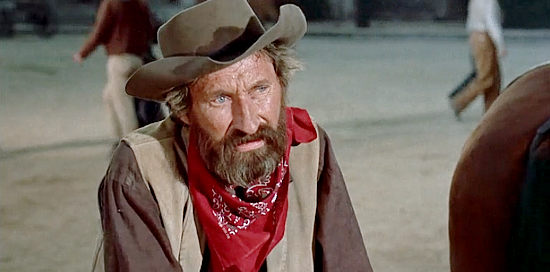
The casting always seems to be perfect in Boetticher’s films. Randolph Scott is simpatico with Boetticher. His character here is a good man who will do what it takes to survive while also keeping his honor intact. Boetticher and Scott are truly a match made in heaven. Richard Boone is great as Frank Usher, the leader of the outlaws. He could have killed Scott’s character Brennan, but he is glad to have an honorable man to talk to after spending all of his time with Billy Jack and Chink. Boone somehow makes his outlaw leader into an honorable man even though he’s done many dishonorable things. It’s an impressive feat. Maureen O’Sullivan has an important role as Doretta Mims, the rich but plain woman, who married Willard because she was afraid she’d end up all alone. Her career goes all the way back to the 1930’s where she played Jane in the original Tarzan movies. She’s a good actress whose character undergoes the widest arc in the entire movie. Henry Silva’s Chink is a sociopath who is keeping score of the number of people he kills. Boone’s Usher would have been much better off if he would have gone with Chink’s advice and put Brennan and the Mims’ in the well back at the Sassabee station! Based on his nonchalant penchant for violence, you can see how Henry Silva would go on to having an amazing career playing bad guys. The last person I want to mention in the cast is Arthur Hunnicutt, who played Ed Rintoon. Hunnicutt is special to me because he comes from the hills of Arkansas, from a little town called Gravelly. He attended the same college I attended, although it was called the Arkansas State Teachers College when he was there. It was the University of Central Arkansas when I came through. Hunnicutt specialized in wise, rural characters. He was even nominated for an Acadamy Award a few years earlier for a movie called THE BIG SKY. He’d go on to be in so many good movies, including playing “Bull” in EL DORADO with John Wayne. I’m just proud of the guy for growing up in extreme rural Arkansas and then becoming a great character actor in Hollywood. I’ll watch anything he’s in.
I recommend all of these Budd Boetticher / Randolph Scott westerns, and THE TALL T is one of the very best!


 Through the Shattered Lens