 So, we all know that The Hurt Locker was the first best picture winner to have been directed by a woman. And we also all know that, when Kathryn Bigelow won her Oscar for that film, she was the first woman to win the Academy Award for Best Director.
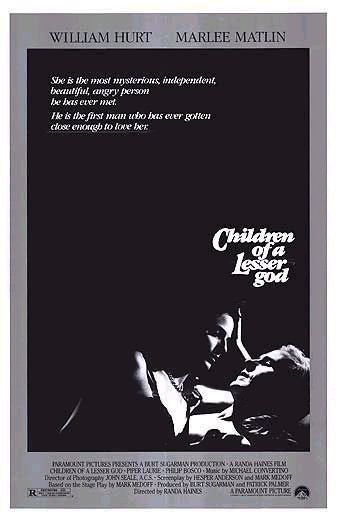
But do you know the title of the first film to be both be directed by a woman and to be nominated for best picture? Well, you probably do now because I’m assuming that you’ve read the title of this post and you’ve seen the picture of the film’s poster above. But, let’s just pretend that you don’t so I can triumphantly say, “The 1986 film Children of a Lesser God was the first nominee for best picture to be directed by a woman!”
And the name of that director was Randa Haines. Never heard of her? You’re probably not alone in that. After making her feature debut with Children of a Lesser God, Haines only directed three more theatrical films. Instead, she’s spent most of her career in television and, if not for the nudity and the language, Children of a Lesser God could probably pass for a well-made Lifetime movie. That’s not necessarily a criticism because I happen to like well-made Lifetime movies. But still, it’s not surprising that Children of a Lesser God was the only 1986 best picture nominee not to receive a nomination for best director.
(For the record, Platoon won best picture and Oliver Stone won best director. Nominated in Haines’s place was David Lynch for Blue Velvet.)
As for the film itself, it’s a well-acted and well-made film. It’s not exactly great in the way that we ideally expect a best picture nominee to be. It’s directed a bit too much like a television movie and the film ends on a happy note that doesn’t exactly feel earned. (If any film would have benefitted from a bittersweet conclusion, it would have been Children of a Lesser God.) Still, at the same time, you can tell why the film was nominated. It deals with a social issue (in this case, the way that the deaf are marginalized by mainstream society) and it’s a romance between … well, I was going to say mature adults but actually, William Hurt was 15 years older than Marlee Matlin when they played lovers in this film, which adds a perhaps unintentional layer of ambiguity to their relationship. Children of a Lesser God was also the first film to feature a deaf performer in a lead role and, when Marlee Matlin won the Oscar for Best Actress, she became both the youngest and, to date, the only deaf actress to win.
Ultimately, Children of a Lesser God is more interesting from a historical point of view than a cinematic one. But the value of history should never be underestimated! It’s a worthy-enough film and Matlin’s angry performance holds up well. (As for William Hurt, how you respond to his performance will depend largely on how much tolerance you have for his voice. Whenever Matlin communicates through sign language, Hurt repeats aloud whatever it is that she’s said. As a result, the film is basically 2 hours straight of William Hurt talking and, on occasion, it’s a bit too theatrical and distracting. If the film were made today, the filmmakers would probably just use subtitles.) Finally, and perhaps most importantly, even if it didn’t lead to bigger things for Randa Haines, Children of a Lesser God did open the door for others to follow.
 Through the Shattered Lens