Lisa Reviews An Oscar Nominee: Kitty Foyle (dir by Sam Wood)


(With the Oscars scheduled to be awarded on March 4th, I have decided to review at least one Oscar-nominated film a day.  These films could be nominees or they could be winners.  They could be from this year’s Oscars or they could be a previous year’s nominee!  We’ll see how things play out.  Today, I take a look at the 1940 best picture nominee, Kitty Foyle!)

Kitty Foyle opens with a title card informing us that, before the film can tell us the story of Kitty Foyle, it is necessary to remind audiences of how Kitty Foyle — and so many other “white-collar” girls — arrived in their present (which is to say, 1940) situation.

We then get a strange little montage of life at the turn of the century.  A woman meets a man.  The man marries the woman.  They’re a happily married couple.  The man goes to work.  The woman takes care of the house.  The man comes home.  Everything’s perfect.  Then suddenly — oh my God, it’s the suffragettes!  They’re holding rallies!  They’re parading around with signs!  They’re demanding the right to vote!  They’re demanding prohibition!  Suddenly, women are expected to be independent and to have careers…

Which leads us to New York in the 1940s, where a bunch of women in an elevator discuss how difficult it is to find a good husband, especially now that they’re all busy working as salespeople and administrative assistants.  Apparently, this is the price that we all had to pay for the right to vote.  On the one hand, the women who cast their first votes in 1920 elected Warren G. Harding and spared the nation from another four years of Wilsonianism.  On the other hand, it’s now difficult to find a husband.

Fortunately, Kitty Foyle (Ginger Rogers) doesn’t have that problem.  She has a wonderful suitor, a man who has just asked her to marry him.  His name is Dr. Mark Eisen (James Craig).  He may not have a lot of money but he’s handsome, he’s considerate, and he spends all of his time providing medical care to the poor and indigent.  When Mark asks her to marry him, he asks her if she’s sure that she’s over that man from Philadelphia.  Kitty says that she is.

Of course, as soon as Kitty returns home, that man from Philadelphia is waiting for her.  Wyn Stafford VI (Dennis Morgan) is handsome, rich, and totally in love with Kitty.  Of course, he’s also married to his second wife.  (The identity of his first wife isn’t revealed until late in the film but you’ll be able to guess who she is.)  Wyn is in love with Kitty and he wants her to run away to South America with him.  Kitty says yes.

However, as Kitty is packing to leave, her reflection in the mirror starts talking to her.  It turns out to be a pretty judgmental mirror.  The rest of the film is an extended flashback, showing us how Kitty was raised by her single father (Ernest Cossart), how she first moved to New York, and how she met and fell in love with both Wyn and Mark.  Will she run off and live in wealthy sin with Wyn?  Or will she stay in New York and marry honest, hard-working Mark?

The main problem with Kitty Foyle is that there really isn’t much suspense as far as the film’s central dilemma is concerned.   Mark is a living saint who heals children.  Wyn is a heel who wants to abandon his wife and son so that he and Kitty can live in South America.  About the only thing that Wyn has going for him is that he’s got a better sense of humor than Mark but, in 1940, that wasn’t necessarily considered to be a good thing.  There’s really no question about who Kitty is going to pick and, in fact, the answer is so obvious that you kind of lose respect for Kitty when it takes her so long to make up her mind.  It’s like being told you could either marry a Nobel Peace Prize winner or someone who embezzles from a charity and replying, “Let me think about it…”

Of course, the main focus of Kitty Foyle is less on the love triangle and more on Ginger Rogers’s performance as Kitty.  This was one of Ginger’s first films after she stopped making films with Fred Astaire and it’s obvious that the film’s main theme was that Ginger Rogers could do more than just dance with Fred.  In Kitty Foyle, she gets to make jokes.  She gets to cry.  She gets to fall in love.  She gets a huge dramatic scene in which she mourns the loss of a child.  She does it all and yes, she does it very well.  Still, Kitty Foyle is never as much fun as the movies that she made with Fred.

Ginger Rogers won the Oscar for Best Actress for her performance in Kitty Foyle, beating out Katharine Hepburn, Joan Fontaine, Bette Davis, and Martha Scott.  Kitty Foyle was nominated for Best Picture but lost to Hitchcock’s Rebecca.
Cleaning Out The DVR #19: The Awful Truth (dir by Leo McCarey)


(For those following at home, Lisa is attempting to clean out her DVR by watching and reviewing 38 films by this Friday.  Will she make it?  Keep following the site to find out!)

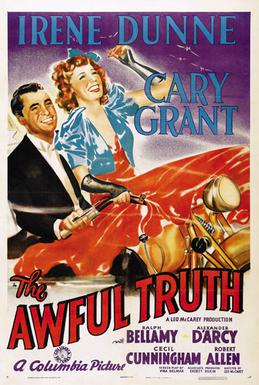
Theawfultruth1937

First released way back in 1937, The Awful Truth is one of the most delightful comedies that I’ve ever seen.  In fact, if I could recommend one movie for you to make an effort to see, it would be The Awful Truth.  This is definitely the best film to ever have the word “awful” in the title.

(Speaking of being the best, The Awful Truth is also the rare screwball comedy to receive a nomination for best picture.  However, it lost to the far more serious The Life of Emile Zola.)

Jerry (Cary Grant) and Lucy Warner (Irene Dunne) are young, married, stylish, and rich.  They seem to have it all but, as the result of Jerry’s lies and a misunderstanding concerning Lucy and her music teacher (Alexander D’Arcy), they end up getting a divorce.  Fortunately, they still share a common bond.  They both love their dog, Mr. Smith (played by Skippy, the same adorable and incredibly talented dog who played Asta in The Thin Man).  Lucy wins custody of Mr. Smith and takes him with her when she moves in with her eccentric Aunt Patsy (Cecil Cunningham).

(It’s not a screwball comedy without an eccentric aunt.)

Jerry, however, has weekly visitation rights with Mr. Smith.  It’s during once such visit that Jerry discovers that, with only two months to go before the final divorce decree, Lucy has become engaged to her next door neighbor, Dan (Ralph Bellamy).  Dan is from Oklahoma and spends most of his time wistfully talking about tumbleweed, oil, and cattle.  He also can’t wait to marry Lucy so that they can both move back to Oklahoma City.  Dan is a nice guy but he’s no Cary Grant.  (He’s also dominated by his judgmental mother.)  Realizing that he still loves Lucy, Jerry wants to reconcile with her but complications and misunderstandings ensue.

(It’s not a screwball comedy without complications and misunderstandings.)

Eventually, in order to prove that he is over Lucy, Jerry starts to date a vacuous heiress, Barbara Vance (a hilariously shallow performance from Molly Lamont).  Suddenly, Lucy finds herself in the same situation that Jerry was in with her and Dan.  Now, it’s her turn to try to break up Barbara and Jerry…

Meanwhile, the day of the final divorce decree approaches…

There’s a lot of reasons to love The Awful Truth.  There’s the snappy dialogue, the physical comedy (at one point, three different men are scurrying around Aunt Patsy’s apartment, two trying to hide from each other and one totally oblivious to everything going on around him), and Leo McCarey’s fast paced direction.  There’s Mr. Smith, a dog so talented that even a confirmed cat person like me loved watching his performance.  There’s the wonderful supporting turns of Ralph Bellamy and Molly Lamont.

But the main reason to see the film is because of the wonderful chemistry between Cary Grant and Irene Dunne.  Grant is so smooth and effortless in his charm that it’s a lot of fun to watch him having to deal with the progressively strange world that he finds himself living in.  The Awful Truth works best when Grant simply reacts to all the craziness around him.  Grant could do more with one look than most actors could do with a Shakespearean monologue.  Meanwhile, Irene Dunne … well, who wouldn’t want to get in a time machine, go back to 1937, and be Irene Dunne for a day?  She’s lively, she’s beautiful, she’s witty, she’s classy, and she’s just neurotic enough to be relatable.

The Awful Truth is pure joy.  If you haven’t seen it, you’re missing out.  If you have seen it, watch it again.

http://www.youtube.com/watch?v=B0-euBr_vRU

Lisa Reviews An Oscar Nominee: Blossoms In The Dust (dir by Mervyn LeRoy)


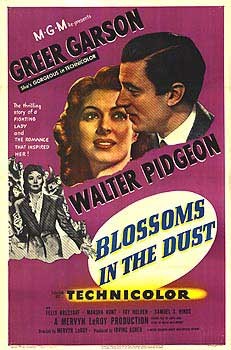
Blossoms_dust_movieposterDid you know that up until the year 1936, if a child was born to unwed parents, it was common practice to actually put the word “illegitimate” on that child’s birth certificate?  As you all know, I am perhaps the biggest history nerd in the world and, while I knew that there was once a huge stigma associated with being born outside of marriage, I did not know just how institutionalized that stigma was.

I’m also proud to say that my home state of Texas — the state that all the yankees love to bitch about — was the first state to ban the use of the word “illegitimate” on birth certificates.  This was largely due to the efforts of Edna Gladney, an early advocate for the rights of children.  Along with starting a home for orphans and abandoned children in Ft. Worth, Edna also started one of the country’s first day care centers for the children of working mothers.

That’s right — there was a time when day care was itself a revolutionary concept.

I have TCM to thank for my knowledge of Edna Gladney, largely because TCM broadcast a 1941 biopic called Blossoms in The Dust.  According to Wikipedia, the film was a highly fictionalized look at Edna’s life but, to be honest, I would have guessed that just from watching the movie.  While Blossoms In The Dust gets the important things right (and it deserves a lot of credit for sympathetically dealing with the cultural stigma of being born to unwed parents at a time when it was an even more controversial subject that it is today), it’s also full of scenes that are pure Hollywood.

In real life, Edna knew firsthand about the challenges faced by children of unwed parents because she was one herself.  Apparently, at the time, that was going too far for even a relatively progressive film like Blossoms In The Dust so, in Blossoms, Edna (played by Greer Garson) is given an adopted sister named Charlotte (Marsha Hunt).  When the parents of Charlotte’s fiancée discover that she was born outside of marriage, they refuse to allow Charlotte to marry their son.  In response, Charlotte commits suicide.

In real life, Edna was born in Wisconsin but, following the death of her stepfather, moved to Ft. Worth to stay with relatives.  Edna was 18 at the time and eventually met and married a local businessman named Sam Gladney.  In Blossoms in The Dust, Edna is already an adult when she first meets Sam (played by Walter Pidgeon, who played Greer Garson’s husband in a number of films) and they meet in Wisconsin.  It’s only after Charlotte dies that Edna marries Sam and it’s only after they’re married that Edna moves to Texas.  Whereas the real life Edna had relatives in Texas, the film’s Edna is literally a stranger in a strange land.

That said, the film is actually rather kind to my home state.  The film spend a lot of time contrasting the judgmental snobs up north with the more straight-forward people who Edna meets after she moves to Ft. Worth and it’s occasionally fun to watch.  (Of course, I would probably feel differently if I was from Wisconsin.)

Blossoms In The Dust was nominated for best picture but it lost to How Green Was My Valley.  Greer Garson was nominated for best actress but she lost to Joan Fontaine in Suspicion.  However, just one year later, Garson would win an Oscar for her performance in the 1942 best picture winner, Mrs. Miniver.  Incidentally, her husband in that film was played by none other than Walter Pidgeon.

Ultimately, Blossoms in the Dust is typical of the type of movies that you tend to come across while watching films that were nominated for best picture.  Some best picture nominees were great.  Some were terrible.  But the majority of them were like Blossoms in the Dust, well-made, respectable, and just a little bit bland.  Blossoms in the Dust is not bad but it’s also not particularly memorable.  If, like me,  you’re a student of history and social mores, Blossoms in the Dust has some historical interest but, when taken as a piece of cinema, it’s easy to understand why it’s one of the more forgotten best picture nominees.