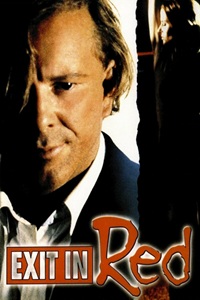
 After a patient that he’s sleeping with commits suicide, psychiatrist Ed Altman (Mickey Rourke) moves to Palm Springs and sets up a new practice in the desert. His attorney (Carre Otis) is able to get Altman off the hook legally but Ed is soon in more trouble as he meets and falls for Ally Mercer (Annabel Schofield). When Ally’s husband is murdered, Ed realizes that Ally and her fur coat-wearing boyfriend (Anthony Michael Hall) are trying to frame him for the crime.
Plotwise, this is a standard late night cable neo-noir, the type that was very popular in the late 90s. The one thing that distinguishes this Showtime production from the film that were airing on Cinemax at the time is the lack of explicit onscreen sex. (Despite the pairing of Mickey Rourke and his then-wife, Carre Otis, this is not another Wild Orchid. Carre Otis is somehow even less convincing as an attorney in Exit to Red than she was in the earlier film.) Instead, Ed just talks about sex constantly and even gives us a long monologue about why he loves long legs as if that’s something that makes him somehow unique. Every guy loves long legs but most of us can appreciate them without having to recite a Spalding Gray-style performance piece about them. If you’ve ever wondered what it would be like to listen to Mickey Rourke read one of those “How To Be A Player” books, you can just listen to his narration in Exit in Red.
Director Yurek Bogajevicz is one of the many 90s filmmakers who went from doing arthouse films like Anna to directing films like Exit In Red. Watching the movie, I got the feeling that Bogajevicz was trying to be subversive with his genre film, in the style of Paul Verhoeven. There are a few times when he almost succeeds but, far more often, his direction seems as if it’s trying too hard to keep audiences from noticing the bad script and the wooden performances. Luckily, Mickey Rourke goes all out as Dr. Altman. The film would have been incredibly dull if he hadn’t.
 Through the Shattered Lens